
Politics
Rivers 2019 Polls: The Intrigues And Implications

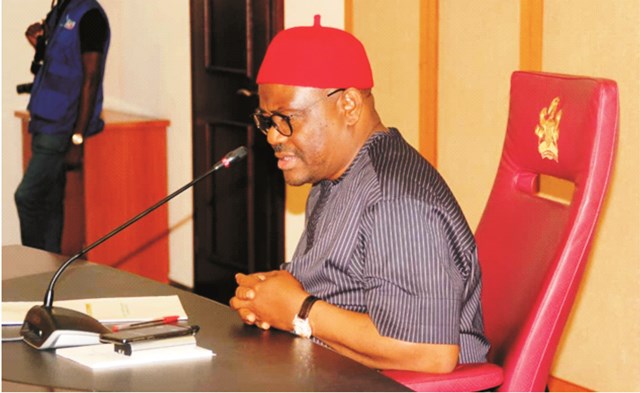
Nyesom Wike of the Peoples’ Democratic Party (PDP), having satisfied the requirements of the law and having scored the highest votes is hereby declared winner and is hereby returned as elected.
This was the declaration of the State Returning Officer for the March 9, 2019 Governorship election in Rivers State, Prof. Teddy Adias, who further declared that Wike polled 886,264 to defeat his closest rival, Biokpomabo Awara of the African Action Congress (AAC), who polled 173,859 to come second.
Out of the 21 Local Government Areas where election took place, Wike won in 19, while Awara won in two. Elections did not hold in Abua/Odual Local Government Area while no results were returned in Gokana.
Backing his declaration with Section 47(b) of the Elections Guidelines which stipulates that where there is wilful disruption of election as was the case of Abua/Odual, the electoral officer is empowered to enter zero as scores, Adia said there is no doubt as to the fact that Wike was the winner.
“Since no results were returned in Gokana as attested to by all party agents, the commission had to discard the results as it would be improper to rely on results from any source other than the one collated by the commission”, he said.
Adias also noted that the difference between Wike’s score and that of Awara was 712,405 while the total number of voters in areas where elections were cancelled or did not hold was 249,324.
The announcement on the morning of April 3, 2019 suddenly broke the expectantly knowing silence warranted by the earlier machinations of a relatively few, who, not minding the will of the people, had brazenly threatened that their will must come to be, come what may.
The atmosphere that followed the declaration was stunningly infectious, and there was hardly any doubt as to the relief it brought to Rivers people. In some areas of the State, there was an uncanny silence that spoke louder than words. The opposition was unhappy that the Governor was re-elected, but even in their silence instituted by their anger over their failure to make their personal will the will of the people, they, by their inactions, acknowledged the Governor’s victory. At other areas where the ecstasy was put into words, even when said in calmness, it sounded very noisy in the depth of meaning.
One noticeable peculiarity in all of this was the unison in acceptance of the victory of Governor Wike by those who, for the sake of clarity, can at best be described as the common people of the state, led by the Civil Servants, whose dependants directly or indirectly constitute a greater population of the state.
Virtually everybody who communicated through words, gestures, and the like, even when it may be for negative reasons, did so in such esoteric acceptance of what is – that Rivers people have taken their stand; that they are tired of brazen deceit by people they had hitherto thought had their interests at heart when all along what mattered to them is that they are worshipped as demigods.
An interesting part of the frenzied celebrations that followed the declaration of incumbent Governor, Nyesom Wike, as Governor-elect was that even before the declaration by the Independent National Electoral Commission (INEC), the handwriting of the victory was on the wall.
From the gradual fading oppositional vituperations following the theatrical self-inflicted removal of the key opposition, the All Progressives Congress (APC), through events leading to the momentary stoppage of the electoral process, and finally to the point at which collation commenced in earnest on April 2, 2019, the signs stood like the directional star.
However, beyond signalling the fulfilment of the wish of majority of Rivers people, the 2019 election in Rivers State also afforded the people, and indeed the world, an opportunity to appreciate what one man can do, just to ensure that his wish supersedes that of a people. It did not matter what price had to be paid.
If the wish cannot be satisfied directly through a legitimate means, illegitimately achieving same in accordance with the Machiavellian principle of the end justifying the means would not make any difference. As far as he was concerned, at this level of political awareness, and a peoples’ hunger for people-oriented dividends of democracy, the best thing for the people is a stooge who would expectedly always do his bidding. How this would have panned out if Wike had not won can only be a topic for another day. The important thing now is the intention behind what was presented to the people.
Another major intrigue of the 2019 elections in Rivers State is the role of security agencies, particularly the military. No matter the denials in military quarters, it will only amount to calling black white, and vice versa.
This is more so going by both what was seen on ground, and the evaluations of notable foreign observers who categorically stated that the involvement of military personnel in many aspects of the February 23 Presidential and National Assembly elections and the March 9 Governorship and State House of Assembly elections, particularly were not in conformity with international best practice.
This position was unanimously expressed by the European Union (EU) Election Observation Mission Nigeria 2019, the joint international observation mission of the International Republican Institute (IRI) and the National Democratic Institute (NDI), Centre for Democracy and Development (CDD) and the Integrity Friends for Truth and Peace Initiative (TIFPI) in their preliminary reports on the elections.
While the action of the military in the 2019 general elections in Nigeria, for whatever reason, may have greatly dented their image, the outcome of the report of the committee set up to investigate the extent of their involvement, and the extent to which recommendations of the report is executed would go a long way in disabusing the minds of the people about what the military has become.
In the face of these and other intrigues, which led to several deaths, Rivers people stood their ground on what they want. At the end of the day, Wike’s victory could not be upturned.
The National Publicity Secretary of the PDP, Kola Ologbondiyan, captured the doggedness of the Rivers spirit thus: “The victory reinforces the confidence of the people in the resoluteness of asserting their democratic choice of leadership as well as standing in defence of their mandate to the end.
“It also demonstrates that the will of the people will always prevail against every form of suppression as were eminently manifested in the desperation by the APC leaders, particularly, the Minister of Transportation, Rotimi Amaechi, to forcefully and violently take over control of the state against the wish of the people”.
By their support for Governor Wike, therefore, as exhibited by their votes, Rivers people may have also stated in unequivocal terms for the Governor to prove them wrong that second tenures in governance has never been favourable to them. Their experience in the four years preceding 2015 is still fresh in their minds.
The wish of Rivers people is thus for the Governor to move up from being “Mr Quality Project” to “Mr Quality Welfare for Rivers People”, as reflected in the joint congratulatory message to the Governor by the Chairperson of the State Chapter of the Nigeria Labour Congress (NLC), Beatrice Itubo, and her Trade Union Congress (TUC) counterpart, Austin Jonah.
Soibi Max-Alalibo



The Independent National Electoral Commission (INEC) has extended the deadline for political parties to submit the list of candidates for the 2027 governorship and state Houses of Assembly elections from Saturday, August 8, to Tuesday, August 11, 2026.
The commission announced the extension in a statement issued on Saturday and signed by the National Commissioner and Chairman of its Information and Voter Education Committee, Mohammed Haruna.
According to INEC, the decision followed appeals by political parties for additional time to complete the submission process through the dedicated online portal.
“The submission window, which according to the revised Timetable and Schedule of Activities for the General Election was originally scheduled to close on Saturday, 8th August, 2026, has been extended to Tuesday, 11th August, 2026,” the commission said.
In a a related development, INEC announced the suspension of PVC collection in Osun State ahead of the August 15 governorship election.
The commission said voters who applied for replacement of lost, damaged or defaced Permanent Voter Cards would have until midnight on Sunday, August 9, to print downloadable copies of their cards.
The electoral body explained that the deadline was necessary to enable it compile data on downloaded PVCs and produce final statistics on the total number of cards collected ahead of the election.
INEC said PVC collection in Osun commenced at the Registration Area level from July 22 to 28, 2026, but was extended to July 31 following complaints about large crowds and difficulties experienced by voters at collection centres.
The exercise subsequently moved to the local government level and ran from August 1 to 7.
The commission also disclosed that replacement downloadable PVCs had been made available to voters in Odo-Otin and Ife Central Local Government Areas following the theft of cards during attacks on the two collection centres.
It stressed that the stolen cards could not be used to vote.
INEC reassured Osun residents of its preparedness for the August 15 governorship election.
“The commission reiterates that the stolen cards cannot be used to vote.
“INEC reassures the people of Osun State of its readiness to conduct a free, fair, credible and inclusive governorship election on 15th August, 2026,” the statement said.
The commission said the deadline, initially set for Saturday, 8 August, has been extended to Tuesday, 11 August 2026, following appeals from political parties for more time.
INEC also announced that the window for voters who applied to replace lost, damaged or defaced PVCs to download their replacement cards will close at midnight on Sunday, 9 August.
The move is to enable the commission compile final PVC collection figures ahead of the 15 August Osun governorship election.
INEC said replacement downloadable PVCs have also been provided to affected voters in Odo-Otin and Ife Central Local Government Areas after hoodlums carted away cards from two collection centres, stressing that the stolen cards cannot be used to vote.
The commission reaffirmed its readiness to conduct a free, fair, credible and inclusive election in Osun State.
Gov. Kefas made the remarks over the weekend at the Federal Medical Centre (FMC), Jalingo, during the flag-off of the second phase of the Renewed Hope Medical Outreach in Taraba State, organised as part of activities marking Prof. Yilwatda’s 58th birthday.
The governor commended Prof. Yilwatda for choosing to mark his birthday by providing medical care to people in need.
“What Professor Nentawe did is a powerful demonstration of what leadership should be,” Gov. Kefas said.
He assured that his administration would continue to support initiatives that complement government efforts to improve healthcare delivery and the wellbeing of residents.
Speaking at the event, Prof. Yilwatda called on Nigerian leaders to embrace the culture of giving and use their positions to touch the lives of the less privileged.
He said his decision to celebrate his 58th birthday in Taraba State was deliberate and informed by the needs of underserved communities, particularly people who face difficulties accessing healthcare because of distance and financial constraints.
According to him, the intervention followed a needs assessment and was extended across the three senatorial districts of the state.
He said the exercise commenced on August 3 at Takum General Hospital and covered the Federal University Teaching Hospital, Wukari; First Referral Hospital, Sunkani, Ardo-Kola Local Government Area; General Hospital, Bali; General Hospital, Gembu; and FMC Jalingo.
Prof. Yilwatda said the intervention provided medical services to thousands of beneficiaries, including people who required surgical procedures.
He said sustainable national development could only be achieved when strong institutions placed Nigerians at the centre of development.
“Leadership is about service,” he said, urging political and public leaders to make giving back to society an important part of their responsibilities.
He reaffirmed his commitment to serving Nigeria and its people, saying his personal vision was to make every day of his life useful to humanity.
“Every day that I live, the vision is: let it be useful to humanity,” he said.
The Taraba State Commissioner for Health, Dr. Bordiya Buma, commended the initiative, saying it was consistent with the Renewed Hope agenda and efforts to strengthen healthcare delivery in the state.
Dr Buma said the second phase followed the successful completion of the first phase, which was conducted simultaneously in six local government areas, with two LGAs selected from each of the three senatorial districts.
According to him, more than 10,000 patients were attended to during the first phase, including people with medical and surgical conditions.
He disclosed that 327 general surgeries, 71 eye surgeries and 575 dental procedures were carried out during the exercise.
The commissioner expressed appreciation to President Bola Tinubu for the Renewed Hope Medical Outreach and thanked Prof. Yilwatda for supporting the initiative and choosing Taraba State as a beneficiary.
The Minister of Health and Social Welfare, Prof. Muhammad Ali Pate, also commended Prof. Yilwatda for choosing Taraba State to mark his 58th birthday through a medical outreach.
Prof. Pate said making healthcare the centrepiece of the birthday celebration was significant because health affects everyone.
-

 News2 days ago
RSG Targets Nine Million Residents in Mosquito Net Distribution Campaign
-

 Oil & Energy2 days ago
Aiyedatiwa Signs New Electricity Bill
-

 Maritime2 days ago
Marine Minister Commends President Tinubu On NPERA Bill Assent
-

 Oil & Energy2 days ago
NLNG Commissions Research And Innovation Centre In RSU
-

 News2 days ago
KenPoly Holds Eight Convocations, August 29
-

 News2 days ago
RSG Begins Another Phase of Projects Commissioning Today
-

 News2 days ago
RMAFC Completes Revenue Sharing Review, Proposes New Pay
-

 Maritime2 days ago
NAGAFF Petitions IGP Over Alleged Maritime Police Harassment