
Politics
This Charade Of An Election

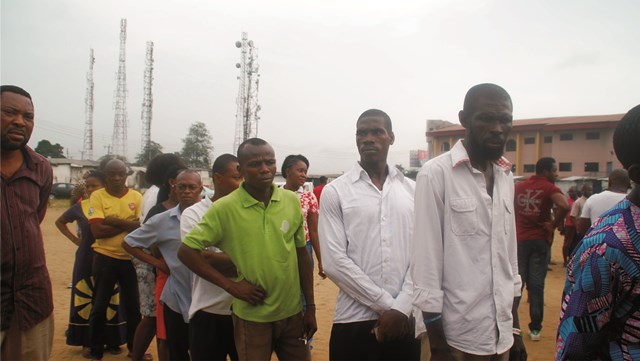
The presidential election has come and gone but its effect leaves a very sour taste in the mouth. For the first time in Rivers State, some major local governments were held hostage by the army and other security personnel to prevent people from exercising their franchise.
No political pundit envisaged that there would be that huge number of causalities in Akuku-Toru Local Government area, especially in Abonnema.
Right from the Bridge leading to the town, entry into the community was not allowed even for journalists covering the election, and it took much discussion with a senior military personnel before phone calls were made to higher military authorities before journalists could gain entrance into the town. This was just an eye opener of what to expect on the date of the Presidential and National Assembly elections. Tension was everywhere.
The situation was not that different in Okrika, Ikwerre, Emohua, Bonny and Abua / Odual Local government areas. In Akuku-Toru local government area, the council secretary, Mr Tobins Tobins was alleged to have been whisked away by security personnel, the council chairman, Mr. Roland Sekibo also had to run for his dear life.
In other local government areas, council chairmen and even some commissioners had to go into hiding for fear of being arrested or detained.
In other states like Imo, / Professor Maurice Iwu, a former chairman of the National Electoral Commission (NEC) was picked up on the day of the election. A similar scenario also played out in Akwa Ibom, Kwara, Kaduna and Kano States.
February 23, 2019 to many voters and monitors was like a date with Satan. You live to die or you live to run. The risk was understood clearly that things will go wrong but not as expected and that was the big surprise.
prior to the elections, when INEC offices were going up in flames in Rivers State, Plateau, Akwa Ibom and Anambra States, nobody thought that there would be invasion of collation centres but this happened expecially in Rivers and Bayelsa States with electoral officials accusing the army of colluding with high ranking government officials in the APC to snatch and doctor result sheets. What transpired in Isiokpo, headquarters of Ikwerre Local Government Area was just a tip of the iceberg in the whole election. Despite threats coercion and mouth-watering offers, Mrs Mary Efeture Imayuwa and her Emohua counterpart, Mr Kenneth Etah refused to bulge or be compromised in declaring false results. They even narrated how soldiers of the 6 Division of the Nigerian Army invaded the collation centres of Emohua and Ikwerre local government areas to snatch result sheets and in the fracas, had to shoot to scare away people. Same thing played out in Okrika with the soldiers acting as thugs.
Elections are supposed to bring out the best in us but when the system is seriously flawed like what happened last Saturday, then, serious questions need to be asked as to whether in Nigeria, our politicians are really sane. How come people who call themselves fathers and grandfathers still behave as common touts or whose diligence from childhood has grown to that of adulthood.
What type of message are we sending to children who also monitored the situation at home from their television sets or listen to radio that in Nigeria either their fathers or their fathers are serial election riggers?
To some, the outcome of the presidential election in particular was not a surprise as they opined that the stage for the disgraceful outing was planned in stages right from 2016. First, the ruling party had to discredit the PDP, Secondly, the judiciary had to be harassed, disgraced and rubbished. Thirdly, disobey court orders, and compromise the judiciary after replacing those who refuse to play the ball, the armed forces and other security operatives induce electoral officers, soothe, use thugs with backings by the army to disrupt elections, cart away result sheets, chase away the opposition and where they resist, shoot either to scare them away or kill.
But one thing remains paramount. Power is always transient. No matter the malfeasance or method used in gaining power, anybody on the seat or power will leave one day.
From all indications, the February 23 presidential election is the worst since the return of democratic governance in 1993. If the war against corruption is a song, then, electoral malpractice should be a hit theme. Nigeria is indeed a giant in distress. No political analyst will claim that the country is better than Equatorial Guinea in electoral matters. Countries such as Benin Republic, Sierra Leone, Liberia, Mali, Senegal, Tanzania and even Congo are by far miles ahead of us in anything to do with elections.
For how long will this charade continue even in places where Boko Haram holds sway with people chased away from their communities recording huge number of votes? Nigeria indeed is a funny country. No wonder we don’t have steady power supply or good roads.
The average Nigerian is very religious and if for example a pastor witnessed the last election in Emohua, or Ikwerre and saw a member of his church running away with result sheets and eventually is declared the winner and comes for thanksgiving in the church, will he as a pastor officiate in such a service? Is such victory from God or Satan. These are questions we should start asking ourselves.
Will this charade roll over into the next elections? Can we do anything to checkmate these challenges?
Holding elections every four years is not the problem, INEC is not the problem, the voter is not the problem. The problem in holding a free, fair and credible election has always remained with the elites. Those who hold the instrument of coercion, power at the centre. Rigging of elections or manipulating election results are always planned by top ranking politicians whose backing comes the centre.
Political parties use thugs as foot soldiers to disrupt the voting process especially where such a political party does not have wide spread support so we will continue to have this problem with us. Why is that in places such as Kwara State, Lagos, Borno, Katsina, Bauchi, Gombe to name a few states, soldiers did not snatch result sheets but did so in Niger Delta states?
As we prepare for the governorship and House of Assembly elections, all the major political actors in Rivers State should not allow what happened last week to re-occur. The people killed were Rivers sons and daughters. They were not the children of politicians. Politics is not a do or die affair. But if this advice is not heeded, then, know that Nigeria’s democracy is in big trouble.
Social critics should also as part of their mandate be more involved in monitoring elections so that they can interact with actual voters and see things for themselves to really understand where the country is heading to.
Tonye Ikiroma-Owiye



The commission announced the extension in a statement issued on Saturday and signed by the National Commissioner and Chairman of its Information and Voter Education Committee, Mohammed Haruna.
According to INEC, the decision followed appeals by political parties for additional time to complete the submission process through the dedicated online portal.
“The submission window, which according to the revised Timetable and Schedule of Activities for the General Election was originally scheduled to close on Saturday, 8th August, 2026, has been extended to Tuesday, 11th August, 2026,” the commission said.
In a a related development, INEC announced the suspension of PVC collection in Osun State ahead of the August 15 governorship election.
The commission said voters who applied for replacement of lost, damaged or defaced Permanent Voter Cards would have until midnight on Sunday, August 9, to print downloadable copies of their cards.
The electoral body explained that the deadline was necessary to enable it compile data on downloaded PVCs and produce final statistics on the total number of cards collected ahead of the election.
INEC said PVC collection in Osun commenced at the Registration Area level from July 22 to 28, 2026, but was extended to July 31 following complaints about large crowds and difficulties experienced by voters at collection centres.
The exercise subsequently moved to the local government level and ran from August 1 to 7.
The commission also disclosed that replacement downloadable PVCs had been made available to voters in Odo-Otin and Ife Central Local Government Areas following the theft of cards during attacks on the two collection centres.
It stressed that the stolen cards could not be used to vote.
INEC reassured Osun residents of its preparedness for the August 15 governorship election.
“The commission reiterates that the stolen cards cannot be used to vote.
“INEC reassures the people of Osun State of its readiness to conduct a free, fair, credible and inclusive governorship election on 15th August, 2026,” the statement said.
The commission said the deadline, initially set for Saturday, 8 August, has been extended to Tuesday, 11 August 2026, following appeals from political parties for more time.
INEC also announced that the window for voters who applied to replace lost, damaged or defaced PVCs to download their replacement cards will close at midnight on Sunday, 9 August.
The move is to enable the commission compile final PVC collection figures ahead of the 15 August Osun governorship election.
INEC said replacement downloadable PVCs have also been provided to affected voters in Odo-Otin and Ife Central Local Government Areas after hoodlums carted away cards from two collection centres, stressing that the stolen cards cannot be used to vote.
The commission reaffirmed its readiness to conduct a free, fair, credible and inclusive election in Osun State.
Gov. Kefas made the remarks over the weekend at the Federal Medical Centre (FMC), Jalingo, during the flag-off of the second phase of the Renewed Hope Medical Outreach in Taraba State, organised as part of activities marking Prof. Yilwatda’s 58th birthday.
The governor commended Prof. Yilwatda for choosing to mark his birthday by providing medical care to people in need.
“What Professor Nentawe did is a powerful demonstration of what leadership should be,” Gov. Kefas said.
He assured that his administration would continue to support initiatives that complement government efforts to improve healthcare delivery and the wellbeing of residents.
Speaking at the event, Prof. Yilwatda called on Nigerian leaders to embrace the culture of giving and use their positions to touch the lives of the less privileged.
He said his decision to celebrate his 58th birthday in Taraba State was deliberate and informed by the needs of underserved communities, particularly people who face difficulties accessing healthcare because of distance and financial constraints.
According to him, the intervention followed a needs assessment and was extended across the three senatorial districts of the state.
He said the exercise commenced on August 3 at Takum General Hospital and covered the Federal University Teaching Hospital, Wukari; First Referral Hospital, Sunkani, Ardo-Kola Local Government Area; General Hospital, Bali; General Hospital, Gembu; and FMC Jalingo.
Prof. Yilwatda said the intervention provided medical services to thousands of beneficiaries, including people who required surgical procedures.
He said sustainable national development could only be achieved when strong institutions placed Nigerians at the centre of development.
“Leadership is about service,” he said, urging political and public leaders to make giving back to society an important part of their responsibilities.
He reaffirmed his commitment to serving Nigeria and its people, saying his personal vision was to make every day of his life useful to humanity.
“Every day that I live, the vision is: let it be useful to humanity,” he said.
The Taraba State Commissioner for Health, Dr. Bordiya Buma, commended the initiative, saying it was consistent with the Renewed Hope agenda and efforts to strengthen healthcare delivery in the state.
Dr Buma said the second phase followed the successful completion of the first phase, which was conducted simultaneously in six local government areas, with two LGAs selected from each of the three senatorial districts.
According to him, more than 10,000 patients were attended to during the first phase, including people with medical and surgical conditions.
He disclosed that 327 general surgeries, 71 eye surgeries and 575 dental procedures were carried out during the exercise.
The commissioner expressed appreciation to President Bola Tinubu for the Renewed Hope Medical Outreach and thanked Prof. Yilwatda for supporting the initiative and choosing Taraba State as a beneficiary.
The Minister of Health and Social Welfare, Prof. Muhammad Ali Pate, also commended Prof. Yilwatda for choosing Taraba State to mark his 58th birthday through a medical outreach.
Prof. Pate said making healthcare the centrepiece of the birthday celebration was significant because health affects everyone.
-

 News2 days ago
RSG Targets Nine Million Residents in Mosquito Net Distribution Campaign
-

 Oil & Energy2 days ago
Aiyedatiwa Signs New Electricity Bill
-

 Oil & Energy2 days ago
NLNG Commissions Research And Innovation Centre In RSU
-

 Maritime2 days ago
Marine Minister Commends President Tinubu On NPERA Bill Assent
-

 News2 days ago
KenPoly Holds Eight Convocations, August 29
-

 News2 days ago
RSG Begins Another Phase of Projects Commissioning Today
-

 News2 days ago
RMAFC Completes Revenue Sharing Review, Proposes New Pay
-

 Maritime2 days ago
NAGAFF Petitions IGP Over Alleged Maritime Police Harassment