
News
WPFD: Saraki, Dogara Seek Media Synergy On Economy

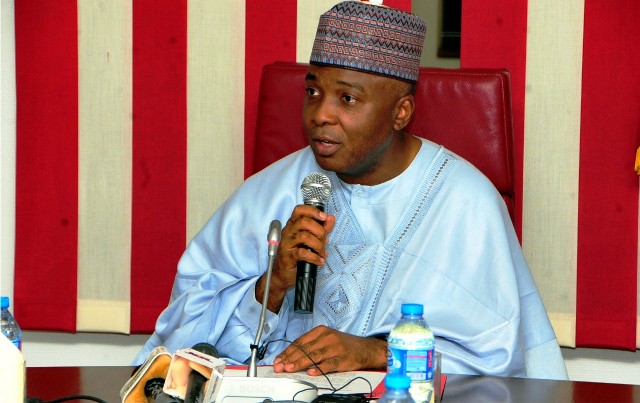
President of the Senate, Dr. Abubakar Bukola Saraki, has identified the media as key players in the economic development of the country, as he called for greater collaboration between the media and government at all levels.
Saraki, in a statement signed by his Special Adviser on Media and Publicity, Yusuph Olaniyon, to mark the 2017 World Press Freedom Day, also paid tribute to journalists across the world who have had to pay the supreme price, suffered injuries and deprivations while carrying out their legitimate duties.
The Senate president noted the enormous sacrifices made by the Nigerian media to end military dictatorship and entrench democracy in the country.
Saraki, stated that having contributed immensely to return the country to democratic rule, it was time for the media to key into the present administration’s determination to exit the current recession, grow the economy, and make life more meaningful for all.
He noted that the theme of this year’s celebration, “Critical Minds For Critical Times: Media’s Role In Advancing Peaceful, Just and Inclusive Societies”, cannot be fully realized without sustained improvement in the economic status of every Nigerian.
His words: “There is no doubt that one of the major challenges confronting us as a people is how to grow the economy and provide jobs for our teaming population. I believe the press has a great role to play in accelerating the process through the dissemination of appropriate information and unbiased reportage of government’s economic recovery efforts.
“The Nigerian media played tremendous role in ending military rule. It is time for her to join the crusade to build a sustainable economy for the benefit of all”.
Saraki, therefore, called on media owners – public and private – to enhance the welfare and security of practitioners in the media, in view of their critical role in the socio-economic development of the country.
Similarly, Speaker of the House of Representatives, Hon Yakubu Dogara, has said that no society can grow without an active press to monitor and report its activities, and restated the commitment of the National Assembly to continue to enact laws which will create conducive environment for journalism to thrive in the country.
In a statement signed by his Special Adviser on Media and Public Affairs, Turaki Hassan, to mark World Press Freedom Day, Dogara also expressed concern over Nigeria’s international press freedom index, saying that it is disheartening that the Press Freedom Index – released last Wednesday by Reporters Without Borders (RWBl) – ranked Nigeria 122 out of 180 countries examined.
The Speaker further argued that the role the media plays in the development of a country as watchdog – especially in a democracy – cannot be overemphasized, and called on the Nigerian media to partner with the present administration to make its task of fighting corruption a success, not only by objective reporting but through investigative journalism.
Dogara assured that the House of Representatives, being aware that the press must be free to truly be the watchdog of the society, will continue to support measures to promote press freedom in Nigeria, especially through laws that facilitate the practice of journalism such as the Freedom of Information Act, which was passed by the National Assembly in 2011.
“We all know the role of the media in promoting democracy, because democracy itself guarantees nothing, it’s just a set of ideals that people utilizing the freedom that democracy brings to organize their lives in such a manner that delivers social progress and economic development,” he explained.
“The media serves as one of the voices of democracy and I believe that beyond all the roles played by all others, the media is far ahead in that it keeps the citizens informed about what government is doing and that enables them to hold public officials accountable, for instance, to the promises that they made.”
He urged practitioners to strive to ensure that there’s always timely, accurate and balanced reportage and decried the situation whereby some professionals engage in brinkmanship or politicizing their content, saying that such acts “tend to endanger democracy, because in that way citizens aren’t well informed.”
Nneka Amaechi-Nnadi, Abuja



The National Drug Law Enforcement Agency (NDLEA) has arrested four notorious female drug dealers in Edo, Imo, Kano, and Gombe states.
The Director of Media and Advocacy, NDLEA, Mr Femi Babafemi, made this known in a statement in Abuja, yesterday.
Giving a breakdown, Babafemi said that in Edo, an intense sweep of notorious drug hotspots within Benin City by NDLEA operatives on June 2 led to the arrest of four key traffickers, including three females.
“At Uyosa, Benin City, two female suspects were nabbed with a cocktail of illicit substances, including 176 grams of skunk, 65g of Loud, and 5 grams of Methamphetamine.
“Along Agbor road in Benin City, another female suspect, 21-year-old Anita Abraham, was apprehended with 95 grams of Scottish Loud and 329 grams of regular Loud.
“At Upper Mission, Benin City, a male suspect was arrested with a diverse cache of psychotropic substances consisting of Loud, Colorado, Swinol, and Methamphetamine.
“A swift operation by operatives in Kano State on Thursday, June 4, led to the arrest of a 19-year-old suspect, Saifullahi Lawan at the Kafi area of Madobi, with 40 blocks of skunk weighing a total of 38 kilograms,” NDLEA said.
In a related development, Babafemi said, operatives in Gombe state intercepted a 28-year-old suspect on June 1 near Dantiti Plaza in the Tumfure area of Gombe.
“The suspect was caught with 15,000 capsules of tramadol,” he said.
He said the War Against Drug Abuse (WADA) social advocacy activities by NDLEA Commands and formations equally continued across the country in the past week.
Reacting to the string of successful operations, the NDLEA Chairman, retired, Brig.-Gen. Buba Marwa commended the officers, men and women of the Imo, Edo, Kano, and Gombe commands for their resilience and vigilance.
Marwa also praised their counterparts in all the commands across the country for pursuing a fair balance between their drug supply reduction and drug demand reduction efforts.
He re-emphasised that the agency remains fully committed to dismantling drug supply chains and would continue to target traffickers regardless of age, gender, or concealment methods.

The Nigerian Navy says its operatives under Operation Delta Sentinel have intercepted over 135,000 litres of suspected illegally refined Automotive Gas Oil (AGO) during separate operations in Rivers State waterways.
Director of Information, Navy Captain Abiodun Folorunsho, said the operations were carried out by personnel of the Nigerian Navy Ship (NNS) Pathfinder around the Onne and Abonema axis.
He said the seizures were made during routine patrols aimed at curbing crude oil theft and illegal fuel transportation across creeks in the state.
In one of the operations, naval personnel intercepted a fibre boat at the entrance of Owogono Creek in Ogu-Bolo Local Government Area carrying drums and jerrycans filled with suspected stolen AGO.
According to him, the occupants abandoned the boat and fled into nearby creeks, while the vessel and about 63,000 litres of product were recovered.
In another operation around Abonema in Akuku-Toru Local Government Area, patrol teams intercepted a wooden boat conveying about 72,000 litres of suspected illegally refined AGO concealed in sacks.
The Navy said the products were being transported through waterways for onward distribution before the operation disrupted the movement.
Folorunsho said the recoveries highlight the continued exploitation of creek networks by criminal elements for illegal petroleum product transportation.
He added that all recovered items were handled in line with established procedures on anti-crude oil theft operations.
The Navy reaffirmed its commitment to intelligence-driven operations aimed at dismantling illegal oil networks and protecting Nigeria’s maritime economic assets.

The Permanent Secretary of Rivers State Ministry of Information and Communications, Dr Honour Sirawoo mni, has charged public servants to embrace accountability and prudent management of public resources, stressing that government funds must be utilised responsibly.
Dr. Sirawoo made the assertion during the 41st anniversary of The Rivers State Television (RSTV), in Elelenwo.
He noted that public service demands commitment and sacrifice, urging workers to justify the opportunities entrusted to them through diligengence and productivity.
“All I try to do is to see that we have value for every kobo that we spend and value for our time.
“Government has a social responsibility to provide opportunities, but when you have one, you must guard it through hard work and ensure your presence is justified,” he stated.
The Permanent Secretary further appealed to workers to see themselves as ambassadors of their respective institutions, adding that government remains committed to creating employment opportunities and improving public service delivery.
Also speaking, former Acting Managing Director of the Niger Delta Development Commission (NDDC), Dr (Mrs.) Christiana Atako, praised the station’s professionalism and consistency despite operational challenges.
“We have never been disappointed. In spite of all the challenges RSTV had at that time, they never failed us. They carried our stories very well,” she said.
Dr Atako encouraged staff members to continually improve themselves through training, education and professional development in order to remain competitive in the evolving media industry.
Earlier, Acting General Manager of RSTV, Ambassador Paul Damgbor, described the anniversary celebration as an opportunity to reflect on the station’s journey of over four decades and appreciate those who have contributed to its development.
Pastor Damgbor said that the station had recorded remarkable improvements in recent months through the acquisition of digital cameras, computers as well as upgrades in audio and visual production facilities.
“We have seen great change. We were able to get new brand digital cameras and improve on our audio. We have also provided new computers for key departments, including News, Programmes and the Library,” Damgbor remarked.
He also unveiled a commemorative magazine chronicling the history and achievements of the station, describing it as a valuable reference material for preserving RSTV’s heritage.
The Acting General Manager, however, expressed concern over the theft of critical equipment from the station’s transformer, a development he said had forced the organisation to rely heavily on generator power supply.
The Senior Pastor of Gateway International Church, Pastor George Izunma, who gave a short charge during the event, urged media practitioners to uphold the ethics of journalism and remain committed to accuracy in reporting.
“You are pressmen. You are okay to doubt, but verify,” he advised, stressing the importance of credibility and responsibility in the profession.
He equally highlighted the need to “ask the help of God, sow a seed of help, and step into something as if you have help” stressing the need to move by faith for growth.
Some participants at the event also raised concerns about employment opportunities while commending RSTV’s growth and contributions to public enlightenment in Rivers State.
A major highlight of the celebration was the presentation of an award to the Rivers State Ministry of Information and Communications in recognition of its diligence and service to the people of the state. Dr Honour Sirawoo also received a special award for his contributions to the growth and development of RSTV.
Awards were equally presented to outstanding members of staff of RSTV for exemplary performance and their dedication to duty.
The event also featured the unveiling and launch of the RSTV commemorative magazine as well as a tour of the station’s newly built cafeteria and other facilities.
The celebration marked another milestone in the station’s 41-year history and reaffirmed its commitment to excellence in public broadcasting.
-

 Rivers2 days ago
Police arrest 3 suspects over killing of driver in Rivers
-
Politics2 days ago
I DIDN’T PROMISE YOU TICKETS, AKPABIO TELLS APC SENATORS WHO FAILED PRIMARIES
-

 News2 days ago
FUBARA ASSURES NUT OF SECURITY OF SCHOOLS IN RIVERS
-

 News2 days ago
NDLEA Arrests Four Notorious Female Drug Dealers In Four States
-

 Sports2 days ago
Okpekpe Road Race Gets Mobility Solutions, Fan Engagement
-
Politics2 days ago
Court Dismisses Rivers PDP Members’ Suit Over LG Election Candidates
-
Politics2 days ago
POST PRIMARIES: IKWERRE MONARCHS ADVOCATE ISSUES-BASED POLITICS IN RIVERS
-

 News2 days ago
WORLD FOOD SAFETY DAY: VETERINARIANS TASK GOVT ON MODERN ABATTOIR IN RIVERS