
Nation
THE STATES

Adamawa
The Adamawa State Police Command has inaugurated
the state chapter of Eminent Persons Forum to assist the command in promoting peace and security.
The state’s Commissioner of Police, Mr Musa Kimo, at the inauguration in Yola, urged members of the forum to partner with the police in intelligence gathering, crime prevention and detection in their communities.
Kimo also urged members of the forum to facilitate interaction between the public and the police to boost confidence and develop local knowledge.
He said “you are also expected to harness logistic support to facilitate the operations of police in your domain.”
In his remarks, the Speaker, Adamawa House of Assembly, Alhaji Kabiru Mijinyawa, and other members of the forum declared their commitment to work for the success of the forum.
Benue
The police have mobilised in full force to tackle the orgy
of violence and deadly cult clashes in Benue State, a top police officer announced in Makurdi.
Assistant Inspector-General of Police in-charge of Zone 4 Headquarters, Makurdi, Agboola Oshodi-Glover, made the disclosure in an interview with newsmen.
He said that the police had risen to the challenge and would stamp out the persistent violence in Benue State in no time.
Speaking against the backdrop of recurring cult killings in the state, Agboola Oshodi-Glover, assured that the police had capacity to tackle the rising crime wave in the state.
Benue, where herdsmen have repeatedly killed hundreds of people in recent times, has also seen recurring deadly cult clashes among university students.
Borno
The United Nations Children’s Fund (UNICEF) has called
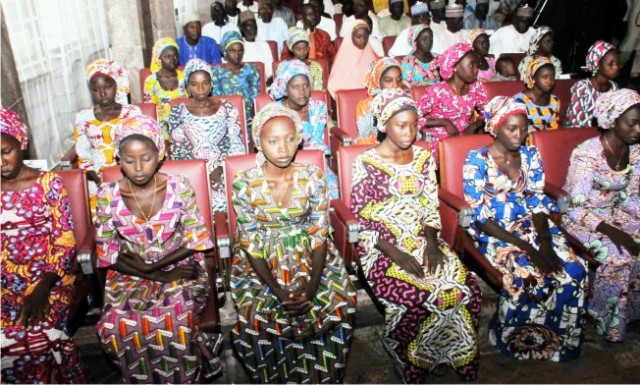
on the Federal Government to provide intensive support for the 21 released Chibok girls to safeguard their future.
The group made the call in a statement signed by its Country Representative, Mr Gianfranco Rotigliano and made available to newsmen in Maiduguri.
He also said that the more than 200 Chibok girls abducted by Boko Haram in April 2014 were among thousands of women and girls that UNICEF estimated had been held and subjected to violence by the group.
“UNICEF has supported hundreds of women and girls who have already been released or escaped from Boko Haram.
“The girls’ report that they have been subjected to rape – frequently in the form of forced marriages – beatings, intimidation and starvation during their captivity. Many returned pregnant or with babies as a result of rape”, he added.
Gombe
The All Farmers Association of Nigeria (AFAN), Gombe
State chapter, has commended the intervention of the Federal Government in tackling the menace of migratory Quelea birds on farms in the state.
The AFAN Secretary, Alhaji Gambo Sarkin-Noma, told newsmen in Gombe that the Federal Ministry of Agriculture had initiated aerial survey and control of the birds.
Sarkin-Noma said that the intervention had saved farmers affected by ravaging birds from colossal financial losses.
According to him, farmers in the state are now happy and anticipate recording bumper harvest this year despite the high cost of fertilizer.
Kaduna
The Deputy Governor of Kaduna State, Barnabas Bantex,
has said that the solution to the unending crisis at Godogodo in Jemaa Local Government is in the hands of the warring parties and stakeholders of the area.
Bantex said this when he took delivery of relief materials from the National Emergency Management Agency (NEMA) for persons displaced by the crisis.
He attributed the security challenge to poverty and idleness, and said the state government was doing everything possible to create job opportunities to absorb idling youths to stem the menace.
Katsina
The Katsina State Government in collaboration with
Nigerian Meteorological Agency (NiMET), has developed an android weather prediction software to guide farmers in the State.
The Managing Director, Katsina State Agricultural Development Programme, Mr Ibrahim Musawa, made this known in an interview with newsmen in Katsina.
He said the software was capable of accurately predicting when rain would begin, the volume of rain being expected and when the rain would stop in the 34 local government areas of the state.
Kogi
Bill and Melinda Gates Foundation (BMGF) in collabo
ration with relevant stakeholders is to translate the Federal Government’s agricultural policies into reality towards driving the agriculture as business initiative.
Senior Programme Officer and Regional Advisor, Seattle, United States (U.S) office of the Foundation, Dr Jacob Mignouna, disclosed this at a meeting with stakeholders and Kogi State Agriculture Vision Group (AVG) organised by Synergos Nigeria in Lokoja, the state capital.
Mignouna stressed the need to translate government policies on agriculture into reality and make them effective at state and local government levels for farmers, especially for rural communities to derive maximum benefits.
Kwara
Seventeen students loitering and wandering during
School hours have been arrested by the Kwara State Anti-Loitering Team.
Commissioner for Education and Human Capital Development, Alhaji Musa Yeketi, who paraded the students in Ilorin, warned that government would not tolerate indiscipline.
He called on principals and head teachers of various schools to take proper charge of their students and pupils.
Yeketi said that the state government, in fulfilling its campaign promises, would ensure education for all.
Some of the arrested students include students from Government Day Secondary School, Adeta and United Secondary School, Bani Secondary School, Government Girls Day Secondary School, Pakata, Mandate Secondary School, Okelele Secondary School and Sheikh Abdul Salam College.
Nasarawa
The Nasarawa State Government says the massive con
struction of bridges across the state would help in fighting poverty, boosting socio-economic activities and improving revenue generation.
State Commissioner for Works and Housing, Mr Godwin Danladi-Makeri, stated this while inspecting the ongoing construction of Bokoko Bridge in Kokona local government area of the state.
This is to help fight poverty, youths restiveness, unemployment as well as crimes and discourage rural-urban migration,” he said.
Niger
Catholic Bishop of Minna Diocese, Martins Uzoukwu,
has called on Nigerians to sacrifice one hour of their time for special prayers to God, to end Nigeria’s economic recession.
“We need God intervention to holistically confront militancy, cattle rustling, insurgency and kidnapping and in enhancing peace, progress and political stability,” he said in an interview with newsmen in Minna.
He said that prayers for divine intervention would pave way for massive economic growth in the country.
Uzoukwu explained that Nigerians irrespective of their religious, ethnic and political differences should support their leaders with prayers to ensure good governance.
Ogun
Ogun State Government has, says it has rehabilitated
no fewer than 126 destitute and reunited them with their families since the beginning of the year.
It also said that it rescued four vagrants on the streets and returned them to their states.
The Director, Social Welfare Service, Ministry of Women Affairs and Social Development, Mr Olumide Sotubo, made this known in an interview with newsmen in Abeokuta.
Sotubo said that the measures were part of the government’s efforts at ridding the state of destitute and other mentally unstable persons across the state.
Osun
A former Chairman of Ife East Local Government Area
of Osun State, Chief Gbenga Owolabi, has commended the Ooni of Ife, Oba Adeyeye Ogunwusi, for modernising the 2016 edition of the Olojo festival through technology.
Owolabi gave the commendation while speaking with newsmen on the sidelines of the grand finale of the Olojo festival in Ile-Ife.
He said this year’s festival was “unique and extraordinary’’ by the way the Ooni had modernised it.
“ This brings a new dawn and new beginning to the cradle of the Yoruba,’’ he said.
Owolabi also commended the monarch for prioritising Yoruba culture as well as promoting peace and unity among traditional rulers and the entire Yoruba race.
Oyo
Governor Abiola Ajimobi of Oyo State, has assented to
the bill creating 35 Local Council Development Areas (LCDAs) in the state.
The Commissioner for Information, Culture and Tourism, Mr Toye Arulogun, said this while briefing newsmen in Ibadan.
He said that the bill, which was enacted by the state House of Assembly, gave legal backing to the creation of LCDAs in the state.
Ajimobi, he said, assented to the bill on October 6. after extensive deliberations on the legislation by the state house of assembly.
He said that a committee would be set up to formulate the modalities for the smooth take off of the LCDAs.



The Rivers State Commissioner for Education, Dr. Peters Nwagor, has commended the orderly conduct of the ongoing 2026 West African Senior School Certificate Examination in the state and urged schools to sustain the standard.
Dr. Nwagor gave the commendation on Tuesday during a monitoring tour of selected secondary schools in Port Harcourt and environs where the WAEC exam is ongoing.
The commissioner, who was accompanied by directors and monitors from the Ministry of Education, said he was impressed with the peaceful atmosphere at the centres visited.
“The students conducted themselves properly and wrote their papers under conducive conditions. Invigilators and supervisors also performed their duties professionally,” he stated.

Nwagor noted that the Rivers State Government had invested heavily to ensure the smooth and credible conduct of the examination across the state
He urged candidates to reciprocate government’s effort by shunning all forms of examination malpractice and focusing on their studies.
“Government has done so much to ensure successful examinations in our schools. Students should take advantage of it by remaining focused,” the commissioner said.
While no case of malpractice was recorded in the centres inspected, Dr. Nwagor warned that any principal, teacher, invigilator, or official caught aiding malpractice would face strict sanctions in line with regulations.
He also commended school administrators, teachers, WAEC officials, and security personnel for upholding the integrity of the process.
Centres visited included County Grammar School, Ikwerre/Etche; Government Comprehensive Secondary School, Borokiri; Government Secondary School, Borokiri; and Pabod Model Secondary School.

Rivers State University and the Otonti Nduka Foundation for Values Education jointly hosted a two-day National Conference on 8 and 9 May 2026 to examine the state of values in Nigeria.
The two days conference held at Rivers State University convocation arena brought together academics, policymakers, legal experts and education leaders under the theme _“Trends and Challenges in Upholding Values in Nigeria.”_
The gathering focused on policy gaps, curriculum reform, and the role of ethics in public service and education.
The event opened on Friday with remarks from Vice Chancellor Prof. Chief Isaac Zeb-Obipi, who stressed the need to address declining moral and civic values across Nigeria’s education and public sectors. A book of abstracts for the plenary sessions was also presented to participants.
Key speakers included former Attorney General Chief Dr Kanu Agabi, SAN; NERDC Executive Secretary Prof. Shehu Salisu; Prof. Hauwa Imam, FNAE, of the University of Abuja; former Rivers SUBEB Chairman Ven Dr Fyneface Akah, ; former NIMASA DG Dr Hon. Dakuku Adol-Peterside; and RSU Director of ICT Prof. Sunny Orike.
Discussions centered on integrating values education into schools, tertiary institutions and public institutions, alongside the impact of technology on moral development among young Nigerians. Panel and plenary sessions produced practical recommendations for curriculum and policy reform.
On Saturday, the foundation marked its centenary with the unveiling of the book _Otonti Nduka in History_, launched by Chief Engr. Grant Offor, FNSE. The Nigerian Academy of Education held a ceremonial procession led by its President Prof. Olu Jegede and the Ikwerre Professors Forum.
In a communiqué, participants called for stronger collaboration between government, civil society and academia to mainstream values education nationwide. They recommended reviewing teacher training curricula and expanding digital platforms to promote ethical civic engagement, with the foundation pledging to share the outcomes with education authorities for implementation.
Dignitaries present included Ogbakor Ikwerre Worldwide as Chief Host, Prof. Emeritus Chief T. Uzodimma Nwala, the Ikenga 1 of Mbaise and first philosophy student of Prof. Otonti Nduka, alongside scholars and community leaders.
Amadi Akujobi
-

 Rivers2 days ago
Police arrest 3 suspects over killing of driver in Rivers
-
Politics2 days ago
I DIDN’T PROMISE YOU TICKETS, AKPABIO TELLS APC SENATORS WHO FAILED PRIMARIES
-

 News2 days ago
FUBARA ASSURES NUT OF SECURITY OF SCHOOLS IN RIVERS
-

 News2 days ago
NDLEA Arrests Four Notorious Female Drug Dealers In Four States
-

 Sports2 days ago
Okpekpe Road Race Gets Mobility Solutions, Fan Engagement
-

 News2 days ago
WORLD FOOD SAFETY DAY: VETERINARIANS TASK GOVT ON MODERN ABATTOIR IN RIVERS
-
Politics2 days ago
Court Dismisses Rivers PDP Members’ Suit Over LG Election Candidates
-
Politics2 days ago
POST PRIMARIES: IKWERRE MONARCHS ADVOCATE ISSUES-BASED POLITICS IN RIVERS