
Featured
Why PDP Extended CTC’s Tenure …Holds Inaugural NEC Meeting

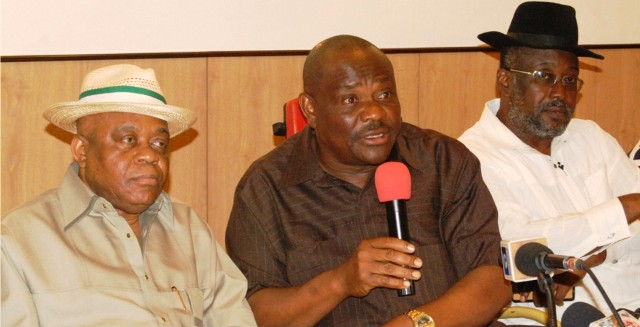
The Peoples Democratic Party (PDP), has explained that the need to avoid leadership vacuum after security agencies shamelessly botched the scheduled elective National convention in Port Harcourt was one of the potent reasons for the extension of the tenure of the Senator Ahmed Makarfi-led National Caretaker Committee of the party by 12 months.
The party also emphasised that delegates decided to extend the tenure of the caretaker committee by 12 months to enable the conclusion of all the litigations in courts, reconciliation efforts as well as restore peace to the party before the next convention in 2017.
The Tide reports that the August 17, 2016, National Convention, which held at the state PDP Secretariat on Aba Road in Port Harcourt unanimously approved the extension of the tenure of the National Caretaker Committee by 12 months, while also increasing its membership to 13.
Moving the motion for the extension of the tenure of the caretaker committee, Deputy Senate President, Ike Ekweremadu, said it was important to avoid leadership vacuum and allow room for the resolution of all outstanding cases in courts.
Seconding the motion, the former Minister of Women Affairs, Hajia Zainab Maina, said the prevailing circumstances impose a burden on the party to resolve its differences, and fashion out how best to prepare for the 2019 general elections, which the PDP must win, to restore confidence in the country’s democracy.
The Chairman of the National Convention Planning Committee, and Governor of Rivers State, Chief Nyesom Wike, however, put the question for the extension of the lifespan of the committee to members, who through a unanimous voice vote, approved the motion.
The convention further expanded the membership of the National Caretaker Committee to 13, and also restated its resolve that no member of the current National Caretaker Committee should contest elections into the National Working Committee (NWC) whenever it is held.
The Tide reports that delegates at the National Convention had earlier adopted a motion moved by the House Minority Leader, Rep Leo Ogor, to amend the agenda of the National Convention and step down the issue of election into various positions in the NWC.
The National Convention of the PDP took place at the Secretariat of the PDP in Rivers State along Aba Road after the Inspector General of Police, Ibrahim Idris, had deployed security agencies to take over the Sharks Stadium in Port Harcourt, where the event was billed to take place.
The Force Public Relations Officer, Mr. Donald Awunah, explained that officers and men of the police were deployed to take over the venue of the convention as early as 4am on Wednesday to avert anarchy and break down of law and order.
Awunah said the primary responsibility of the police was to protect life and prevent crisis, and added that due to the tension and the conflicting rulings by courts of coordinate jurisdiction on the National Convention, the police thought it best to seal off the venue.
According to him, “the warring parties need to follow due process to end their crisis through the courts, and as a law enforcement agency, what do you do? You ensure that there is a superior court order. It is not about taking sides.
“If in the next one hour or two, we get another court order, we will take action. We are there for every Nigerian but when you are the first responder, you have to take action, you have to be proactive.”
It would be recalled that the Rivers State Police command had later on Tuesday, issued a statement, signed by the Police Public Relations Officer, Omoni Nnamdi, confirming the readiness of officers and men of the command to provide adequate security and protect delegates to the convention in line with the order of a Federal High Court in Port Harcourt, last week.
However, following the twist of events, party leaders in separate goodwill messages at the National Convention, condemned the Federal Government for entrenching political impunity, arguing that it was a huge threat to the country’s democracy.
In his acceptance speech, Chairman of the PDP National Caretaker Committee, Senator Ahmed Makarfi, assured that the committee will continue to forge ahead with efforts to reposition the party for future political contests.
He condemned the invasion of the earlier venue of the National Convention, pointing out that it was undemocratic for the security agencies to take such action illegally.
Also speaking, Chairman of the National Convention Planning Committee, Chief Nyesom Wike, stated that the PDP will always survive all obstacles because the people are showing love and support for the party.
The Deputy Senate President, Senator Ike Ekweremadu also said the suffering in the country has forced the people to begin to crave for the PDP to return.
Former Jigawa State Governor, Alhaji Sule Lamido, added that the PDP was the choice of all Nigerians because it was a democratic and inclusive party.
Other leaders, who condemned the action of the security agencies during the National Convention, include the Senate Minority Leader, Godswill Akpabio, Ondo State Governor, Dr Olusegun Mimiko and former Minister of External Affairs, Chief Tom Ikimi.
A delegate from Anambra State, Chief Ugochukwu Okeke, said the decision was a step in the right direction aimed at moving the party forward.
“We will continue to explore all avenues to bring peace to the PDP, and remain a very viable opposition,” he said.
Another delegate, Mr Obi Kachi, said that the party decided to relocate to its secretariat on Aba Road for a non-elective convention because it respects the rule of law and abides by its constitution.
“We support the tenure extension because it is a good decision taken by our members to keep the party going,” he said.
Meanwhile, the Senator representing Bayelsa East Senatorial District, Ben Murray-Bruce, has said that the only way to achieve peace in the PDP is through dialogue.
Murray-Bruce, therefore, urged the Senator Ahmed Makarfi and the Ali Modu Sheriff-led factions to show maturity and initiate dialogue in the interest of the party.
Justice Okon Abang of a Federal High Court, Abuja had ordered the stoppage of the Convention while another Federal High Court in Port Harcourt gave a nod to the National Convention.
While the Makarfi-led faction had Tuesday approached the Appeal Court to give vent to its course, the Sheriff-led faction called on the Chief Justice of Federation to intervene in the rulings.
Meanwhile, the National Caretaker Chairman of the Peoples Democratic Party (PDP), Senator Ahmed Makarfi has inaugurated the National Executive Committee (NEC), with a tacit charge on members to work towards peaceful reconciliation and build a formidable party capable of wresting power from the All Progressives Congress (APC) in 2019.
Performing the inauguration at the Government House, Port Harcourt, on Wednesday, Makarfi said that the National Executive Committee include the PDP governors, National Assembly Caucus, Board of Trustees, National Caucus, 36 state PDP chairmen and the 13-member national officers of the party.
He said that in the absence of the elected national officers, the National Caretaker Committee members will be part of NEC.
Makarfi further said that the National Caretaker Committee members would cease to be NEC members once national officers have been elected at a National Convention.
At the meeting were PDP governors, members of National Assembly Caucus, Board of Trustees, National Caucus, 36 state PDP chairmen, and National Caretaker Committee members of the party.
The meeting later went into a closed door session, and journalists were not allowed to observe the proceedings.



Governor of Rivers State, Sir Siminalayi Fubara, has reaffirmed the unwavering commitment of his administration to peace, unity, security, and inclusive development as Rivers State marked its 59th anniversary, last Wednesday.
In a goodwill message issued on Wednesday to commemorate the anniversary, Governor Fubara stated that despite the challenges faced over the years, the people of Rivers State have continued to demonstrate resilience, strength, and an enduring spirit of unity that has sustained the state since its creation.
The Governor noted that the strong bond of brotherhood among the various ethnic nationalities of the state, including the Ijaw, Ikwerre, Ogoni, Etche, Ekpeye, Andoni, Kalabari, and others, remains one of Rivers State’s greatest strengths and a critical foundation for peace, stability, and progress.
He further observed that Rivers State has remained a major driver of Nigeria’s economy for decades, not only because of its abundant oil and gas resources, but also because of the exceptional contributions of its people across diverse sectors including academia, jurisprudence, business, entertainment, public service, and sports.
Governor Fubara assured the people that his administration will continue to prioritize policies and programmes that promote peace, protect lives and property, and expand development across all parts of the state. He emphasized that governance must be people centered and impactful, with equal attention given to every Local Government Area of the state.
The Governor also paid tribute to the elders and founding leaders of the state for preserving the spirit of unity and coexistence over the years, while urging the youths to remain hopeful, responsible, and actively committed to building a greater Rivers State through innovation, hard work, and patriotism.
He equally acknowledged the invaluable role of women in strengthening families, communities, and society, describing them as indispensable partners in the continued growth and stability of the state.
Governor Fubara called on all Rivers people to use the occasion of the anniversary as a moment of reflection and renewed commitment to peaceful coexistence, mutual respect, dialogue, and collective progress, stressing that the unity and future of Rivers State must always rise above personal interests and political differences.
Rivers State was created on May 27, 1967, by General Yakubu Gowon.


The Rivers State Government has distributed science equipment and materials to all senior secondary schools across the state to support students during the ongoing West African Examinations Council exams and to strengthen practical learning.
Flagging off the distribution at the Rivers State Senior Secondary Schools Board premises in Port Harcourt, on Monday, the State Commissioner for Education, Dr. Peters Nwagor, said the move demonstrates Governor Siminalayi Fubara’s commitment to improving education standards in the State.
Nwagor said the materials were approved and provided by the state government specifically to boost the teaching and learning of science subjects, describing science education as the foundation for technological advancement, innovation, and national development.
“No society can compete globally without deliberate investment in science and technology,” the Commissioner stated.
He commended the governor for consistently prioritising the education sector by providing tools needed for effective teaching and hands-on learning.
The Commissioner directed principals to ensure that the equipment are used strictly for practical lessons in their schools, warning that any principal or administrator found diverting, hoarding, or selling the materials wil face disciplinary action under public service regulations.
Nwagor also warned against examination malpractice, saying any principal found aiding or encouraging malpractices will be decisively sanctioned.
“We must collectively restore the dignity and credibility of our educational system,” he said.
Also speaking, Chairman, Rivers State Senior Secondary Schools Board, Tony Egwurugwu, urged school heads to make judicious use of the materials for students’ benefit.
He thanked the State Government for providing the resources, and assured that monitoring mechanisms would be put in place to ensure the materials serve their intended purpose.
In his own remarks, a Board Member for Technical Education, Nwisabari Bani Samuel, expressed appreciation to the governor for prioritising education and acknowledged the Commissioner’s role in advancing education development in the State.
He said the distribution covers all senior secondary schools in the State and is intended to improve students’ performance in both internal and external science examinations.
Akujobi Amadi
-

 Rivers2 days ago
Police arrest 3 suspects over killing of driver in Rivers
-
Politics2 days ago
I DIDN’T PROMISE YOU TICKETS, AKPABIO TELLS APC SENATORS WHO FAILED PRIMARIES
-

 News2 days ago
FUBARA ASSURES NUT OF SECURITY OF SCHOOLS IN RIVERS
-

 News2 days ago
NDLEA Arrests Four Notorious Female Drug Dealers In Four States
-

 Sports2 days ago
Okpekpe Road Race Gets Mobility Solutions, Fan Engagement
-
Politics2 days ago
Court Dismisses Rivers PDP Members’ Suit Over LG Election Candidates
-
Politics2 days ago
POST PRIMARIES: IKWERRE MONARCHS ADVOCATE ISSUES-BASED POLITICS IN RIVERS
-

 News2 days ago
WORLD FOOD SAFETY DAY: VETERINARIANS TASK GOVT ON MODERN ABATTOIR IN RIVERS