
Rivers
1,000 Firms Bid For Clean-Up Of Ogoniland

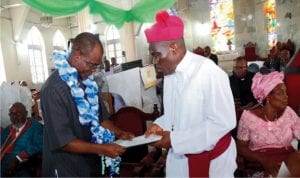
Senior Special Adviser on Security to the Deputy Governor Dr. (Mrs) Ipalibo Harry Banigo, Elder Emmanuel Ibama, presenting address to the Bishop, Niger Delta Diocese Rev. Ralph Ebirien at the 2nd Session of the 22nd Synod of the Diocese at St Augustine Anglican Church, Abonnema in Akuku-Toru Local Government Area.
The Minister of
Environment, Amina Mohammed, has confirmed that more than 1,000 companies have indicated interest to undertake the clean-up of oil impacted sites in Ogoniland, Rivers State.
The minister made the confirmation at a one-day sensitisation forum for stakeholders on the pre and post-launch activities for the clean-up of Ogoni and other oil impacted communities in the Niger Delta region.
Mohammed also said that her ministry had set up three committees to train and sensitise the people on the need to participate actively in the exercise, and avoid acts capable of derailing the process.
The Minister of Niger Delta Affairs, Pastor Usani Uguru Usani, who was also at the sensitisation forum, called for the cooperation of youth in the Niger Delta towards a successful clean-up of the environment.
While speaking at the forum, the Rivers State Government pledged its readiness to give all necessary support to the Federal Government before, during and after the clean-up of oil impacted sites in Ogoniland.
The state Governor, Chief Nyesom Wike, who was represented by the state Commissioner for Environment, Professor Roselyn Konya, gave the assurance at a presentation on sensitisation for the clean-up of Ogoniland.
However, some Ogoni stakeholders, who were at the forum, urged government to hasten the process, and ensure commencement of the clean-up before the next six months.
The Tide correspondent, who covered the sensitisation forum, reports that the leadership of MOSOP, youth and women groups as well as representatives of Shell Petroleum Development Company of Nigeria and its parent company at The Hague, Netherland, attended the forum.
Susan Serekara-Nwikhana

Niger Delta
Make God Your Anchor To Fulfill Destiny, Cleric Charges Christians … As Jaja Marks 70th Birthday


The Lead Pastor at Jesus Appointed People’s Bible Church, Ozogbe, Ikwerrengwo-Etche, in Etche Local Government Area of Rivers State, Pastor Promise Nwaelele, has urged Christians to make God the anchor of their lives in whatever position they find themselves, in order to attain the destinies set for them by God.
Pastor Nwaelele, who gave the charge recently in a sermon he preached at the 70th birthday anniversary thanksgiving service of Sir Donald Michael Jaja, a veteran journalist in Rivers State, said this is because any genuine child of God is a permanent target for destabilization and destruction by the devil.
Taking his text from the Bible book of Mark 4:16-17, the preacher stated that fulfilment in life for a child of God required faith, obedience to God’s word, humility and grace to withstand trials and temptations.
According to him, temptations and afflictions are bound to happen in the lives of those who have accepted Jesus Christ as their Lord and Savior.
“No wonder the Bible said that those that endure till the end shall be saved”, he said.
The Clergyman said God prospers believers who are humble, not proud and conceited, and leads them to destiny fulfilment.
“David said in Psalm 51:17, that the sacrifices acceptable to God are a broken spirit, not an impatient or proud spirit”, the preacher said.
He called on Christians not to allow persecutions and afflictions to sway them from the love and blessings of Jesus Christ.
On his part, Jaja, a seasoned Journalist who retired as an Acting Editor of the Rivers State Government-owned The Tide Newspaper, gave thanks to God for honouring him by giving him the grace of attaining 70 years.
“I cannot capture what the good Lord has done for me in my entire life in this fleeting moment of thanksgiving. But, I know that without Him, I wouldn’t have been who I am today, in all spheres. Therefore, my joy knows no bounds as I give thanks to my creator today, alongside my family. Praise be His holy name”, Jaja said.
The Eze Oha Evo III of Evo Kingdom, HM, King Leslie N. Eke, JP, Eze Gbakagbaka, has urged residents to embrace peace and avoid all forms of violence as the Christmas and New Year festivities draw near.
Eze Eke issued the caution during a pre-festive security briefing at his palace in Woji, Obio/Akpor Local Government Area.
The Eze Woji XII, who is also the Chairman of the Supreme Council of Ikwerre Government-Recognised Traditional Rulers, reminded the community and its residents that Christmas should be a season of love, reconciliation, and communal harmony and not be used for violence.
He stressed that no celebration should be allowed to degenerate into violence and added that peace remains central to the cultural values of the Ikwerre people.
The monarch expressed concern over the tendency for heightened social activities to lead to avoidable confrontations.
He urged residents to conduct themselves responsibly and avoid actions that could endanger other people’s lives and property.
“The festive season should strengthen community ties, not create opportunities for conflict or reckless behaviour”, he said.
Addressing the youths specifically, King Eke advised them to steer clear of cultism, drug abuse, street fights, and other disruptive acts.
He emphasised the need for young people to play critical roles in peace sustainance across Evo Kingdom and beyond.
“You must not allow yourselves to be used as instruments of violence. Channel your energy toward productive engagements that is capable of promoting unity and peace”, he said.
He further urged parents and guardians to pay closer attention to their children and wards during the holiday period.
The monarch also noted that seasonal gatherings often expose young people to negative influences and that family oversight was essential to preventing misconduct.
On security preparedness, King Eke disclosed that both local vigilantes and formal security agencies have been placed on heightened alert to ensure a hitch-free festive period.
He noted that the safety of the community remained a collective duty and encouraged residents to promptly report suspicious activities to the appropriate authorities.
The King cautioned against jungle justice and retaliatory actions, advising that disputes be resolved through lawful and peaceful channels.
He also lauded the efforts of the Rivers State Governor, Sir Siminalayi Fubara, over his relentless push for peaceful environment in the state.
King Onunwor
The management of Rivers State University (RSU), Port Harcourt, has stated that poor funding has hindered the institution’s ability to meet its expected academic targets.
Vice-Chancellor of the university, Prof. Isaac Zeb-Obipi, made this statement during a press briefing held at the institution on Monday ahead of the week-long 37th and 38th combined convocation ceremony scheduled for today and tomorrow.
Prof. Zeb-Obipi emphasized that poor funding continues to be a major challenge limiting the institution’s ability to meet its targets, adding that the management of the institution trusts the State Governor, Sir Fubara Siminalaye, who is the visitor to the university, to continue to strengthen and support them.
He noted that the state governor has demonstrated his commitment to supporting the university, recently approving N700m for the ongoing NUC accreditation.
The Vice-Chancellor stated that the university faces deficits in classrooms, staff accommodation, and student hostels, with the infrastructure gap widening, and existing lecture halls and laboratories requiring renovation.
“We are prioritizing phased upgrades based on program needs,
He added that the university is short-staffed, having lost staff to retirement, death, and changes in job or place of work, and that new programs, departments, and faculties have been created to meet the contemporary needs of society.
Mean while,a total of 13,242 students are set to graduate in the combined convocation, with 10,648 undergraduates, 1,356 Master’s degree students, 700 postgraduate diplomas, and 538 Doctors of Philosophy.
The Vice-Chancellor also used the opportunity to list some achievements of his administration, including the creation of new directorates, completion of abandoned laboratories, and upgrades in the faculty of sciences, made possible with support from the Tertiary Education Technology Fund (TETFund).
He expressed appreciation to the governor and visitor to the university, Sir Siminalaye Fubara, for approving his appointment and promised to justify the confidence placed in him.
Akujobi Amadi
-
 Business3 days ago
CBN Revises Cash Withdrawal Rules January 2026, Ends Special Authorisation
-
Business3 days ago
Shippers Council Vows Commitment To Security At Nigerian Ports
-

 Business3 days ago
Nigeria Risks Talents Exodus In Oil And Gas Sector – PENGASSAN
-

 Business3 days ago
FIRS Clarifies New Tax Laws, Debunks Levy Misconceptions
-
Business3 days ago
NCDMB, Others Task Youths On Skills Acquisition, Peace
-

 Politics3 days ago
Tinubu Increases Ambassador-nominees to 65, Seeks Senate’s Confirmation
-
Sports3 days ago
Obagi Emerges OML 58 Football Cup Champions
-

 News3 days ago
Tinubu Swears In Christopher Musa As Defence Minister