Connect with us

Education

Why RSUST SUG President Was Removed

Published

on

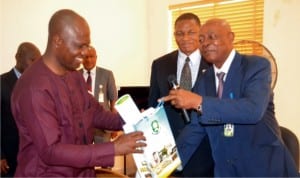
Acting Vice Chancellor Rivers State University of Science and Technology Nkpolu Port Harcourt,  Prof. Blessing Didia (right), presenting souvenir to the State Chairman NUJ, Mr. Ayo Tamuno, during a working visit to the acting vice chancellor recently.                     						          Photo: Nwiueh Donatus Ken

Acting Vice Chancellor Rivers State University of Science and Technology Nkpolu Port Harcourt, Prof. Blessing Didia (right), presenting souvenir to the State Chairman NUJ, Mr. Ayo Tamuno, during a working visit to the acting vice chancellor recently. Photo: Nwiueh Donatus Ken

Developments surround
ing the recent suspension of the Student Union  Government (SUG) President of the Rivers State University of Science  and Technology (RSUST), Comrade Wealth Gospel  seem to have taken a clearer turn.
The initial feeling of some of the students was that the Acting V ice Chancellor (VC), Professor Blessing Didia, “arranged” the suspension in a bid to install his loyalist.
No sooner had the SUG President been suspended than the students alleged that they started experiencing some vices such as theft and rape in the campus, even in day light.
Some of the students who spoke to The Tide  alleged that several of their colleagues, especially females had been raped and their handsets and other valuables, including money taken from them.
They also claimed that the classrooms were gradually becoming unsafe for them because their fellow students, believed to be cultists, came to terrorise them in the classrooms.
When contacted, the VC debunked claims of students being terrorised and all insinuations of a return to the era of cultism in the university, giving his own version of the suspension of the SUG president.
In an exclusive interview in his office, Professor Didia, unequivocally stated that he had no hand in the expulsion of the SUG president.
According to him, he in herited the Executive of the SUG on his appointment on August 1, 2015 and settled down to work with them, only to be approached in October 2015 by other members of the Executive that they had suspended their President.
“That Executive was introduced to me by the former VC (Professor Barineme Fakae). I had no business desolving them under the pretext that I don’t know how they came to be.
“By October 2015, the Executive came to inform me that they had suspended their President. The evidence was there. Following this, I  reasoned that there could be crisis if the students go the way they were  going”, he said.
The Acting VC explained further that rather than allow things to degenerate into chaos, he urged members of the executive to have a rethink. At the end of the day, they heeded his advice, “and the President  knelt down and begged his colleagues that he would turn a new leaf and work closely with them”
But rather than keep to his words, the SUG President went and appointed his own Chief Security Officer (CSO), and a task force, headed by the CSO, which allegedly did some of the things the students stated.
This, Professor Didia said, was in addition to mismanagement of SUG fund for his personal interest, which included empowering of members of his taskforce to the detriment of both students and the school authority.
“Members of the task force snatched phones from students and made the classrooms uncomfortable for learning”, the Acting VC said, adding that when it was verified that those carrying out the acts were insiders, measures were taken to address the situation.
“We hastened our own security system and started arresting them. Right now, they are in police custody. We found out that they were able to do what they did because they were backed by the SUG President. That was  the increase in cultism as alleged”, he concluded.


Sogbeba Dokubo

Continue Reading

Education

*Ogbakor Etche IAUE Chapter Pledges Support for Rivers Education Commissioner*

Published

on

The Honourable Commissioner for Education, Rivers State,. Dr. Peters Nwagor, on Friday hosted members of the Ogbakor Etche, Ignatius Ajuru University of Education (IAUE) Rumuolumeni Chapter, during a courtesy visit that underscored unity and mutual respect between the Ministry and key stakeholders.
The delegation was led by the Chapter Chairman, Prof. Gift Nwiyi, who spoke on behalf of the group. He commended Dr. Nwagor’s leadership style, describing it as purposeful and people centered. He urged the Commissioner to remain focused on his mission to reposition the education sector in Rivers State.
As a mark of solidarity, the delegation presented a symbolic gift to the Commissioner. Prof. Nwiyi said the gesture represents the Chapter’s collective support and confidence in Dr. Nwagor’s capacity to deliver on his responsibilities.
Responding, Dr. Nwagor thanked the group for the visit and their kind gesture. He noted that goodwill from academic and community bodies provides strong encouragement for the Ministry to stay committed to its reform agenda.
The Commissioner restated his resolve to work with stakeholders across the state to improve learning outcomes, teacher welfare, and infrastructure in schools. He added that partnerships with groups like Ogbakor Etche IAUE are critical to achieving sustainable development in the sector.
Members of the delegation also reiterated their readiness to collaborate with the Ministry on programmes that advance quality education. They pledged to mobilize intellectual and community support for policies that raise standards in Rivers State schools.
The visit ended on a note of unity, with both parties reaffirming their shared commitment to educational advancement. It marked another public endorsement of Dr. Nwagor’s leadership since his assumption of office as Commissioner for Education.
By: Akujobi Amadi
Continue Reading

Education

Professor Olonisakin Seeks More Funding for Research On Medicinal Plants, Laboratories

Published

on

An organic chemist at Adekunle Ajasin University, Akungba Akoko, Professor Adebisi Olonisakin has charged the government and relevant stakeholders to strengthen investment in research that explores the various known and undiscovered health and industrial potentials of plant secondary metabolites, in order for ‘Africa to evolve organic, home-grown methods of tackling health challenges if it must preserve its population and save its economy’.
He made this call on Tuesday, March 24, 2026, while delivering the 57th inaugural lecture of the institution titled ‘Nature’s Pharmacy: Unlocking the Secrets of Plant Secondary Metabolites’.
He further advocated sustainable governance principles, encouragement of conservation efforts and clubs, establishment of botanical gardens, biotechnology research units, approval of complementary herbal medicine, and setting up of laboratory infrastructure and central analytical facilities as avenues to getting the most from nature.
Prof. Olonisakin posited: ‘Secondary metabolites are nature’s valuable compounds that have contributed significantly to human well-being, safety and economic activities. These compounds have been a rich source of medicines, food additives, and other valuable products. Their diverse biological activities and potential applications make them an important area of research, offering new opportunities for improving human health and quality of life.
‘The isolation of secondary metabolites from plants has led to the discovery of numerous bioactive compounds with potential applications in medicines, agriculture and other industries. These compounds have shown promising results, making them attractive candidates for further research and development in order to uncover more of nature’s hidden treasures.’
Professor Olonisakin said secondary metabolites are natural compounds found in leaves, roots, bark and seeds of plants that protect them from insects and infection, adding that scientists study these plant chemicals to produce drugs for treating illnesses.
While affirming that nature can be seen as a pharmacy because it provides healing substances, the organic chemist urged students and researchers to pay attention to local plants, saying that Nigeria is blessed with many medicinal plants whose properties are yet to be fully discovered and utilised to help improve healthcare and boost the country’s economy.
Prof. Olonisakin noted that mosquito-borne viral diseases such as malaria continue to pose significant global health challenges with increasing resistance of mosquitoes to conventional insecticides. This, he said, has created an urgent need for alternative vector-control strategies through further research and development of plant secondary metabolites.
He, however, stressed the need for intentional scientific research into beneficial and safe plant-derived compounds, noting that genetic and environmental factors significantly influence the efficacy and chemical composition of plant secondary metabolites.
The chemist highlighted some of the challenges associated with secondary metabolites research to include complicated extraction process, low yield of secondary metabolites in sources, compound instability, structural diversity, high-demanding purification techniques, and limitations in analytical techniques.
To address these challenges, Prof. Olonisakin called on the Nigerian government to adopt integrated management principles that include responsibility, scale-matching, precaution, adaptive management, full cost allocation and stakeholder participation. He added that large-scale botanical gardens be established in all Nigerian states to conserve and manage useful plants effectively.
He also urged relevant stakeholders to encourage the establishment of conservation awareness and clubs from primary schools to universities and across local communities.
While presenting the inaugural lecturer, the Vice Chancellor and Chairman of the occasion, Prof. Olugbenga Ige, described Prof. Olonisakin as a distinguished scholar whose work sits at the intersection of tradition and science, as well as nature and human well-being. He commended him for his unwavering commitment to solution-driven research that advances knowledge within the university and benefits society at large.
Continue Reading

Education

Over 10,000 Teachers Register for TRCN Exam

Published

on

The Teachers Registration Council of Nigeria (TRCN) on Wednesday, March 25, 2026, announced that over 10,000 teachers across the country have successfully registered for its upcoming Professional Qualifying Examination (PQE) scheduled for May 14 to 16, 2026. The development is being seen as a major sign of growing confidence in the council’s digital registration platform, which has become central to teacher licensing and certification in Nigeria.
According to TRCN Registrar and Chief Executive, Dr. Ronke Soyombo, the high turnout reflects increasing trust in the portal’s ability to manage registration, licensing, and certification efficiently on a national scale. She explained that although the system faced early technical difficulties after its September 2025 launch, those issues were largely caused by heavy traffic, system upgrades, and users adjusting from manual to digital processes.
Soyombo further stressed that the portal is now operating smoothly and remains the only approved channel for TRCN registration, warning teachers against unofficial third-party agents or fraudulent form sales.
Beyond the numbers, the milestone represents a broader shift in Nigeria’s education sector toward digital efficiency, transparency, and professional standardisation, with the TRCN positioning itself as a key driver of modern teacher regulation.
Continue Reading

Trending