
Nation
THE STATES

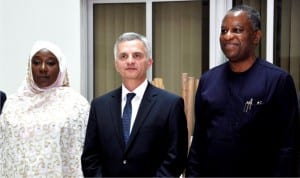
From Left: Minister of State for Foreign Affairs, Hajia Khadija Ibrahim, Swiss Minister of Foreign Affairs ,Mr Didier Burktialter, and Minister of Foreign Affairs, Mr Geoffrey Onyeama during the courtesy visit to Federal Ministry of Foreign Affairs in Abuja on Tuesday
Bauchi
The Bauchi State Health Care Development Agency has
trained 50 public and private health workers in Bauchi Local Government Area of the state on haemorrhagic fevers.
The Executive Secretary of the agency, Mr Adamu Gamawa, said this in Bauchi at the opening of the training.
Gamawa said that the agency explained that it was government desire to train front line health care providers as they were the first contacts in communities.
He said the exercise would further expose them to the clinical methods of identifying suspected cases at the community level.
According to him, the training would be conducted in four local government areas that were endemic to the disease.
“The agency will not relent in its efforts to continue the war against Lassa fever in order to wipe out the outbreak in the state.
“Similar training will be conducted in four local government areas of Bauchi, Toro, Dass and Alkaleri,’’ he said.
Borno
A High Court Judge in Borno, Justice Fadawu Umar, has
charged the Nigeria Bar Association (NBA) to fight corruption within the judicial system.
Fadawu gave the charge while presenting a paper in Maiduguri at the annual NBA annual law week of 2016.
He said that some legal practitioners had desecrated the revered judiciary and violated the ethics of the profession.
He explained that some lawyers go into Judge’s Chambers either before or after every court sitting to greet the judges with the aim of obtaining favour.
“These crops of lawyers commit this act in the full glare of litigants and the members of the public.
“It is not unusual to find lawyers calling Judges on phone in the comfort of their chambers when their phones are on hands free so as to give impression to clients that they are very close to the Judge.
“Lawyers must desist from paying homage to judges and magistrates at their chambers shortly before the court’s sitting as it is a breach of the rules of professional conduct”
FCT
As Nigeria joins the rest of the world to celebrate World
Book Day, the Association of Nigerian Authors (ANA) has urged the Federal Government to review the nation’s book policy.
The President of the association, Mr Denja Abdullahi,made the call in an interview with newsmen in Abuja.
Abdullahi urged the government to institute a working book policy plan to encourage the citizenry and imbue in them the culture of reading.
He expressed worry at the attitude of some Nigerians to reading, adding that the government must do all within it powers to inculcate in Nigerians a flair for reading.
According to him, the government has yet to put in place activities that can encourage Nigerians to read.
Jigawa
Some farmers in Hadejia, Jigawa have called on Jigawa
government to distribute fertilisers using the Short Message Service (SMS), to guard against diversion of the commodities.
A cross section of the farmers made the call in separate interviews with newsmen in Hadejia.
It would be recalled that the state government had announced plans to distribute about 5, 000 metric tons of assorted fertilisers to farmers for dry season farming.
Malam Hadi Aina, a farmer, said the call was imperative to ensure that the commodity got to the genuine farmers.
Aina alleged that they did not receive fertilisers and other inputs distributed by the government during the past rainy season due to diversion of the commodity.
He noted that distribution of the commodity through committees was making it difficult for genuine farmers to benefit from the exercise.
Kaduna
A Federal High Court sitting in Kaduna has sentenced
one Gambo Ado, 42, to four years in prison for unlawful possession of 270.1 kilogrammes of Indian hemp.
Ado of Dutsen-Wai in Kubau Local Government Area of Kaduna State was arraigned before Justice Emeka Nwite by the National Drug Law Enforcement Agency (NDLEA).
Counsel to NDLEA, Mr T.J. Atserhgh told the court that the accused committed the offence in 2015.
Kano
The Nigerian Air Force (NAF) would deploy additional
forces to Kano to secure the state’s airfield, the Chief of Air Staff, Sadique Abubakar, said.
He made the disclosure in Kano when he paid a courtesy visit to Governor Abdullahi Ganduje at the Government House.
He said that the additional forces was to boost NAF’s operations and other internal security operations across the country.
He added that “we are going to expand the infrastructure in the state and bring in additional force to secure our base, airfield and assist other security agencies’.
Abubakar said that the NAF base defence forces would serve as a standby force to assist other security agencies in the event of any security problem.
The air chief said that the force was committed to discharging its responsibilities and working with the Nigerian Army to end the insurgency.
Katsina
The Katsina State Government has given two months to
motorcyclists and tricycle operators to register their vehicles or be arrested and prosecuted.
The Commissioner of Water Resources, Alhaji Salisu Dandume, disclosed this while addressing newsmen on the outcome of the State Executive Council meeting.
He explained that the decision was aimed at improving the state’s Internally Generated Revenue due to the decrease in the price of crude oil in the international market.
The commissioner said that the registration would also assist in detecting the bad eggs among them and protect the lives of people in the state.
“Commercial motorcycle owners will pay N6,650, while the private ones will pay N6,200 each. The amount is for number plate registration fees, vehicle licence, road worthiness and learners permit.
“In the same vein, tricycle operators will pay N7,500 as licence fees annually. The amount was reduced by 50 per cent to encourage people to register after which the normal rate will be restored”.
Niger
Governor Abubakar Bello of Niger State has said that he
would prioritise electrification of rural communities for socio-economic development of the state.
He stated this during his visits to some communities in Bosso Local Government Area of the state.
Bello said that this would improve the living standard of the people as well as reduce rural-urban migration among youths.
He expressed concern about the neglect of infrastructural facilities in some communities by the past administrations.
“For the past 16 years, major communities such as Gusasa, Beji in Bosso, Banji under Mariga, Gulu under Lapai, Katcha, Agware,
Mashegu were under-developed due to lack of electricity supply.
“These communities are linked to each other and they are business-saturated areas.
“Providing electricity to the people of such communities will go a long way to attract more investors and generate more revenue for the state”
Osun
The Federal Road Safety Corps (FRSC) in Osun says
that the mobile court in the state has convicted 68 motorists for various road traffic offences.
The FRSC‘s Public Relations Officer, Mr Komolafe Noah, told newsmen in Osogbo that the offenders were convicted by the mobile court for various traffic-related offences.
Noah said that the initiative was to engender best road practices among motorists.
He added that some traffic offences attracted jail terms, especially when the offender failed to fulfill the compulsory fines.
“Details of the convictions indicated: speed limit violation, dangerous driving, overloading, tyre and seat belt rules violations. “
Noah advised motorists to always ensure proper maintenance of their vehicles.
Sokoto
The Chairman, Sokoto State Independent Electoral Com
mission (SIEC), Alhaji Usman Abubakar, says the commission will employ 15,000 ad hoc staff for the conduct of March12 Local Government elections in the state.
Our correspondent reports that Abubakar made the disclosure when the state House of Assembly committee on Public Service Matters visited the commission’s headquarters.
He said that the commission was fully equipped and prepared to conduct the elections across the 23 local governments in the state on March 12.
‘’We are ready with all the necessary materials provided by both the government and the Independent National Electoral Commission (INEC).
“We have made all the necessary arrangements at our own level to employ 15, 000 ad hoc staff for the smooth conduct of the elections.
“Moreover, our staff and security agencies are fully committed in ensuring free, fair and credible election processes across the local governments in the state,” he said.
Abubakar disclosed that the commission had borrowed 4,000 card readers from INEC.
Zamfara
A Gusau Chief Magistrates’ Court has ordered the
remand of a motorcyclist, Salisu Abubakar for allegedly raping a passenger.
Though the accused pleaded not guilty, Chief Magistrate Bello Kucheri, ordered that he should be remanded in prison custody and adjourned the case till March 15 for mention.
The prosecutor, Cpl. Ibrahim Aliyu, had told the court that on February 22, one Salina Saidu of Kwari village, Shinkafi Local Government Area, reported the case at Kaura Namoda Police Station.
Aliyu said that on February 21,Saidu boarded the accused motorcycle, to convey her from Dauran to Birnin Magaji.
The prosecutor said that the accused diverted and entered a bush where he allegedly raped the complaint.
He alleged that the accused beat up the complainant, tied her hands before committing the crime.



Rivers State University and the Otonti Nduka Foundation for Values Education jointly hosted a two-day National Conference on 8 and 9 May 2026 to examine the state of values in Nigeria.
The two days conference held at Rivers State University convocation arena brought together academics, policymakers, legal experts and education leaders under the theme _“Trends and Challenges in Upholding Values in Nigeria.”_
The gathering focused on policy gaps, curriculum reform, and the role of ethics in public service and education.
The event opened on Friday with remarks from Vice Chancellor Prof. Chief Isaac Zeb-Obipi, who stressed the need to address declining moral and civic values across Nigeria’s education and public sectors. A book of abstracts for the plenary sessions was also presented to participants.
Key speakers included former Attorney General Chief Dr Kanu Agabi, SAN; NERDC Executive Secretary Prof. Shehu Salisu; Prof. Hauwa Imam, FNAE, of the University of Abuja; former Rivers SUBEB Chairman Ven Dr Fyneface Akah, ; former NIMASA DG Dr Hon. Dakuku Adol-Peterside; and RSU Director of ICT Prof. Sunny Orike.
Discussions centered on integrating values education into schools, tertiary institutions and public institutions, alongside the impact of technology on moral development among young Nigerians. Panel and plenary sessions produced practical recommendations for curriculum and policy reform.
On Saturday, the foundation marked its centenary with the unveiling of the book _Otonti Nduka in History_, launched by Chief Engr. Grant Offor, FNSE. The Nigerian Academy of Education held a ceremonial procession led by its President Prof. Olu Jegede and the Ikwerre Professors Forum.
In a communiqué, participants called for stronger collaboration between government, civil society and academia to mainstream values education nationwide. They recommended reviewing teacher training curricula and expanding digital platforms to promote ethical civic engagement, with the foundation pledging to share the outcomes with education authorities for implementation.
Dignitaries present included Ogbakor Ikwerre Worldwide as Chief Host, Prof. Emeritus Chief T. Uzodimma Nwala, the Ikenga 1 of Mbaise and first philosophy student of Prof. Otonti Nduka, alongside scholars and community leaders.
Amadi Akujobi

The Shell Nigeria Gas Limited, in partnership with the Manufacturers Association of Nigeria, has reaffirmed support for efforts to expand gas distribution infrastructure in Rivers State as part of initiatives aimed at improving access to affordable, cleaner and more reliable energy for industries across the South-South region.
The commitment was highlighted during the SNG–MAN Business Forum held in Port Harcourt, where stakeholders from the industrial and public sectors examined the role of natural gas in driving industrialisation, boosting local production and strengthening energy security.
Speaking at the forum on behalf of the Managing Director of Shell Nigeria Gas Limited, the company’s Head of Gas Distribution, Mr. Chukwuka Amos Ejesi, described natural gas as a critical component of Nigeria’s energy mix and a key driver of sustainable industrial growth.
According to him, Nigeria’s gas development agenda has reached a stage where policy direction must be matched with practical implementation capable of addressing the energy challenges confronting manufacturers.
He noted that pipeline gas offers industries a cleaner, more dependable and cost-effective energy alternative capable of supporting uninterrupted operations, reducing emissions and improving production efficiency.
“Gas is the backbone of manufacturing, and we are encouraged by the growing recognition among stakeholders of the need for cleaner and more reliable energy solutions,” he said.
Ejesi stressed the need for sustained collaboration among energy providers, government institutions and industrial stakeholders to maximise the country’s gas resources for economic development.
He added that improved gas infrastructure would strengthen manufacturing value chains, enhance productivity and promote more competitive industrial operations across Rivers State and the wider South-South region.
Participants at the forum also emphasised the importance of expanding energy infrastructure as a pathway to unlocking industrial capacity, reducing operating costs and promoting sustainable industrial development.
Representing Governor Siminalayi Fubara, the Director-General of the Rivers State Investment Promotion Agency, Dr. Chamberlain Peterside, reaffirmed the state government’s commitment to partnering with private sector investors to revitalise industrial activities in the state.
He identified key projects targeted under the initiative to include the revival of the Ahoada Industrial Park, the New Port City project and the proposed Bonny Industrial Park, all aimed at stimulating economic growth and expanding industrial opportunities along the Bonny corridor.
According to the governor, the long-term vision is to position Rivers State as a leading manufacturing hub in Southern Nigeria through strategic public-private partnerships.
Governor Fubara also commended Shell Nigeria Gas and MAN for sustaining engagements geared towards improving industrial energy access, noting that gas infrastructure development remains central to the state’s economic recovery plans.
He further observed that the gas sector presents enormous opportunities for economic growth, especially as global energy systems continue to shift towards cleaner energy sources.
The governor called on stakeholders to work collectively towards developing a practical and sustainable gas framework capable of supporting the state’s industrial and energy development objectives.
Chairman of MAN, Rivers and Bayelsa Branch, Elder Vincent Okuku, described gas as indispensable to industrial operations, noting that many manufacturers continue to struggle with the high cost of alternative energy sources.
Similarly, President of the Port Harcourt Chamber of Commerce, Industry, Mines and Agriculture, Dr. Chinyere Ngozi Nwoga, said the transition to natural gas had become increasingly necessary for businesses seeking stable and cost-efficient operations.
“Pipeline natural gas provides a more cost-effective and reliable source of energy for industries,” she stated.
Also speaking, former Chairman of MAN in Rivers and Bayelsa States, Mrs. Emilia Akpan, stressed the need to align energy infrastructure development with investment in human capacity.
She maintained that rebuilding the state’s economy would require not only reliable energy supply but also the development of technical skills needed to support long-term industrial growth.
By Kevin Nengia

The City Boy Movement in Etche Local Government Area of Rivers state has commended Senator Allwell Onyesoh on his victory in the APC primary election for Rivers East Senatorial District.
Chairman of the group in Etche, Dr. Fortune Uchenna Obi, spoke to journalists in Okehi Ward after participating in Monday’s direct primary. He described Onyesoh’s emergence as the party’s candidate for the 2027 senatorial election as a reflection of the people’s will.
Dr. Obi said the senator has performed well during his first term and deserves re-election. He also thanked FCT Minister Nyesom Wike, leader of the Renewed Hope Agenda and Rainbow Coalition in Rivers State, for supporting Onyesoh’s candidacy. According to him, Wike’s backing was instrumental to the senator’s nomination, clearance, and victory at the primary.
He further praised voters in Etche and across Rivers East for turning out in large numbers at ward centers and urged them to sustain the support to ensure Onyesoh’s success in the January 2027 general election.