
Nation
THE STATES

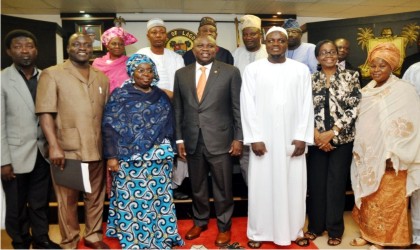
Governor Akinwumi Ambode of Lagos State (4th left), his Deputy, Dr Oluranti Adebule (3rd left), Amirul Hajj and Chairman, Special Adhoc Committee for the Lagos 2015 Hajj, Dr Abdulhakeem Abdullateef (3rd right) and others, during the inauguration of the Committee in Lagos last Monday
Adamawa
The wife of Adamawa State Governor, has organised a Sallah
party for the Internally Displaced Persons (IDPs) in Malkohi Camp near Yola.
Addressing the IDPs at a party, Jibrilla said the gesture was to give them a sense of belonging and make them feel at home.
She urged them not to lose hope, assuring that this administration was committed to their safety and welfare.
Also speaking, the Permanent Secretary, Ministry of Women Affairs, Hajiya Maisaratu Bello, reiterated the state government’s commitment to the welfare of the IDPs, particularly the vulnerable ones comprising women and children.
Responding on behalf of the IDPs, the Excutive Secretary of the Adamawa State Emergency Management Agency (ADSEMA), Alhaji Haruna Furo, thanked the governor’s wife for the party and donation of foods and other materials to IDPs.
Benue
The General Manager, Benue Environmental and Sanitation
Agency (BENSESA), Mr Ediga Akpa, says additional dump sites will be created across the state to facilitate waste management.
Akpa disclosed this in an interview with newsmen in Makurdi.
He said the additional dump sites would facilitate effective discharge of the agency’s duties as well as enhance compliance with sanitation laws.
He said the present dump sites at North bank, Gboko road and Naka road were inadequate. Akpa attributed the indiscriminate refuse heaps in Makurdi to ongoing evacuation of drains and gutters by his men.
According to him, the evacuation will allow for the free flow of drains in the city and prevent flood.
FCT
The practice of true federalism will fast track Nigeria’s develop
ment, Mr Rafiu Salau, National Chairman, Alliance for Democracy (AD), has said.
Salau made the remark in Abuja during a meeting of the National Executive Council (NEC) of the party.
The meeting was attended by executive members of the party from the six geo-political zones of the country.
“The party believes that the nation needs true federalism.
“The practice of true federalism will boost our democracy and enhance national growth and development,’’ Salau said.
The chairman said the creation of local governments was not the responsibility of the federal government but that of the state.
“It is not the responsibility of the federal government to decide the number of local governments for a state.
Gombe
The National Emergency Management Agency (NEMA) has
donated drugs to victims of multiple blasts at Dukku and Dadin/Kowa motor parks, Gombe.
Presenting the drugs, the Director-General of the agency, Alhaji Sani Sidi, described the incident as unfortunate.
He said the donation was part of the Federal Government’s efforts to assist victims of the disaster.
Sidi commended the state Hospitals Management Board for treating the victims and condoled families of those who lost their lives during the incident.
He said the agency would continue to support the state government to take good care of the victims.
Receiving the drugs, an official of the Federal Teaching Hospital, Gombe, Dr Zainab Chukuma, thanked the agency for its concern.
Jigawa
The Jigawa State Government recently nnounced its decision
to establish School of Nursing and Specialist Hospital in Hadejia Local Government Area of the state.
This is contained in a statement issued by Malam Bello Zaki, the Special Assistant on Media to Governor Muhammad Badaru, made available to newsmen in Dutse.
The statement quoted Zaki as saying the governor stated this when he visited the Emir of Hadejia, Alhaji Adamu Maje, during a working tour to inspect parts of the town wrecked by flood.
Zaki said “Governor Muhammad Badaru has announced his government’s decision to establish School of Nursing and Midwifery in Hadejia town and the conversion of the town’s General Hospital to a specialists hospital during the tour.
“The governor mentioned it at the palace of the Emir of Hadejia, Alhaji Adamu Maje, during courtesy visit.’’
The special assistant said Badaru had reiterated the state government’s readiness to expand the Birniwa Hospital in Birniwa Local Government Area of the emirate to standard general hospital.
Kano
The Kano State Government, has directed its health of
ficials to investigate the reasons for the large number of unhealthy and dead cattle that littered abattoir in the state capital.
The Commissioner for Environment, Alhaji Haruna Makena, gave the directive last Saturday in Kano while monitoring the monthly sanitation exercise in Kano metropolis.
Makena, who was represented by Alhaji Sagir Wall, the Permanent Secretary, expressed concern that unhealthy and dead cattle could endanger the health of the people.
“We cannot just sit by and watch the health of our citizens being jeopardised,” he said and urged health officials to look into the cause of large numbers of dead and unhealthy cattle in its abattoir.
The commissioner commended Kano residents for participating in the sanitation exercise.
Nasarawa
Nigeria and her citizens need God’s favour to overcome
challenges and be self sustainable, Pastor Ben Andrew of Living Faith Church in Lafia Nasarawa State.
The cleric made the declaration in a Sunday sermon entitled “favour, its impacts and benefits.
According to him, if the country and its citizens are not spiritually favoured by God, they cannot escape the struggles even if all manner of aids are offered freely to them.
He said “the lack of God’s favour makes one not to progress and creates unending problems. The lack of God’s favour makes one to be forgotten.’’
Andrew also said the lack of divine favour could result into daunting struggles with nothing to show.
He then pleaded with leaders in the country and the citizens to look up to God for lasting favours rather than shun Him and rely on fellow humans whose favours were unpredictable, short lived and had unreasonable conditions.
Oyo
A cleric, Moses Kasali, has called on Nigerians to be
patient with President Muhammadu Buhari over the delay in constituting his cabinet.
He made the call recently while addressing the congregation at the auditorium of the ministry in Ibadan.
Kasali, Head, Mercy of Prayer Ministry, Ibadan, was optimistic that the President would choose members of his cabinet within the first 100 days of his administration.
He also urged Nigerians to avoid calling the President ‘Baba Go Slow’ for not constituting his cabinet almost two months after his inauguration.
He said that Buhari was studying the situation to ensure appointment of competent and reliable hands into key ministries and parastatals.
Kasali said the wrangling in the two chambers of the National Assembly was a carryover of the old order.
Plateau
Plateau State Governor, Simon Lalong, last Sunday appointed
Sheikh Sani Yahaya Jingir as the state’s Amirul Hajj for this year’s Muslim pilgrimage to Saudi Arabia.
Jingir is Chairman, Council of Ulama of the Jama’atul Izalatul Bidi’a Walikatis Sunna, which headquarters is in Jos.
Lalong, in a statement signed by Mr Emmanuel Nanle, Director of Press Affairs, also directed intending pilgrims that had completed the payment of their Hajj fare, to appear for screening from July 29, 2015.
According to him, the screening team, led by Alhaji Danlami Abdullahi, will carry out the exercise for two weeks.
The statement assured intending pilgrims that their safety and comfort would be ensured,both in Nigeria and Saudi Arabia.
Sokoto
Binji Local Government in Sokoto State has spent N100 million
into the construction of 10 Primary Healthcare Centres (PHCs), its Chairman, Alhaji Umaru Danhabe, said in Sokoto, Sokoto State, recently.
Danhabe told newsmen that the council spent N10 million in constructing each of the facilities.
According to him, each of the PHCs had 10 wards with beds for 20 patients.
He said that one ambulance had also been provided to each of the centres to cater for emergency situations.
The chairman advised the people to promptly report any outbreak of epidemic to the nearest health centres, and assured them of government’s readiness to cater for their health needs.
Taraba
The Caretaker Chairman of Kurmi Local Government Area of
Taraba State, Mr Stephen Agya, has appealed to the federal and state governments to provide assistance to Internally Displaced Persons (IDP) in the area.
Agya, who made the appeal in an interview with journalists in Jalingo, noted that thousands of people have been displaced by communal clashes and rainstorm in the area.
“I want to appeal to the federal and state governments to come to the aid of the council in taking care of the victims of communal clashes and rainstorm, who have been in camps for so long.
“NEMA and SEMA carried out assessment of the level of damage in the area five months ago, but no assistance has yet been given,’’ he said.
Agya said that the council had been catering for the IDPs within its limited resources.
Zamfara
The Deputy Director, Special Education, Federal Ministry of
Education, Mrs Joyce Eke, said last Saturday that globally there were 58 million children of primary school age who were not enrolled in school.
Eke said in Gusau at a two-day National meeting on the revision of the Girls Education Project (GEP-3) Enrollment Drive Guidelines that globally 100 million children do not complete primary education.
The meeting was organised jointly by UNICEF, the Federal Ministry of Education and the five GEP-3 states of Zamfara, Sokoto, Niger, Katsina and Niger.
She said that Nigeria was responsible for 10.5 million out of the 58 were, a figure, she said was the highest in the world.



The Hydrocarbon Pollution Remediation Project (HYPREP) has announced that the mangrove wetlands in Ogoniland have been officially designated a Ramsar Site of International Importance by the Secretariat of the Ramsar Convention on Wetlands.
The designation, according to HYPREP, underscores the global ecological significance of Ogoniland’s mangrove wetlands and highlights ongoing restoration efforts aimed at addressing environmental degradation in the area.
In a press statement issued by the Project Coordinator of HYPREP, Prof Nenibarini Zabbey, the recognition was described as a major milestone for the agency, the people of Ogoni and other stakeholders working towards environmental restoration in the region.
Zabbey explained that the mangrove wetlands, which cover more than 31,700 hectares, consist of islands, tidal creeks, mudflats and mangrove forests that support a wide range of biodiversity. The ecosystem provides habitat for several species including fin fish, shellfish, crustaceans, crocodiles, turtles and the endangered grey parrot.
He noted that beyond biodiversity conservation, the wetland also provides essential ecosystem services such as fisheries production, flood control, water purification and carbon storage. According to him, the international recognition will further support local livelihoods, promote ecotourism and bring global attention to the region.
The HYPREP coordinator disclosed that the designation followed a meticulous process that began in 2024 when the project submitted a memorandum to the National Council on Environment seeking support for the recognition of the Ogoni wetlands as a Ramsar site.
Following the council’s review and approval, the Honourable Minister of Environment and Chairman of HYPREP’s Governing Council, Balarabe Abbas Lawal, formally wrote to the Ramsar Convention Secretariat requesting international recognition of the wetlands.
After a comprehensive ecological assessment, the Ramsar Secretariat granted the designation, officially recognising the Ogoniland wetlands as one of the world’s sites of international importance.
Zabbey said the recognition would strengthen ongoing environmental restoration efforts in the area and encourage stronger conservation measures and sustainable management of the wetlands for the benefit of present and future generations.
He added that the designation also fulfils a key recommendation of the United Nations Environment Programme (UNEP) Environmental Assessment Report on Ogoniland, marking another significant step in the implementation of the report’s recommendations.
The HYPREP project coordinator reaffirmed the agency’s commitment to restoring the Ogoni environment through the remediation of oil-polluted land, shorelines and mangrove ecosystems.
He also called for collective responsibility and stakeholder support to sustain the progress of the Ogoni cleanup programme and facilitate the development of a comprehensive and sustainable management plan for the Ogoni mangrove wetlands.

The Permanent Secretary, Rivers State Ministry of Social Welfare and Rehabilitation, Mrs Lauretta Davies-Dimkpa, has attributed the successes of the 12-day programme organised for adolescent girls aimed at eliminating Female Genital Mutilation(FGM) in some parts of the State to the ability of the respective stakeholders to take ownership of the programme.
Mrs Davies-Dimkpa, who dropped the hint in an interview at the end of the programme in Elele-Alimini Community in Emohua Local Government Area on Saturday, said the event had a buy-in component, an ownership mentality, whereby facilitators, staff, and everyone involved took ownership of the project.
She explained that the Rivers State Ministry of Social Welfare and Rehabilitation, in collaboration with the United Nations Children’s Fund (UNICEF) and the United Nations Population Fund (UNFPA) had packaged a series of training sessions for adolescent girls aimed at ending the practice of Female Genital Mutilation (FGM) in some communities across the State.
According to her, the initiative was designed to educate young girls on the harmful effects of the practice and empower them to become advocates against it within their communities.
She noted that the programme, which lasted for several weeks, targeted adolescent girls from different local government areas where the practice is still prevalent, stressing that
data collected by UNICEF and the Ministry revealed that Female Genital Mutilation is still practised in some parts of the State, prompting the need for intensified sensitisation and community engagement.
Mrs Davies-Dimkpa explained that the programme adopted a “train-the-trainer” approach where adolescent girls were educated on the dangers of the practice and encouraged to share the knowledge with their peers, families and communities.
“This is a programme by the Rivers State Ministry of Social Welfare and Rehabilitation with support from UNICEF and UNFPA to train adolescent girls towards ending Female Genital Mutilation, which is still practised in some local government areas,” she said.
She further explained that each participating local government area had a three-day training session, with the exercise running for a total of 12 days.
The local government areas, where the programme took place, she noted, included Ahoada West, Abua-Odual, and Emohua, adding that the initiative is part of broader efforts by the state government and development partners to eliminate harmful traditional practices and protect the rights and wellbeing of girls.
She revealed that prior to the training of the adolescent girls, the Ministry and its partners had also engaged community facilitators, including older women and men, to sensitise them on the dangers associated with Female Genital Mutilation.
According to her, the involvement of community leaders and adults is essential in addressing the cultural and social factors that sustain the practice.
Speaking on the response of the participants, the permanent secretary expressed satisfaction with the level of engagement and enthusiasm shown by the girls throughout the training sessions.
She noted that many of the participants said they were learning about the harmful effects of Female Genital Mutilation for the first time.
“The girls are between the ages of 12 and 17 and from the interactions we had with them, they were very excited. Some of them are hearing these things for the first time and never knew that the practice is harmful,” she said.
She expressed optimism that the knowledge gained from the training would enable the girls to serve as advocates for change within their communities.
She added that the Rivers State Government, alongside its partners, would continue to intensify efforts and expand community-based interventions aimed at ending the practice across the State.
Meanwhile, the participants for Emohua Local Government Area were drawn from Elele-Alimini, Egbeda, Rumuji, Ibaa, Rumuekpe, Rumuakunde, Eligbarada, and Ogbakiri Communities.
The participants,who spoke in separate interviews described the training as eye-opening, noting that it helped them better understand issues surrounding adolescent health, personal hygiene, reproductive health, and the harmful consequences of Female Genital Mutilation.
Favour Azukwu from Rumuekpe community, said the programme provided a deeper understanding of the dangers associated with the practice, particularly its impact on the health and wellbeing of girls and women.
She explained that the training sessions exposed participants to the medical, social and psychological effects of Female Genital Mutilation, including severe bleeding, infections and complications during childbirth.
She revealed that she personally experienced the practice at the age of 12 and suffered heavy bleeding afterwards, an experience that has strengthened her determination to advocate for its eradication.
According to her, many communities still practise Female Genital Mutilation because it is perceived as a cultural tradition, despite the dangers associated with it.
“I do not support Female Genital Mutilation because there are many dangers involved. I experienced severe bleeding when it was done to me as a child.
Another participant, Glory Ken, a 16-year-old secondary school student from Rumuji community, said the programme broadened her understanding of several important topics affecting adolescents.
She explained that beyond the discussion on Female Genital Mutilation, the training also focused on issues such as personal hygiene, reproductive health, peer education, and self-care.
According to her, the sessions helped participants understand the importance of making informed health decisions and supporting one another as peer educators.
“I learned about many things that affect young people in society and how to take care of myself. I also learned that Female Genital Mutilation is harmful to our health. The message I am taking back to my community is that this practice should stop,” she said.
Also speaking, Goodness Kenjika Nyeche described the programme as very impactful.
She noted that the training equipped participants with the skills and confidence to educate others about the harmful effects of Female Genital Mutilation.
She said she plans to organise sensitisation among adolescents in her community, particularly girls between the ages of 10 and 19, to ensure they understand the dangers associated with the practice.
“I learned many things from this programme and I feel very good about it. I will educate other young girls in my community and help them understand why Female Genital Mutilation should not continue,” she said.
For Queen Dike from Ibaa community, the programme helped clarify misconceptions surrounding the practice.
She explained that in some communities, the practice is still referred to as circumcision and is viewed as part of cultural identity.
She said the training helped participants understand that Female Genital Mutilation involves the cutting or removal of parts of the female genital organs and that it has serious health consequences.
She stressed that awareness and education are key to ending the practice, especially among communities that continue to uphold it as tradition.
“I think the programme is very helpful because many people still believe it is part of culture. More awareness is needed so people can understand why it should stop,” she said.
Another participant, MyJoy Echika Amadi, said the programme provided critical information about adolescent health and the dangers associated with Female Genital Mutilation.
She described the initiative as enlightening and said it encouraged young people to become advocates for change in their communities.
According to her, participants were encouraged to use various platforms such as churches, peer groups, schools and community gatherings to spread awareness about the harmful effects of the practice.
“This programme has enlightened us about the dangers of Female Genital Mutilation. I will do my best to create awareness in my community and encourage people to stop the practice,” she said.
Many of the participants emphasised that the knowledge gained during the programme has empowered them to challenge harmful traditions and promote healthier practices among young people.
They also called on the Rivers State Government, development partners and civil society organisations to sustain the sensitisation campaigns and extend the training to more communities across the State.
According to them, empowering young people with the right information will play a critical role in eliminating Female Genital Mutilation and protecting the rights, health and dignity of girls in Rivers State.
The participants expressed appreciation to the Rivers State Ministry of Social Welfare and Rehabilitation, UNICEF and UNFPA for organising the programme and for investing in the wellbeing and future of adolescent girls in the State.

-

 Business3 days ago
NERC Amends Order on Meter Tampering, Power Bypass For Discos
-

 Business3 days ago
NCDMB Signs Mgt Deal With Radisson, Edison…As Board’s 204 Rooms Hotel Open December 2026
-

 Rivers3 days ago
KENPOLY Rector Promises To Prioritise Students’ Welfare
-

 Business3 days ago
Nigeria, AFC sign $1.3 billion deal to build alumina refinery
-

 News4 days ago
Police Arrest Nigerian, Two Others For Kidnapping In Edo
-

 Rivers3 days ago
Don, Stakeholders Urge Environmental Laws In N’Delta
-

 Rivers3 days ago
ADIAFRICA Flags-off Free Eye Screening Outreach In PH
-

 Business3 days ago
FG engages foreign investors at PEBEC Roundtable on business environment reforms