
Nation
THE STATES

Adamawa
The Adamawa State Police Command has confirmed the
abduction of the Vice Chairman of Hong Local Government, Mr Bijida Yakubu, by suspected insurgents.
The Public Relations Officer of the command, DSP Othman Abubakar, who confirmed the incident, said three vigilante members that were with Yakubu lost their lives in the encounter.
Abubakar, who did not give details, however, said policemen investigating the incident had so far recovered the vice chairman’s shoes.
A resident of Hong who simply identified himself as Hussaini told newsmen that the incident occurred in Gayafa village of the area.
“You know, insurgents attacked the village last week. The vice chairman who hail from the village was on an assessment visit with some hunters when the insurgents attacked and over-powered them.
“ About seven insurgents were killed in the encounter before they over-powered the hunters and took away the vice chairman,” he said.
Hussaini claimed that the abducted vice chairman was later allowed by his captors to call his wife with his cell phone before the device was switched off.
The Chairman of Adamawa branch of Association of Local Governments of Nigeria (ALGON), Alhaji Sahabo Gurin, also confirmed the incident.
Bauchi
The Raw Material Research and Development Council
(RMRDC), said it would collaborate with the Bauchi State Government to train 20 local government council chairmen on cluster formation.
The Bauchi State Coordinator of the council, Malam Ahmed Waziri said the training would help drive industrialisation in the state through clusters, which he described as a congregation of various industries that produced similar products, using common raw materials or mineral resources as input.
Waziri told newsmen in Bauchi that plans were on to deploy the council’s Ward-Based Cluster Technology Programme (WBCTP) to all the wards of the 774 local government areas in the country to start the process.
“Clusters have been identified as one of the engine rooms for industrialisation globally.
“When they are concentrated in one geographical location, it is easy for the government to provide them with a common facility.
Benue
The Benue State House of Assembly has directed the
state Commissioner for Finance to submit details of revenue received from the Federation Account to it before March 3.
The House gave the directive during the plenary after considering the motion moved by 23 members.
Our correspondent reports that the motion called on the state government to furnish the house with details of its financial status.
Speaking, the leader of the group, Mr James Ochojila, stated that the constitution had empowered them to investigate any matter or thing that it had power to make laws on.
Ochojila further said that the power of investigation of the House covered the conduct of affairs of any person, authority, ministries, departments and agencies.
FCT
Electricity consumers in the commercial and industrial
sectors of the country have called on the Nigerian Electricity Regulatory Commission (NERC) to suspend the implementation of the new electricity tariff.
NERC, on December 23, approved a review of the Multi Year Tariff Order (MYTO) 2.1 regime for commercial and industrial consumers on D3 with the take-off date of January 1.
Some members of the sector made the call at a consumer forum organised by NERC for commercial and industrial consumers in Abuja.
Mr Felix Okojie, a representative of the Steel Manufacturers Association, said that 45 per cent increase in tariff for the commercial and industrial sector was astronomical and inappropriate.
He said that the increase had interrupted the long term planning by members of the association.
Kaduna
The Nigeria Security and Civil Defence Corps (NSCDC)
has alerted passengers of commercial vehicles in Kaduna to be wary of armed robbers posing as drivers.
The warning was contained in a statement signed by the Kaduna State NSCDC Commandant, Alhaji Zakari Ningi.
It said the operators of the vehicles took advantage of passengers and ended up robbing them at vulnerable spots.
“The operators of painted commercial buses in the metropolis carry unsuspecting passengers but end up robbing them on board,” Ningi said.
He said the command had received complaints from victims of such robberies, and advised passengers to be extra careful while boarding commercial vehicles, especially within Kaduna metropolis.
He said the command had since commenced investigation into the matter after it received “two reports of persons who have been robbed in such manner”.
The commandant urged the general public to assist the NSDC with useful information to track down and apprehend the perpetrators.
Kano
The Police in Kano have arrested a female politician,
Hajiya Aisha Maijama’a, over alleged sponsorship of political thugs in Tudun Wada Local Government Area of the state.
The state Police Commissioner, Mr Ibrahim Idris, announced this while briefing newsmen in Kano recently.
Idris said the woman who is a strong member of one of the political parties, was apprehended along with 23 thugs found carrying different kinds of local weapons trying to instigate violence in the area.
He said investigation had commenced after which the suspects would be charged to court.
The commissioner said the command had on different occasions warned politicians against acts capable of causing violence in the state.
He said the command would not allow any groups or individuals to breach the peace, warning that anybody who indulged in acts of violence would be arrested.
Kebbi
The Nigeria Immigration Service in Kebbi State has de
ported 500 illegal immigrants as part of security measures ahead of the forthcoming general elections.
The Comptroller of the service in the state, Alhaji Abdullahi Salahu, told newsmen in Birnin Kebbi that the arrest and deportation of illegal immigrants would be a continuous exercise.
He said the exercise followed the directives of the Controller-General of the service, Mr David Paradang.
He said the service would ensure that foreigners did not partake in the elections.
“During the mop-up operation 47 National Identity cards; 16 Permanent Voter Cards (PVCs); 53 Temporary Voter Cards and three Court Affidavits were impounded from the illegal immigrants,” he said.
Lagos
A businessman, Aremulola Anjorin, who allegedly de
frauded some people of N36.7 million, has been charged before an Ebute Meta Chief Magistrates’ Court, Lagos.
Anjorin, 42, is facing charges of stealing, conspiracy, issuance of dud cheques and fraud.
Prosecutor G.O. Osuji told the court that the accused committed the offences at different times in his office.
He said that the accused defrauded Mr Ernest Uduebor of N2.5 million on June 2, 2014, at No. 2, Ayorinde St., Ojota, adding that he defrauded Mr Kenneth Eromosele of N20.9 million sometime in May 2012, on Ogudu Road, Ojota.
Osuji also submitted that the accused obtained N8.9 million from Mr Basil Ogoha under false pretences and issued a dud cheque to him to cover the amount.
“Anjorin also obtained the sum of N4.8 million from one Ibukunoluwa Otesile with a promise to supply her company petroleum products.’’
The prosecutor said that the offences contravened Sections 285 (9) (b), 312(3) and 409 of the Criminal Law of Lagos State, 2011.
Nasarawa
Nasarawa State Government has budgeted N1.2 billion
for the construction of students’ hostels in four state owned tertiary institutions to improve the standard of education in the state.
Alhaji Husseini Abubakar the supervising commissioner for Higher Education, made the disclosure recently in Lafia while defending the 2015 budget of the ministry before the House of Assembly Committee on Education.
He said that if the budget was approved, the money would be utilised for the construction of students’ hostels in four higher institutions to reduce the problem of accommodation.
Abubakar said the ministry had done its best to improve the standard of education in the state through the execution of various projects aimed at providing conducive environment for teaching and learning.
He appealed to the committee to ensure speedy passage of the budget to enable the ministry execute more projects.
Oyo
The Oyo State Government says it has met the demands
of its judiciary workers who have been on strike since January 5.
The state’s Attorney-General and Commissioner for Justice, Mr Adebayo Ojo, said this in an interview with newesmen in Ibadan recently.
He said government officials had met with executives of the Oyo State branch of the Judiciary Staff Union of Nigeria (JUSUN), adding that the strike was expected to be suspended.
“We had a meeting with the JUSUN last week and we have fulfilled their demands. We, therefore, expect them to call off the strike,” he said.
But the JUSUN Chairman in the state, Mr Ayoade Ademola, said that the expected suspension of the strike by the attorney-general was “ wishful thinking.’’
“This must be his wishful thinking because our demands are still not yet met.
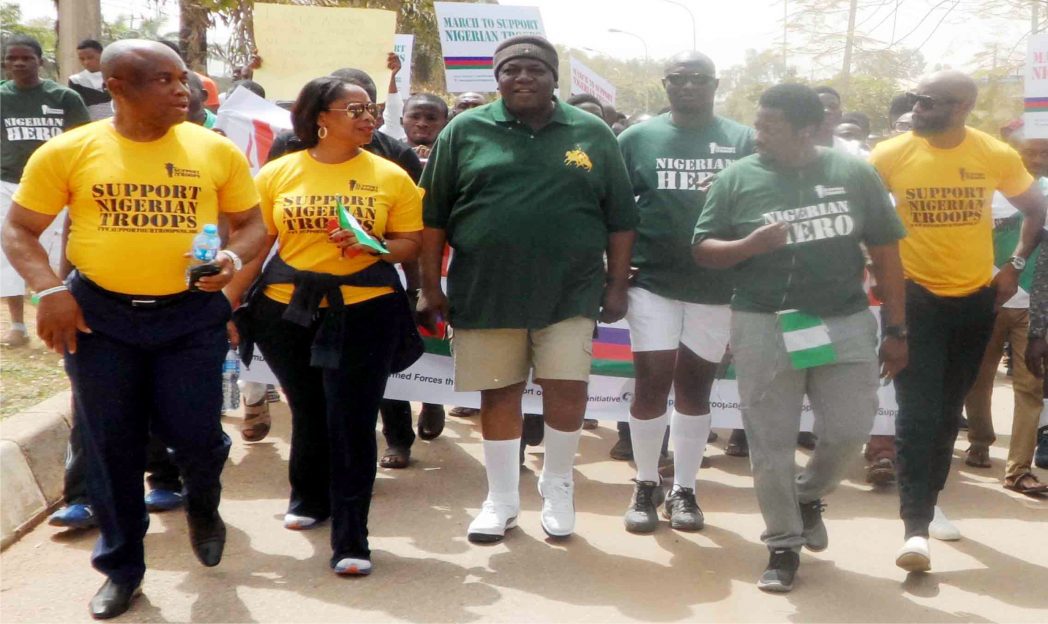
L-R: Founder, Support Our Troops Foundation (Sotf), Mrs Funmi Ogbue, Minister of Culture, Tourism and National Orientation, Chief Edem Duke, member, Board of Trustees of Sotf, Mr Femi Adesila and others, during a road walk by Sotf in Abuja last Saturday

Nation
Zabbey Emerges Social Impact Man Of The Year 2025 …Reaffirms Commitment To Ogoni Transformation


The Project Coordinator of the Hydrocarbon Pollution Remediation Project (HYPREP), Prof. Nenibarini Zabbey, has been named Social Impact Man of the Year 2025 by Daily Independent Newspapers.
The award was presented at the Independent Awards 2025 Silver Jubilee Edition held at Eko Hotels and Suites, Lagos, as part of activities marking the organisation’s 25th anniversary of editorial excellence.
Managing Director and Editor-in-Chief of Independent Newspapers, Steve Omanufeme, said the award recognises individuals who have demonstrated exceptional leadership and transformative impact in their respective fields. He explained that recipients emerged through a rigorous process involving public voting, editorial board scrutiny, and assessment by a panel of judges.
Omanufeme noted that Zabbey’s selection reflects his outstanding contributions to environmental restoration and community development in Ogoniland through the Ogoni cleanup project.
With over two decades of experience spanning research, advocacy, capacity development, and administration, Zabbey has, within three years of leading HYPREP, implemented people-focused initiatives aimed at improving livelihoods and restoring degraded ecosystems.
Under his leadership, the project has reportedly created more than 7,000 direct jobs and facilitated the training of thousands of youths and women in high-demand skills, including mechatronics, cybersecurity, commercial diving, underwater welding, and data analytics.
HYPREP has also trained over 5,000 beneficiaries across 21 vocational skill areas, providing start-up kits to support entrepreneurship and economic empowerment.
In the area of environmental sustainability, the agency has established 31 environmental clubs in secondary schools and trained 2,500 youths with International Maritime Organization (IMO) certification to support shoreline cleanup and mangrove restoration efforts.
The project has recorded significant ecological milestones, including the cleanup of over 1,000 hectares of shoreline and restoration of 560 hectares of mangroves. This progress contributed to the designation of Ogoni mangrove wetlands as a Ramsar Site of international importance.
Beyond environmental remediation, HYPREP has expanded its social intervention programmes to include educational grants and scholarships for over 1,000 students, support for small and medium-scale enterprises, and skills training for persons living with special needs.
Infrastructure and healthcare development have also featured prominently, with ongoing projects such as the Ogoni Specialist Hospital, a Cottage Hospital, the Ogoni Power Project, and the Centre of Excellence for Environmental Restoration. The agency has further strengthened emergency healthcare delivery by donating five ambulances to medical facilities in the region.
Additionally, potable water has been provided to more than 40 communities, alongside the construction of wind-powered water systems in underserved areas.
Speaking on the award, Zabbey described it as a validation of HYPREP’s integrated approach to environmental restoration, healthcare improvement, and economic empowerment.
“We remain committed to delivering a cleanup that not only restores the environment but also improves livelihoods in line with the Renewed Hope Agenda of President Bola Ahmed Tinubu,” he said.
HYPREP, in a statement, expressed appreciation to the management of Independent Newspapers for the recognition, the Federal Ministry of Environment for its oversight role, and the Ogoni communities for their continued support and collaboration.
The agency was established by the Federal Government of Nigeria to implement the recommendations of the United Nations Environment Programme (UNEP) report on Ogoniland and restore areas impacted by oil pollution.
Nation
Rivers State Judiciary Counters NBA National Position over Contempt Ruling, Says Judge Acted Within the Law

The Rivers State Judiciary has faulted the Nigerian Bar Association National over its March 26, 2026 press release condemning the jailing of a lawyer for contempt, insisting the trial judge acted lawfully to protect the court’s integrity.
In a rejoinder issued by Chief Registrar High Court,David D. Ihua-Maduenyi, Esq., the judiciary said it was necessary to “set the records straight” following reactions to the NBA’s statement on the contempt conviction of Mrs. Lovinah Ugbana Benjamin.
Titled: “JUDGES MUST NOT BULLY LAWYERS OR
ABUSE POWER TO PUNISH FOR CONTEMPT AS A TOOL
FOR INTIMIDATION OF LAWYERS”
RE: IN THE MATTER OF CONTEMPT OF COURT BY MRS.
LOVINAH UGBANA BENJAMIN
IN SUIT NO.
PHC/301/2016 CORAM C. NWOGU J., OF THE HIGH
COURT OF RIVERS STATE.
The state judiciary explained that case in question is Suit No. PHC/301/2016 before Justice Chinwendu Nwogu of the Rivers State High Court, where Mrs. Benjamin served as defence counsel.
The statement read thus
“We are compelled to make this rejoinder regarding the
incident of the conviction for contempt and subsequent
unconditional discharge of Mrs. Lovinah Ugbana Benjamin,
Learned Counsel for the Defendants in the above suit by Hon.
Justice Chinwendu Nwogu of the High Court of Rivers State in
order to set the records straight, and not allow the
misinformation, misconception and reactions arising from the
NBA National Press Release in the matter to fester as reality or
truth.”
In the suit under reference wherein the said Learned
Counsel appeared for the Defendants, the Learned Counsel
attempted to mislead the Court by her signed and filed final
written address, by knowingly and falsely presenting non-
existent facts and evidence of a witness. When confronted by the
Court, she admitted that what she stated in her final written
the address was not true and she was unapologetic.”
“The to uphold the dignity and integrity of the Court, which the
said Learned Counsel treated with clear and brazen contempt, the
Court after following due process, convicted her for contempt and
sentenced her to prison for 3 days only, instead of the 3 months
statutory term due to passionate plea from the Bar.”
“According to the statement the suggestion of the NBA National in paragraph 10 of the
Press Release under reference that “where a court considers
counsel’s conduct improper, the proper course is to invoke
recognised disciplinary mechanisms, including referring
counsel to the Legal Practitioners Disciplinary Committee
(LPDC), rather than resorting to summary punitive measures”,
is not an invariable rule because the act of the Defence Counsel
constitutes contempt in facie curiae which the Court can punish
instantly, hence the action of the Judge is not an abuse of power
or an act of intimidation.”
“Nevertheless, due to the numerous calls from respected
members of the Bar to the offices of the Chief Registrar and the
Honourable Chief Judge for the release of the said Learned
Counsel, and the intervention of the NBA Port Harcourt Branch
delegation led by its Chairman, Mrs. Cordelia U. Eke to the Judge.
in his Chambers in the morning of 26/03/2026 where the
delegation upon learning the true facts of the incident, apologised
and pleaded for the release of the said Learned Counsel.
“The Judge
having accepted the apology signed a production warrant and
upon her production in court and oral application by Mrs. Cordelia
U. Eke, discharged her unconditionally that same morning.”
The statement further stated that It is therefore shocking to read later that day the NBA
National Press Release signed by its President and Secretary, Mazi
Afam Joseph Osigwe (SAN) and Dr. Mobolaji Ojibara respectively,
fiercely threatening and hastily advocated the following ultimata and
the immediate release of the affected
Counsel.
:That the Hon. Chief Judge of Rivers State
immediately investigate the circumstances
surrounding this incident and take
appropriate administrative action.
That appropriate disciplinary steps be taken
by the National Judicial Council, where
necessary.
That the remand of Mrs. Lovinah Ugbana
Benjamin under the circumstances be
condemned and set aside”
“That all NBA branches in Port Harcourt and
its environs and all legal practitioners
boycott the proceedings before the Court of
Hon. Justice Nwogu for a period of 7 days if
Mrs. Lovinah Ugbana Benjamin is not
released within 24 hours.
“It seems to us that it is either the NBA Port Harcourt Branch
leadership did not relate the true position to the NBA National or
if they did, the NBA National decided to speak daggers, not peace
to impugn the Judge as a villain.
“We find the position of the NBA National on this subject very
offensive and embarrassingly raising a feeling of acrimony against
the Judge in particular, and the High Court bench of Rivers State
in general. We categorically state that the Hon. Justice Chinwendu
Nwogu is one of our respected and respectful Judges with
unblemished integrity.
We view this Press Release as an isolated departure from the
enterprising and amiable leadership of the NBA National,
especially its President, whom we hold in high esteem and
admiration.”
“Whilst we appreciate the concern of the NBA National in
bringing attention to the event of 25th March 2026, we assure that
the Bench and the Bar in Rivers State remain veritable partners
in the administration of justice.
“We firmly restate that the Bench in Rivers State holds the Bar
in high esteem and this event would not disrupt the cordial
relationship between the Bench and the Bar.”