
Business
‘Less Than 3% Land Ownwers In Nigeria Have C of O’

The Surveyor-General of the Federation, Prof. Peter Nwilo, has said that less than three per cent of Nigerians who owned land had Certificate of Occupancy (C of O).
Nwilo, who made this known in Abuja, Monday, attributed the development to poor implementation of the Land Use Act.
He explained that the Act should be properly implemented by state governments to ensure lawful allocation of land, noting that since 1978 when the Act took effect no state had implemented it.
“Not up to three per cent of Nigerians have Certificate of Ownership and it is only when you have a C of O that you know you own a land.
“The Land Use Decree says that the governor of the state holds the land in trust; so, every C of O should be signed by the governor or his representative.
“It is easy to say a law does not work but there is provision for every state to have its committee that deals with allocation of lands; no law is perfect but that law can continue to be improved.
“The Federal Government has set up a committee on land reform.
“What the committee is doing is to bring to the fore the shortcomings of our actions that have caused the Land Use Decree not to work the way it should work,” he said.
He explained that unnecessary processes involved in the acquisition of a C of O hampered development in the country.
He said there was a need for enhanced collaboration among bodies responsible for the implementation of laws governing the allocation of land.
“When you want a C of O, there are so many obstacles, it can take up to three years to get it; it is not supposed to be so.
“What is important is that you show evidence that the land belongs to you and that you have a survey plan that is properly done.
“This affects us in terms of development; the C of O is the basis of everything we do such as establishing industries.
“Where we register land it takes donkeys years and no developer or industrialist will be ready to wait for so long,” Nwilo explained.
He said the committee on land reform was working to ensure that state governments adhered strictly to the provisions of the Land Use Act in enhancing land registration.
Nwilo also said there was a need for professional surveys to be conducted when allocating and acquiring lands.
He said that conducting professional surveys was necessary to accurately map out where land structures should be and to guard against erection of structures inappropriately.
“What survey does is to show exactly where the land is; and a cadastral survey is a survey done to give a person the right to ownership of a piece of land.
“The cadastral map is one thing that is not available in this country; ask state governments how many of the states are mapping, yet we have survey departments doing nothing.
“We have slums because development came without mapping; if there is proper mapping you will know where to place the infrastructure,” he said.
The surveyor-general also emphasised on the need for all stakeholders to implement best practices to promote development.
He said: “If you do not map an area, you cannot manage it.
“With adequate survey and planning or with topographic survey, you will in advance have adequate information to know where to place every structure.”
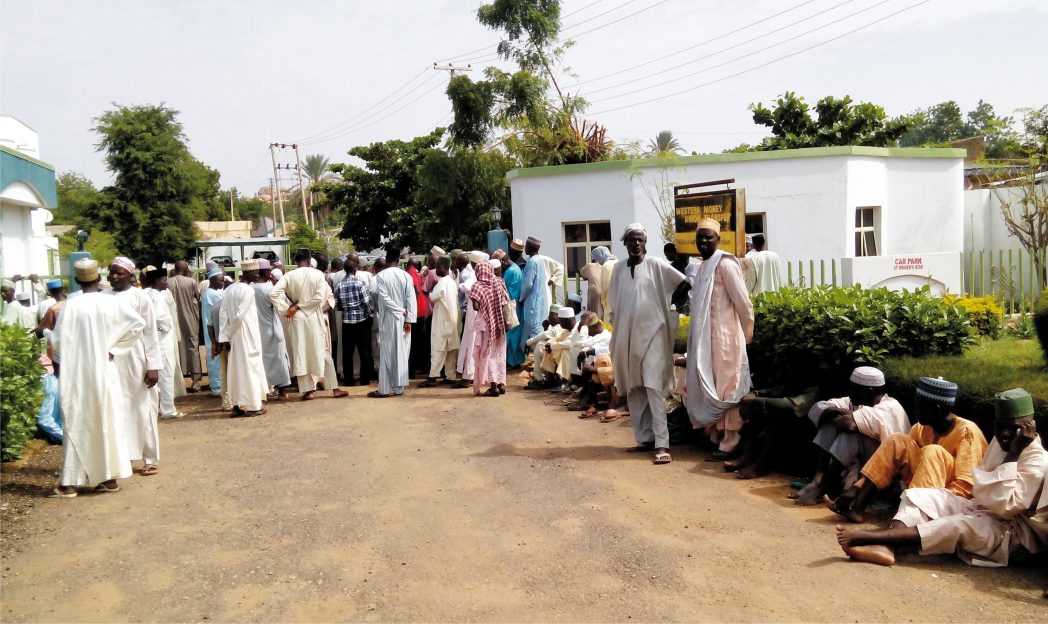
Customers waiting to collect money from a bank in Dutse, recently. Photo: NAN



-

 Business1 day ago
NERC Amends Order on Meter Tampering, Power Bypass For Discos
-

 News2 days ago
Police Arrest Nigerian, Two Others For Kidnapping In Edo
-

 Business1 day ago
Nigeria, AFC sign $1.3 billion deal to build alumina refinery
-

 Rivers1 day ago
KENPOLY Rector Promises To Prioritise Students’ Welfare
-

 Rivers1 day ago
Don, Stakeholders Urge Environmental Laws In N’Delta
-
 Business1 day ago
NCDMB Signs Mgt Deal With Radisson, Edison…As Board’s 204 Rooms Hotel Open December 2026
-

 Rivers1 day ago
ADIAFRICA Flags-off Free Eye Screening Outreach In PH
-

 News2 days ago
NDLEA Arrests Ex-Councillor With 40kg Skunk, Recovers Drugs In Diapers