
Business
Clearing Agents Want Review Of New Automobile Policy

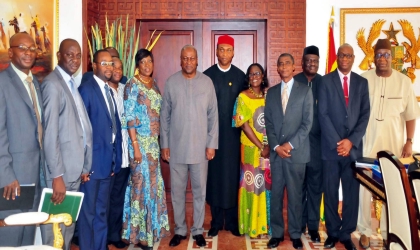
President John Mahama of Ghana (7th right), Frsc Corps Marshal, Osita Chidoka (6th right) and other officials from Nigeria and Ghana, during the visit of the Frsc Corps Marshal to Ghana last Thursday. Photo: NAN
The Association of Nigerian Licensed Customs Agents (ANLCA), has urged the Federal Government to review the new National Automotive Policy to impact positively on Nigerians.
Making this known to The Tide in Port Harcourt, last Friday, the secretary to ANLCA, Port Harcourt, Mr Stanley Okonkwo, said that government should not make hasty decisions on issues that would affect the people.
Okonkwo stated that while the government has the power and right to make decisions for the people, it should endeavour also to analyse their impact and give enough time for the implementation.
According to him, changes are done globally, but we believe that it should be transitional rather than an instant thing.
He said government should ensure that car manufacturing and assembling plants were functioning effectively and their capacity could meet the needs of the people.
Okonkwo also said that the vehicle manufacturing and assembling plants should be able to produce cars of N1.6 million to N2 million, otherwise the effort would be defeated, and advised government to ensure that the power sector functioned well to be able to sustain the automobile industry.
It would be recalled that on March 6th, Freight Forwarders protested against the implementation of the new policy measures in the automotive industry.
With the new policy, the import duty on buses increases from 10 per cent to 20 per cent, cars from 20 per cent to 35 per cent and trucks from 35 to 70 per cent.



-

 Business2 days ago
NERC Amends Order on Meter Tampering, Power Bypass For Discos
-

 News2 days ago
Police Arrest Nigerian, Two Others For Kidnapping In Edo
-

 Rivers2 days ago
KENPOLY Rector Promises To Prioritise Students’ Welfare
-

 Business2 days ago
Nigeria, AFC sign $1.3 billion deal to build alumina refinery
-
 Business2 days ago
NCDMB Signs Mgt Deal With Radisson, Edison…As Board’s 204 Rooms Hotel Open December 2026
-

 Rivers2 days ago
Don, Stakeholders Urge Environmental Laws In N’Delta
-

 Rivers2 days ago
ADIAFRICA Flags-off Free Eye Screening Outreach In PH
-

 Environment2 days ago
IWD: NGO promotes clean energy access for women in Kaduna