
Business
FAO To Focus On Strategic Objectives In Nigeria

The FAO Country Office in Nigeria said it would from 2014 to 2017 focus on five strategic objectives anchored on the agency’s Global Corporate Strategic Framework.
The FAO Country Representative, Ms Louise Setshwaelo, told newsmen in Abuja that the objectives were contained in the FAO Country Programming Framework for Nigeria developed in 2012.
Setshwaelo said that the first objective was contributing to the eradication of hunger, food security and malnutrition.
“Nigeria is actually one of the countries recognised for reducing the proportion of people suffering from hunger, which is the Millennium Development Goal (MDG) 1.
“But we should not at the same time lose sight of the fact that even though at the national level we have managed to reach MDG 1, we still have in the country in some of the areas like the Northern Sahel states, we still have high levels of chronic malnutrition there.
“We still have high levels of acute malnutrition particularly in the under-fives, to an extent that some development partners are working there to address the acute malnutrition in children.”
The FAO representative explained that the essence of the first objective was to support the country to increase agricultural productivity and also put in place the strategies and policies that would facilitate the attainment of the objective.
According to her, such support will also enable the government and partners, including the private sector participants, to be able to support that objective of reducing hunger and poverty in the country.
The FAO representative said that the second objective entailed providing the enabling environment to ensure that the way natural resources were used did not lead to a degradation of the environment.
“This strategic objective is mainly looking at the way we use natural resources.
“How do we support countries to provide an enabling environment such that even though we want to increase agricultural productivity, it should be at a sustainable manner.
“We should not at the same time also be increasing degradation of the natural resources that we depend on particularly for agricultural production in improving food security.
“In this respect, we are also looking at the issue of climate change, the issues of governance in terms of access to these productive resources, issues of women, issues of access to land, issues of governance.
“When we look at the way we are exploiting our forests, are the governance structures which provide the regulatory framework in place.
“If they are in place, the implementation itself, the regulations, are they being observed? Are they being enforced?”
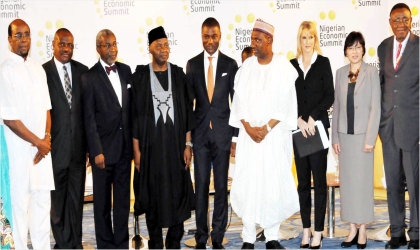
L-R: Chairman, Senate Committee on Education, Senator Uche Chukwumerije, Supervisory Minister of Education, Mr Nyesom Wike, Chairman, Nigerian Economic Summit Group, Mr Foluso Phillips, Vice President Namadi Sambo, Director-General, Nigerian Economic Summit Group, Mr Frank Nweke Jnr., Supervisory Minister of National Planning, Amb. Bashir Yuguda, Executive Director, CNBC Africa, Bronwyn Nielsen, Vice President, Human Development, World Bank, Dr Elizabeth King and Board Chairman, West African Examination Council (WAEC), Prof. Pai Obanya, at the 20th Nigerian Economic Summit in Abuja, yesterday.



Business
Jonathan, Diri, Others Laud Firm’s Milestone in Bayelsa …Says Project Will Drive Industrialisation, Create Jobs



-

 News3 days ago
RSG Targets Nine Million Residents in Mosquito Net Distribution Campaign
-

 Oil & Energy3 days ago
Aiyedatiwa Signs New Electricity Bill
-

 Oil & Energy3 days ago
NLNG Commissions Research And Innovation Centre In RSU
-

 Maritime3 days ago
Marine Minister Commends President Tinubu On NPERA Bill Assent
-

 News3 days ago
KenPoly Holds Eight Convocations, August 29
-

 News3 days ago
RSG Begins Another Phase of Projects Commissioning Today
-

 News3 days ago
RMAFC Completes Revenue Sharing Review, Proposes New Pay
-

 Maritime3 days ago
NAGAFF Petitions IGP Over Alleged Maritime Police Harassment