
Business
Fashola Signs N489.69bn Budget Into Law

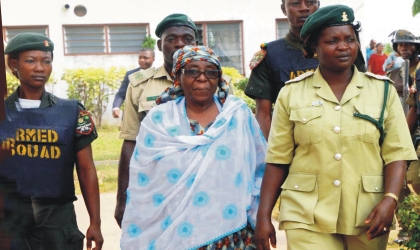
Former Oyo State Head of Service, Alhaja Kudirat Adeleke (middle), coming out of the State High Court on alleged pension fraud case in Ibadan last Friday.
Lagos State Governor Babatunde Fashola has signed the 2014 budget of N489.69 billion into law with a promise to complete all ongoing projects.
Speaking at Lagos House, Alausa, Ikeja, on Monday shortly before signing the budget into law, Fashola promised that optimum implementation of the budget would ensure and urged relevant stakeholders to get ready to commence full work in order to consolidate previous achievements.
It will be recalled that the state House of Assembly last Thursday passed the budget after several deliberations and the setback it suffered at the end of last year.
The governor said: “With this signing today, we are giving this budget the required push to ensure optimum implementation. This signing is a signal that we must get ready to commence full work.”
The 2014 budget is 3.43 per cent lower than the last year’s budget of N499.105 billion. For the first time since 2007 when Governor Fashola assumed office, the state is running a zero deficit budget surplus with N234.665 billion as Recurrent Expenditure and N255.025 billion for Capital Expenditure.
The breakdown of the budget shows that the state will spend the sum of N51.378 billion on Education; Heath gets N22.07 billion; Works and Infrastructure gets N100.12 billion and N25.67 billion was allocated to Environment.
The sum of N23.21 billion was budgeted for Agriculture and Cooperative, while N29.13 billion was allocated to Transportation. Information and Strategy gets N28.73billion; Judiciary N31.28 billion; Commerce and Industry N7.98 billion; and Women Affairs, Poverty Alleviation N1.36billion and House of Assembly takes N11.8 billion.
Speaking earlier, the Commissioner for Economic Planning and Budget, Mr. Ben Akabueze, said that the budget would assist the government to fast-track the infrastructural development in the state.
The commissioner said: “The allocation of the largest percentage of the budget to the Ministry of Works and Infrastructure was in line with the state government’s commitment to address infrastructural deficit.”
He added that allocating the largest share of the budget to the Ministry of Works and Infrastructure had always been the constant feature of the state.



-

 Business1 day ago
NERC Amends Order on Meter Tampering, Power Bypass For Discos
-

 News1 day ago
Police Arrest Nigerian, Two Others For Kidnapping In Edo
-

 Business1 day ago
Nigeria, AFC sign $1.3 billion deal to build alumina refinery
-

 Rivers1 day ago
KENPOLY Rector Promises To Prioritise Students’ Welfare
-

 Rivers1 day ago
Don, Stakeholders Urge Environmental Laws In N’Delta
-

 News1 day ago
NDLEA Arrests Ex-Councillor With 40kg Skunk, Recovers Drugs In Diapers
-
 Business1 day ago
NCDMB Signs Mgt Deal With Radisson, Edison…As Board’s 204 Rooms Hotel Open December 2026
-

 Nation2 days ago
Perm Sec Explains Success Of FGM Elimination Programme In Rivers