
News
PDP Crisis: Sacking NWC Portends Danger For Party, Secondus Warns

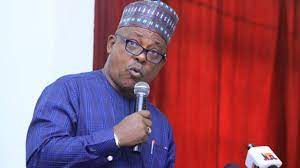
The National Chairman of the Peoples’ Democratic Party (PDP), Prince Uche Secondus, yesterday, counselled party organs to resist the temptation to do away with the current leadership of the party, noting that doing so portends ills for the party.
Secondus has had a week to forget, following persistent calls for his removal from several quarters, including some members of the National Working Committee (NWC).
Addressing members of the Board of Trustees (BoT) of the party at the Wadata Plaza national secretariat of the PDP, yesterday, Secondus acknowledged that those picking holes with his management style were entitled to do so but pleaded that misunderstandings should be resolved internally.
While reminding leaders of the party that his leadership has less than four months to go, the PDP boss called on all organs of the party to come together in the interest of the party.
He said, “Anything contrary to the smooth running of our party towards the remaining three months will not be good enough for our party. Any dislocation will cost an infraction that will result to several unknown issues that we may not be able to come out of.”
According to him, the past three years and eight months he has been in the saddle have been very peaceful, adding that the issues now rocking the party are not new.
In a veiled dig at his detractors, Secondus pointed out that forms for the various leadership positions will soon be on sale, saying, “After the main state congresses, both the public and our party are looking forward to a smooth and peaceful convention, which is coming up in December. We believe the preparation is being done in the office of the National Organizing Secretary. Soon, the schedule of events, the timetable and other things shall be presented before the Caucus, BoT, NEC and all organs of our party for action leading to the convention.”
He lauded incumbent NWC, saying for the first time, leadership was provided without rancour until recently, even as he informed the party leaders that the seven national officers who earlier in the week tendered their resignations, have been attended to.
The PDP boss further called on leaders of the party to forge a united and formidable force to dislodge the ruling All Progressives Congress (APC) in the 2023 election cycle.
Meanwhile, the Chairman of the BoT, Senator Walid Jibrin, has called on the leaders of the party to be guided by the crises, which led to the ouster of past chairmen, with a view to drawing sufficient lessons.
In his submission at the meeting, Walid bemoaned the current crisis, regretting that while Nigerians were earnestly looking up to the PDP to rescue the nation from the stranglehold of the ruling APC, the party itself was engulfed in needless squabbles.
He called on members to unite ahead of the 2023 elections, saying, “in order to achieve complete success, we must do away with any personal interest and unnecessary in-house fighting aiming at killing the objectives set by the party.”
This is even as he urged the party to take a firm stand on discipline.
“Please, let us examine why many past national chairmen did not complete their tenure successfully- Chief Audu Ogbeh, Chief Okwesilieze Nwodo, Alhaji Bamanga Tukur, Alhaji Ahmed Mua’zu, Alhaji Modu Sheriff, and now the deputy national chairman, threatening to resign,” he added, assuring that the party will come out of the current crisis stronger.
Others who attended the meeting include, immediate past Senate President, Dr Bukola Saraki, former Foreign Affairs Minister, Chief Tom Ikimi, former Minister of Special Duties and Intergovernmental Relations, Tanimu Turaki, ex-Osun State governor, Prince Olagunsoye Oyinlola, and Rivers State Governor, Chief Nyesom Wike, amongst others.
However, the Benue State Governor, Samuel Ortom, yesterday, assured Nigerians that the Peoples’ Democratic Party (PDP) would deploy its internal conflict resolution mechanism to resolve whatever disagreements there was at the national leadership level of the party.
He assured that the issue would be surmounted in no time, saying that the PDP remains the only hope for Nigerians.
The governor spoke when he received in audience a former All Progressives Congress (APC), senatorial candidate in the state, Chief Mimi Adzape-Orubibi and the chairman of the party in her area as well as the party’s executives who will formally decamp to the PDP on Saturday.
The governor said, “I want to assure Nigerians that despite the leadership challenge we have we are till together and we will resolve it soon. We may recall that even the tongue and the teeth sometimes fight but they settle.
“And so PDP is going to deploy its internal conflict resolution mechanism and we shall rise up from there because Nigerians are fed up. They are tired of being taken from the top to the button since 2015. Have you not heard what Mr President said that he was going to take Nigeria from top to bottom and he has actually done that.
“How much was the Dollar in 2015 when President Buhari took over from Goodluck Jonathan? N180. Today we are battling with over N500. Can you imagine! On security, we were battling with only Boko Haram then, but today, we have Fulani bandits, we Fulani herdsmen, we have Fulani mercenaries, we have Fulani kidnappers, we have Fulani armed robbers, we have Fulani thieves, we have Fulani AK-47. And then they will deceive us that they are tackling them.
“So, we want a leadership that will take us from bottom to top.
“I commend my sister for taking a bold step like I did in 2017. Though as a member of the ruling party, when I saw the injustice being perpetrated on our people and the inequality and the unfairness, I decided to jump ship and joined the PDP where I contested and won.
“And since I left the APC I have not regretted. APC is a party of injustice; it is a party that does not believe in the rule of law. It is a party that does not believe in democracy, equity, fairness and justice. It is a party that believes that no other Nigerian, except the Fulanis should be equal.
“We can see what they are doing already, it is a party that wants to make everybody slave but for some of us, we say no, we cannot be slaves to others.
“We believe in democracy, we believe in one Nigeria. And we believe that everyone should have freedom of speech, freedom of expression and freedom of association. Let there be equity, fairness and justice. That is what we stand for, yesterday, today and forever. We stand for equity, fairness and justice in this country for all Nigerians.
“We oppose those who think that they can impose their culture on us. Nigeria is a country of over 250 nationalities, we respect every nationality, whether you are Fulani, you are Tiv, Yoruba, Idoma, Igala, Hausa or you are Igbo or South-South, we respect you.
“For us in Benue, that’s what we respect. We oppose any culture that wants to dominate us and take over our land and give it to their people. We say no to that, we will always stand to defend our people.
“In Benue State we are committed to this and I am working closely with the people that elected me as governor of Benue State. And I stand in solidarity with them and I stand with utmost commitment to my people because democracy is about the locality.
“All politics is local. So, we remain grateful and committed to our locality, our locality first before outside. And so, we are going to resist any attempt to impose a different culture on us and we are not going to impose our culture on other people.
“So, I commend Mimi and all of you who are here to pay solidarity with her and to assure you that I will visit your local government on Saturday to witness the formal decamping of our illustrious daughter.”
Similarly, the former Senate President, Dr Bukola Saraki, assured Nigerians that all efforts would be put in place to strengthen PDP NWC within 72hours.
The PDP national leader, explained that PDP was very important to Nigerians; hence the need to resolve internal crisis.
Saraki’s assurance was after the PDP Board of Trustees (BoT), had met over the crisis in the party.
During the meeting, it was agreed that the members of the constituted committee are to meet within the next 48 to 72hours to decide PDP’s direction.
But Saraki, in a series of tweets wrote, “Earlier today, the PDP Board of Trustees resolved to set up a committee that will look into the issues that are affecting the party.
“This committee, which includes governors, members of the BoT, members of the national assembly, members of the National Working Committee (NWC), former governors, and former ministers of the party, is expected to meet within the next 48 to 72hours to determine the direction of the party.
“Nigerians should be rest assured that as a party, we fully understand the importance of our platform to Nigerians. This is why we will continue to do everything that we can to strengthen our party in the best interest of all Nigerians.”



The State Coordinator of the forum, Archbishop Lucky Aroh, made this known during a breakfast and thanksgiving meeting held in Port Harcourt, where leaders gathered to pray for the stability of the party and the safety of its candidates ahead of the 2027 general elections.According to him, the meeting was convened to seek divine intervention for peace, unity, and security among APC candidates across Rivers State.
“Today we are praying for APC stability in Rivers State and the security of our candidates that have been elected to contest the 2027 elections. It is a breakfast meeting,” Aroh said.
He further expressed optimism that the party’s candidates would not disappoint the people if entrusted with leadership responsibilities.
“They will not fail when elected into office. We are here as fathers of the land to let them know, and I must tell you the truth that these are the authentic people that will do well in Rivers State,” he added.
Speaking earlier, the National Chairman of the forum, Professor Olanrewaju Abraham, commended the Rivers State chapter for organizing the programme, noting that the national body of the forum believes strongly in the power of prayer.
He stated that political leadership provides an opportunity to influence society positively, including advancing moral and spiritual values, while expressing confidence that APC candidates at all levels would emerge victorious in the upcoming elections.
Also speaking, the Rivers State Women Leader of the APC, Hon. Darling Amadi, praised the forum for its commitment to prayers for peace, stability, and the protection of party candidates.
Represented by the Deputy Women Leader of the party in the state, she described the initiative as commendable and urged other political and support groups within the party to emulate the gesture in promoting unity and stability.
By: John Bibor, Menebe Emmanuel & Fortune Paibi
The colourful celebration took place at the Port Harcourt Golf Club, where friends, associates, and well-wishers converged to pay tribute to the revered elder statesman.
Chairman of the occasion, High Chief (Dr.) Ikenna Okafor, described the celebrant as a detribalised Nigerian whose generosity, humility, and commitment to humanity have earned him admiration across different communities and backgrounds.
According to Dr. Okafor, Pa Osagwe-Ogo’s impact on society and the development of his community remains unparalleled. He noted that members of the golfing community are proud to be associated with a father figure who consistently promotes the welfare and well-being of those around him.
He further stated that the history and growth of the Port Harcourt Golf Club cannot be told without acknowledging the significant role played by the celebrant, whose wisdom, encouragement, and leadership have helped sustain the club over the years.
“We are here to celebrate a man who has impacted humanity positively, a peace-loving individual and an epitome of hope for the younger generation. We pray to emulate his virtues. Today, we celebrate a bridge-builder, a trailblazer, and an iconic leader whose life continues to inspire many,” Dr. Okafor said.
He expressed delight at the large turnout of guests from various walks of life, describing it as a testament to the respect and affection Pa Osagwe-Ogo commands within and beyond Rivers State.
In his response, the celebrant, Pa Anthony Osagwe-Ogo, expressed profound gratitude to God for preserving his life and granting him the privilege of attaining the milestone age of 70.
He also thanked members of the Port Harcourt Golf Club, family members, friends, and associates for identifying with him during the celebration and for their unwavering support over the years.
The event featured the cutting of the birthday cake, presentation of awards to deserving members of the club, goodwill messages, and moments of celebration among guests.
The ceremony was attended by notable personalities from the business community, the golfing fraternity, and other sectors, all of whom joined in celebrating the life and legacy of the respected elder statesman.
The awards, which formed part of activities marking Nigeria’s Democracy Day on June 12, were formally presented on Tuesday at the Ministry of Information and Communications in Port Harcourt.
Presenting the awards was Hon. Abdul Hameed Oladipupo Alli, popularly known as “Mr. Nigeria,” Publisher of Asiwaju Trumpet Magazine and Achievers World International Magazine.
Governor Fubara was recognised for his efforts in sustaining peace, stability, and a conducive political atmospherJohn Bibor / Menebe Emmanuel / Fortune Paibie in Rivers State. The organisers noted that his administration has fostered harmony and strengthened civic participation across the state.
Dr. Sirawoo, on the other hand, was honoured for his exemplary administrative leadership and significant contributions to effective information management within the Ministry of Information and Communications.
Representing Dr. Sirawoo at the presentation ceremony, Dr. Christian Davies received the award on his behalf and expressed gratitude for the recognition. He described the honour as a reflection of Dr. Sirawoo’s unwavering commitment to professionalism, excellence, and dedicated public service.
Dr. Davies assured the organisers that the award would be formally conveyed to the Permanent Secretary.
The event also featured the presentation of commemorative publications highlighting major governance and civic milestones in Rivers State, including Easter celebrations, Workers’ Day activities, the Governor’s third anniversary in office, and Democracy Day programmes.
Organisers of the awards commended the Rivers State administration for what they described as sustained peace, political stability, and improved civic engagement, noting that these achievements have contributed significantly to the state’s continued development.
By: Jessica Sambol