
Featured
Buhari Seeks US Assistance To End Insecurity

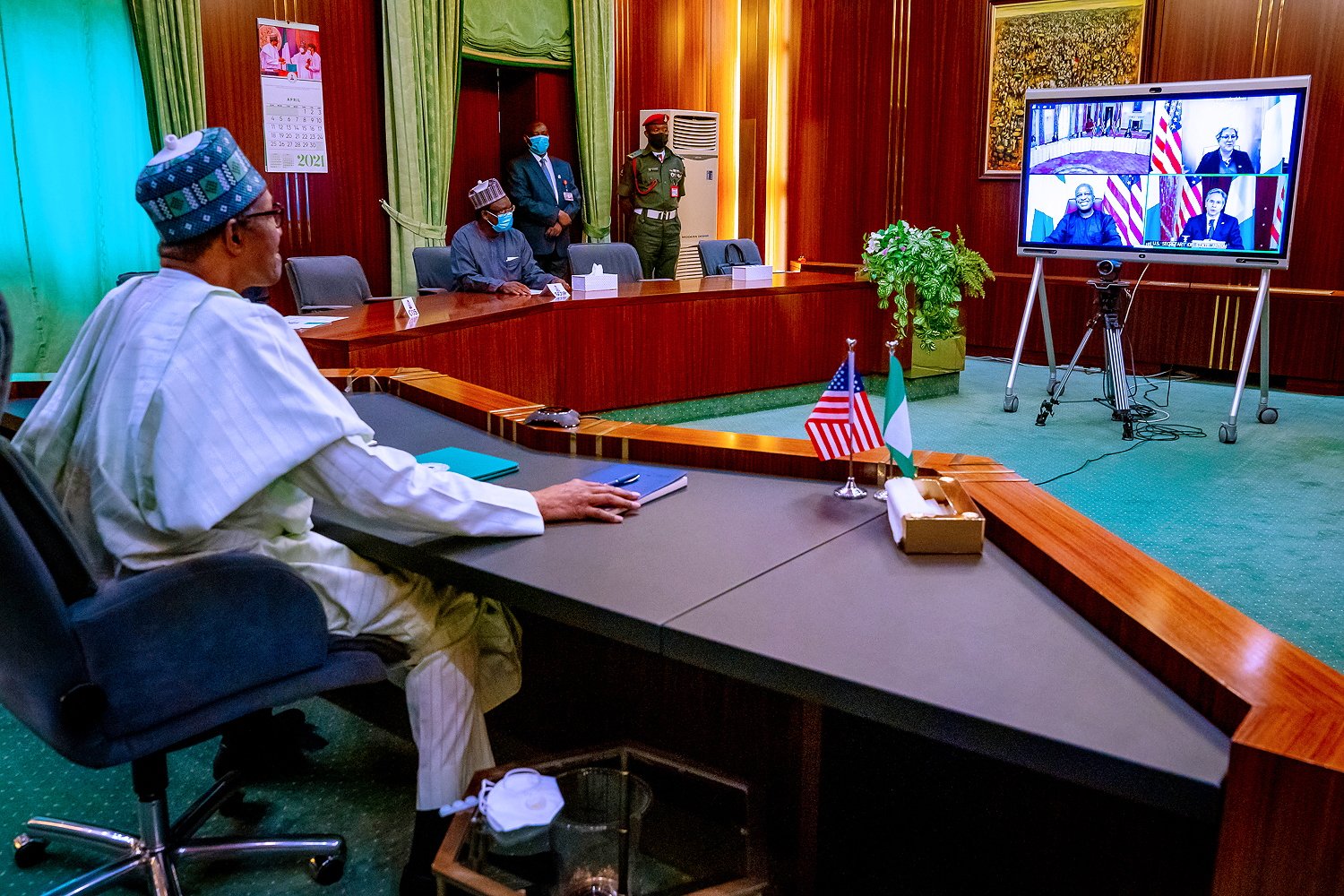
President Muhammadu Buhari yesterday stressed the need for the support of the United States and other “important and strategic partners” in combating the security challenges facing Nigeria.
He said the support was necessary because the consequences of insecurity in Nigeria would affect all nations.
According to a statement by his Special Adviser on Media and Publicity, Femi Adesina, the President made the call during a virtual meeting with the US Secretary of State, Mr Anthony Blinken.
The statement was titled, ‘Security: President Buhari asks US to relocate headquarters of AFRICOM to Africa, warns of likely spill over’.
Recall that Nobel Laureate, Prof Wole Soyinka, had while lamenting the nation’s security situation on Saturday, called on the President to seek help.
Apart from seeking the assistance of the US, according to the Presidency’s statement, Buhari also called on the US to consider relocating US Africa Command from Stuttgart, Germany, to Africa, nearer the Theatre of Operation.
He also admonished the international community to support Nigeria and the sub-region in tackling growing security challenges to avoid spill over.
Buhari said AFRICOM, which partners with countries to counter transnational threats, should be relocated to Africa to strengthen ongoing efforts to check the security situation, with likely effect on other nations.
He said, “The security challenges in Nigeria remain of great concern to us and impacted more negatively, by existing complex negative pressures in the Sahel, Central and West Africa, as well as the Lake Chad Region.”
“Compounded as the situation remains, Nigeria and her security forces remain resolutely committed to containing them and addressing their root causes.
“The support of important and strategic partners like United States cannot be overstated as the consequences of insecurity will affect all nations hence the imperative for concerted cooperation and collaboration of all nations to overcome these challenges.
“In this connection, and considering the growing security challenges in West and Central Africa, Gulf of Guinea, Lake Chad region and the Sahel, weighing heavily on Africa, it underscores the need for the United States to consider re-locating AFRICOM Headquarters from Stuttgart, Germany to Africa and near the Theatre of Operation.”
Buhari said Nigeria would enhance collaborations in all forms, with friends and strategic partners, to work together for greater security for all, which remain the most significant condition for overcoming the existential challenges.
He congratulated Blinken on his appointment by President Joe Biden, and commended US for the decision to repeal the immigration restriction known as the “Muslim ban’’, re-joining the World Health Organisation and Paris Agreement on Climate Change.
He added, “Nigeria attaches great importance to its relations with the United States. Let me in this connection express appreciation to President Joe Biden for his welcome and reaching decision to repeal the Immigration restriction known as the ‘Muslim ban’ on travel and visas for citizens predominantly from Muslim nations and African countries, including Nigeria.
“I also wish to congratulate the United States for re-joining the World Health Organization and Paris Agreement on Climate Change. The leadership of the United States in these two organisations is crucial for international community.
“This action is a demonstration of the United States commitment in championing and supporting international organisations with the aim to build a better world for all.”
Buhari noted that Nigeria remains resolute in her commitment to supporting global efforts as enshrined in the Paris Agreement on Climate Change, which seeks to limit global warming and reduce greenhouse gas emissions.
According to the President, the convening of the Climate Change Summit last week by President Biden was a strong indication of the renewed interest of the United States to the Paris Agreement.
“I would like to extend our goodwill message to President Joe Biden and his Administration. May I also thank you for initiating this meeting, which I am confident, given your background and current position, you will use to promote the existing bilateral relations between our two countries,’’ the President said.
The statement also quoted the Secretary of State as saying that he was pleased to make Nigeria part of his “first virtual visit to Africa,” noting that Nigeria and the US share a lot in bilateral issues.
He added that he would be delighted to build on the foundation that was laid between the two countries over 60 years ago, disclosing that areas of discussion with Nigeria would include “how to build our economies back after the Covid-19 pandemic, security for vulnerable communities, and climate issues.”
In his response, the Secretary of State, Antony J. Blinken, said, that the US will continue the strengthen joint efforts to counter terrorism and insecurity, strengthen health systems, support democratic institutions, bolster economic growth, advance gender equality, and boost bilateral trade between the United States and Nigeria.
On U.S.-Nigeria Relations, he said, “With Africa’s largest population, democracy, and economy, Nigeria is one of our most important partners on the continent.
“The year 2020 served as an historical benchmark, as Nigerians reflected on the opportunities and challenges the country faces while marking its 60th anniversary of independence and bilateral relations with the United States.
“Nigeria is the largest source of immigrants from Africa to the United States, with more than 500,000 Nigerian-born American citizens and legal residents in the U.S”.
On Pandemic Response and Health Diplomacy, Blinken noted that, “The United States and Nigeria have collaborated closely to combat the Covid-19 pandemic. More than 60 interagency members from the U.S. Mission worked side-by-side with Nigerian counterparts on the Presidential Task Force on Covid-19 to plan and respond to the disease.
“The United States has contributed more than $73million in Covid-related equipment and technical assistance. This includes the delivery of a mobile field hospital, 200 ventilators, epidemiological Covid detection surveys, personal protective equipment, provision of rapid response teams, training of over 200,000 military and civilian personnel on Covid-19 control measures, and technology transfer for virtual training.
“Ongoing U.S. health programs reach more than 60 million Nigerians with lifesaving services, including by training public health workers and improving access to quality medicines, vaccines, medical facilities, and reproductive health materials.
“The President’s Emergency Plan for AIDS Relief (PEPFAR) has worked with the Government of Nigeria since 2004 to provide HIV and TB care and treatment services, with a momentum propelling Nigeria toward epidemic control within two years. As of December 2020, more than 1.2 million people receive PEPFAR-supported HIV treatment, and our partners placed 350,000 new patients on lifesaving antiretrovirals despite the Covid-19 pandemic.
“Since 1997, the United States has directly supported polio surveillance and polio campaigns that reached nearly all of Nigeria’s 33 million children under 5 years of age, contributing to Nigeria being certified as wild polio-virus free in 2020.
“Since 2011, the President’s Malaria Initiative has procured more than 60 million insecticide-treated nets, 46 million rapid diagnostic test kits, 87 million treatment courses for malaria, and 20 million doses of malaria prophylaxis during pregnancy, as part of over $690million contributed to malaria control in Nigeria.
“Nigeria is a key U.S. partner in the Global Health Security Agenda (GHSA). The mission approved $3.4million in FY 2020 GHSA funding for capacity building programs to strengthen zoonotic surveillance labs, infection-prevention control, antimicrobial resistance, and risk communication”.
On Bilateral Economic Engagement, the secretary of state, said, “Nigeria is our second largest trading partner in Africa; two-way trade between our nations expanded to over $10billion in 2019. The United States is proud to be one of the largest foreign investors in Nigeria. S. support for economic growth includes funding $8.5million in feasibility studies and technical assistance in 2020-2021, extending loan guarantees worth up to $80million, and coordinating development finance in important sectors such as agriculture, healthcare, renewable energy, and information and communication technology. These activities support bilateral trade and investment ties while building more modern and sustainable infrastructure across Nigeria.
“Through Feed the Future, the United States supports private sector expansion of markets, as well as the introduction of techniques to increase productivity, strengthen resilience, and improve nutrition for more than two million farmers and their communities.
“Since its launch in 2013, Power Africa has mobilized $4.3billion in financing and connected nearly two million households and businesses in Nigeria. Power Africa helps to attract private sector investment and supports the rollout of both on-grid and renewable off-grid electricity connections in order to spur economic growth and reduce poverty”.
Speaking on Educational and Cultural Exchanges, Blinken said, “With over 100,000 travelers to the United States each year, Nigerians boost American businesses, colleges, and universities. There are over 8,800 education and exchange program alumni from Nigeria and the United States.
“Nigeria sends more students to American colleges and universities than any other country in Africa and is the eleventh largest source worldwide of international students to the United States. In Academic Year 2019-2020, a record-breaking number of nearly 14,000 Nigerians pursued U.S. graduate and undergraduate degrees, bringing an estimated $501 million to communities across America. In 2020, advisees of EducationUSA services received scholarships worth $28million.
“The United States provided more than 9 million teacher’s guides and books in five of Nigeria’s most widely spoken languages to advance early grade reading”.
On peace and security, he said, “North-East Nigeria has become one of the world’s most challenging and complex humanitarian crises. The United States is the largest humanitarian donor in response to the crisis, providing $1.45billion since 2015 and supporting almost two million conflict-affected households.
“Since 2017, Department of State and Department of Defense security assistance for Nigeria totals approximately $650million, including $500million in Foreign Military Sales. The United States looks forward to delivering twelve A-29 Super Tucano aircraft this year. “Nigeria also has one of the largest International Military-Education and Training (IMET) programs in Sub-Saharan Africa.
“The United States promotes strong and broad collaboration between government and civil society at all levels, including civil society organizations led by women and members of marginalized groups. We also support the establishment of robust early warning systems to identify and mitigate drivers of communal conflict and violence in vulnerable states.
“We provide technical assistance, and train and equip law enforcement and judiciary professionals to address a wide range of priorities, ranging from stopping banditry to protecting intellectual property rights to more effectively addressing trafficking in persons and gender-based violence. Law enforcement programming focuses on building capacity for civilian security actors, particularly the Nigeria Police Force.
“As the Gulf of Guinea has become the world’s hotspot for piracy and armed robbery at sea, Nigeria has stepped up efforts to stem this problem, including a new initiative, Deep Blue, consisting of vessels, shoreside infrastructure, and personnel that can be dispatched to respond to piracy incidents. It is expected to become operational by mid-2021. U.S. efforts to stem piracy in the Gulf of Guinea help to strengthen maritime governance, enable the development of sustainable, maritime-based economies, and protect international maritime commerce”, Blinken added.

Featured
JUNE 12: Democracy Remains Nigeria’s Strongest Path To Unity, Progress, Says Fubara ….Extols Abiola, Wife


Governor of Rivers State, Sir Siminalayi Fubara, has reaffirmed that democracy remains the most effective system of government for Nigeria, given the country’s rich diversity of ethnic, religious, and cultural identities.
In a goodwill message to Nigerians on the occasion of the 2026 Democracy Day celebration, Governor Fubara said June 12 represents far more than a historic date; as it embodies the enduring struggle, sacrifice, and collective aspiration of Nigerians for freedom, justice, and representative governance.
The Governor extended warm felicitations to Nigerians at home and in the Diaspora, paying tribute to the heroes and heroines of the democratic struggle, particularly Chief MKO Abiola, his wife, Kudirat Abiola, and countless others whose courage and sacrifices helped secure the democratic freedoms Nigerians enjoy today.
According to him, “June 12 is a reminder of the price paid for the democracy we enjoy today. The sacrifices made by Chief MKO Abiola, Kudirat Abiola, and many other patriots who laid the foundation for the democratic journey we continue to enjoy today. Their commitment to the principle that power must ultimately reside with the people remains a source of inspiration for every generation of Nigerians.”
Governor Fubara noted that thirty-three years after the historic June 12, 1993 election, Nigeria’s democratic experiment has continued to evolve despite challenges and setbacks.
“Our democratic journey has not been without difficulties, but the resilience of our institutions and the determination of our people have kept the nation moving forward. The ability to express differing opinions, engage in constructive debate, and peacefully choose leaders through the ballot remains one of the greatest achievements of our nation,” he said.
Governor Fubara stressed that democracy provides the best framework for managing Nigeria’s diversity and transforming it into a source of national strength.
“Nigeria’s diversity should never be seen as a weakness. Properly harnessed, it is our greatest asset. Democracy offers us the opportunity to build consensus, promote inclusion, strengthen national unity, and create the conditions for sustainable development and shared prosperity,” he said.
Governor Fubara commended President Bola Ahmed Tinubu, for his commitment to the Renewed Hope Agenda and ongoing efforts aimed at economic revitalization, strengthening security, and deepening democratic institutions across the country.
He reiterated the readiness of Rivers State to continue partnering with the Federal Government in advancing policies and programmes that improve the lives of citizens through infrastructure development, job creation, enhanced security, quality education, healthcare delivery, and good governance.
The Governor further called on Nigerians, regardless of political affiliation, ethnic background, or religious belief, to use the occasion of Democracy Day to renew their commitment to the Nigerian project and the ideals that underpin democratic governance.
“Democracy must not be viewed merely as a periodic electoral exercise. It must be reflected in our daily commitment to accountability, transparency, tolerance, justice, respect for the rule of law, and responsible leadership. As citizens and leaders, we all share a collective responsibility to strengthen our democracy and build a nation that future generations will be proud to inherit,” he said.
Governor Fubara expressed optimism about Nigeria’s future, urging citizens to remain united, hopeful, and committed to the values of peace, dialogue, and national development.
“Together, we can build a stronger, more inclusive, and more prosperous Nigeria where every citizen has the opportunity to thrive and contribute meaningfully to national progress,” he said.

Governor of Rivers State, Sir Siminalayi Fubara, has reaffirmed the unwavering commitment of his administration to peace, unity, security, and inclusive development as Rivers State marked its 59th anniversary, last Wednesday.
In a goodwill message issued on Wednesday to commemorate the anniversary, Governor Fubara stated that despite the challenges faced over the years, the people of Rivers State have continued to demonstrate resilience, strength, and an enduring spirit of unity that has sustained the state since its creation.
The Governor noted that the strong bond of brotherhood among the various ethnic nationalities of the state, including the Ijaw, Ikwerre, Ogoni, Etche, Ekpeye, Andoni, Kalabari, and others, remains one of Rivers State’s greatest strengths and a critical foundation for peace, stability, and progress.
He further observed that Rivers State has remained a major driver of Nigeria’s economy for decades, not only because of its abundant oil and gas resources, but also because of the exceptional contributions of its people across diverse sectors including academia, jurisprudence, business, entertainment, public service, and sports.
Governor Fubara assured the people that his administration will continue to prioritize policies and programmes that promote peace, protect lives and property, and expand development across all parts of the state. He emphasized that governance must be people centered and impactful, with equal attention given to every Local Government Area of the state.
The Governor also paid tribute to the elders and founding leaders of the state for preserving the spirit of unity and coexistence over the years, while urging the youths to remain hopeful, responsible, and actively committed to building a greater Rivers State through innovation, hard work, and patriotism.
He equally acknowledged the invaluable role of women in strengthening families, communities, and society, describing them as indispensable partners in the continued growth and stability of the state.
Governor Fubara called on all Rivers people to use the occasion of the anniversary as a moment of reflection and renewed commitment to peaceful coexistence, mutual respect, dialogue, and collective progress, stressing that the unity and future of Rivers State must always rise above personal interests and political differences.
Rivers State was created on May 27, 1967, by General Yakubu Gowon.

-

 Niger Delta3 days ago
Warri Airport Manager Disputes Air Peace Bird Strike Claim
-

 News3 days ago
Nigeria Won’t Surrender Any Territory To Criminals -Tinubu
-

 News3 days ago
FG Begins Trial Of Over 600 Terrorism Suspects
-

 Rivers3 days ago
79th IAUE Inaugural Lecture: Prof Anero Advoctes Tuition-Free Education For Children
-

 Politics3 days ago
Parties’ Deregistration: How Justice Lifu Overruled Appeal Court Justices
-

 Politics3 days ago
ADC: Okonkwo Rejects Amaechi As Presidential Running Mate, Withdraws Support
-

 Politics3 days ago
2027: Tinubu’s Projects Give APC Edge In South East – Yilwatda
-

 News3 days ago
Rivers Judges Commence Annual Vacation, July 20