
Politics
Obasanjo’s Letter

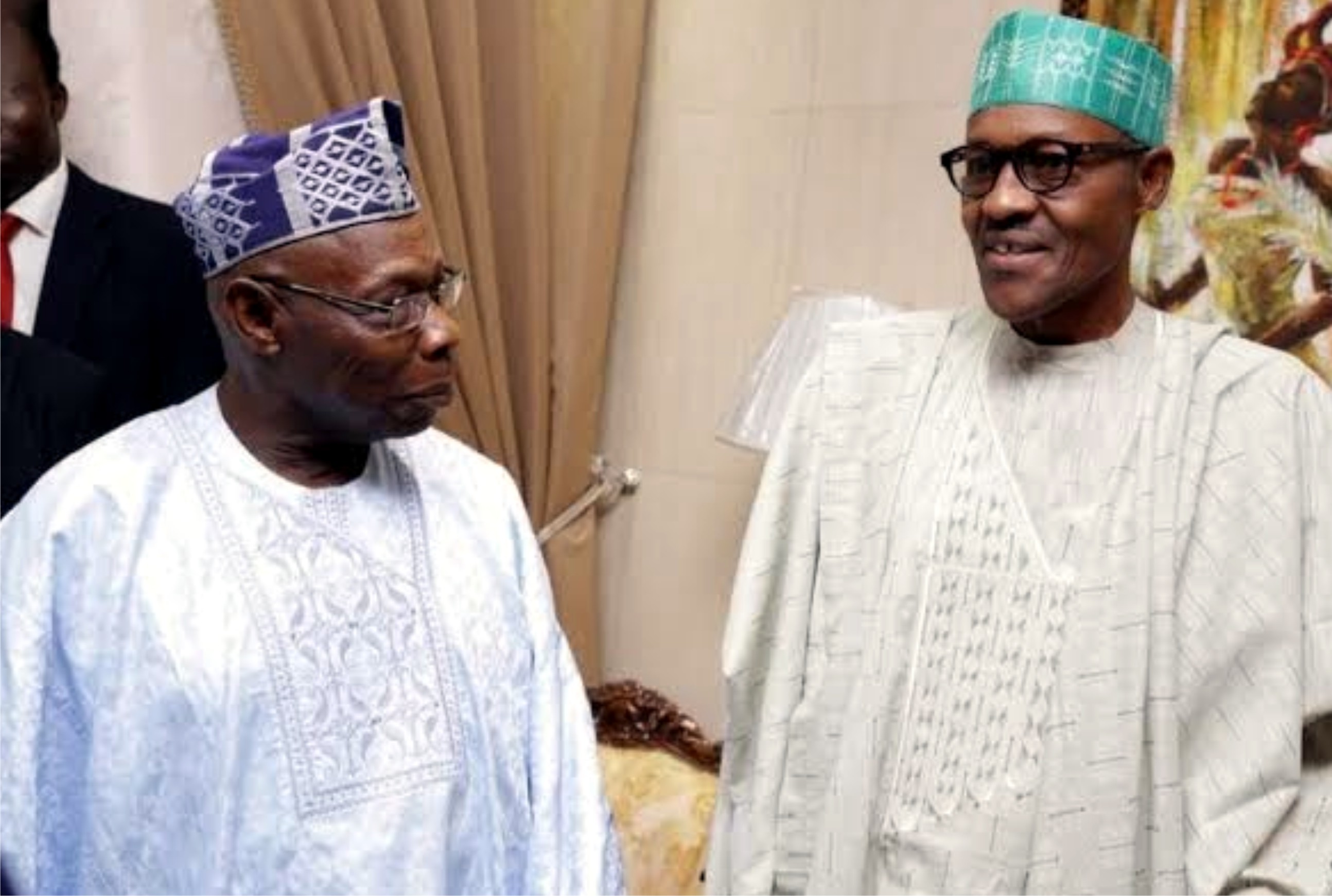
There is this African adage that says, “A dancer does not see his back”. This assertion is apt as it is the spectators that judge the dancing skills of a dancer and could, when asked to make a comment, point out the mistakes the dancer makes.
In essence, dance steps follow a drum beat or musical beat and when a dancer performs well, follows the correct rhythm, he or she is commended for a job well done. Also, in the political realm, the accolades or criticisms follow the same pattern as it takes only the professional to see the fault in any political setup and offers good advice to those at the helm of affairs.
Just this week, former President, Chief Olusegun Obasanjo sent an open letter to incumbent President Muhammadu Buhari on the state of the nation where he expressed worry over the security situation and other lapses of the administration. This is not the first time Chief Obasanjo has done so. During the presidency of the late Alhaji Shehu Shagari, he counselled the former President and hauled abuses and condemnation at him. Under Ibrahim Babangida, he did same and the reaction was not different under Yar Adua and Dr Goodluck Jonathan. His pen danced and danced and the reward he got was not different.
Chief Obasanjo two years back also wrote a letter to the same President Buhari on his handling of the ship of the nation but was criticised not minding the fact that it was the same Obasanjo that Buhari met to seek his support for the office of the Presidency in 2015.
That notwithstanding, advice is never a curse. That is why those who really want to succeed in life brook criticisms and never hits back at those who give them useful advice. But to say Chief Obasanjo who fought in Nigerian Civil War and even saw to the surrender of Biafra is an unpatriotic person is really ludicrous and laughable.
Obasanjo has paid his dues and most of his observations are done without malice and it is only a dumb-witted person, people who don’t love the country that will see nothing good in his observations and advice.
The issue is not that Obasanjo is a saint or knows it all, but the stark reality is that Nigerians are in trouble and probably have entered what motor park touts call a ‘one chance journey.”
Of all the points or observations made by the former president which really touch the fabric of the country’s future is the issue of Nigerians gradually losing confidence in the ability of the Buhari administration to fight criminality perpetrated by herdsmen, Boko Haram and kidnappers in virtually every part of the country.
Today, even the wealthy in the cities and the poor in the rural areas are afraid for their lives, our houses have become fortresses and our streets in the urban areas are now gated. There is no week that we don’t hear of killings and kidnapping on our waterways and highways which have become death traps to travellers’ and commuters. In short, no place is safe anymore in the country.
Basically, Obasanjo’s letter raises about 11 salient points which include the need for a national dialogue to discuss the way forward and suggested that all former presidents, heads of state, heads of security , governors (both present and past) and other major stakeholders in the country, including council chairmen be invited to deliberate on the issues confronting the country.
Another point he raised was that the government must be an inclusive one. This observation is quite apt because of serious lopsidedness in the composition of the country’s security structure and other critical appointments which show that they favour only one section of the country and people of a similar religious affiliation.
This to some Nigerians shows that the present administration is the most sectionally -minded government Nigeria has ever had. That even after the end of the Civil War under General Yakubu Gowon, Nigeria was a better place in terms of appointment of people to positions of trust.
The advice did not come as a surprise to all who have been following the trend in the country and for Chief Olusegun Obasanjo to use his pen once again to sound a note of caution on the nation’s march into the future calls for concern. According to him, it seems Nigeria has been handed over to a bunch of criminals that even the Chief of Army Staff seems confused and is blaming the spate of insecurity on sabotage and lack of commitment by personnel of the Armed Forces. Is it not the same government that said it has crushed Boko Haram? How come this confession that it is fighting the war against criminality suddenly overwhelming it?
For Obasanjo to say the security issue is hitting the very foundation of our existence is not far from the truth as herdsmen have become a threat to the corporate existence of the country, and if left unchecked, might eventually result in massive inter-tribal war on a national scale as acts of retributive justice may lead to ethnic cleansing as it happened in Rwanda in 1994. So to curb any upheaval of such nature, the president must start thinking of solution and stop living in a cocoon where he sees nothing, hears nothing and is not even aware that his security chiefs are also doing nothing.
It is quite sad that in Nigeria, we are never always truthful to those who occupy the office of the president or governor. That is why according to the late music maestro, Fela Anikulapo-Kuti, “Nigeria is a big blind country”. A country where advice is seen as a crime with those who render good advice hounded, called nasty names and even threatened with arrest or even arrested for disturbing the peace of the nation. To be truthful, President Muhammadu Buhari has failed in all facets of governance. Under his watch between June 2018 to May 2019, over 7,253 Nigerians have been killed. The figure released by Nigeria Security Trackers (NST), a project of the Council on Foreign Relations Africa, consists of those killed by Boko Haram and Islamic State in the Northern part of the country, herdsmen and extra-judicial killings by the military.
During the time frame according to the report, Borno and Zamfara recorded the highest number of killings, contributing to 49% of the total deaths within the last one year. Borno recorded 2,384 killings while 1, 157 people were killed in Zamfara. Other states that make up the most affected states are Kaduna, 540, Benue 330, Adamawa 303, Yobe 264, Taraba 176, Plateau 166, Rivers 160 and Katsina, the President home state, with 127 deaths.
One of the factors that ensured President Buhari’s success in the 2015 election was the issue of insecurity and most Nigerians thoughts that with his military background he would do a better job in the fight against criminality, but today, the tale is different as things are worse. States which never experienced bandits before are now bearing the brunt of banditry, robbery and kidnapping. States like Sokoto, Kebbi in the north and Ekiti, Oyo and Kogi axis are now seeing people killed on the highways, homes and farms. Not just there alone, farmers both in the South-South and South-East regions are even not faring better.
The situation is so bad that even elderly women are reportedly raped in their farms, killed or maimed and yet nothing is done to arrest and prosecute the culprits.
To Obasanjo, this is due to poor management of or mismanagement of our diversity, and when the silence by the victims becomes too much, something might set up a spark which might result in unforeseen circumstance. The earlier we tackle this malady, the better for the future of the country. And the only way forward is for President Muhammadu Buhari to be presidential in his actions by abiding by his oath of office to ensure the safety of lives and property of Nigerians and obey the constitution.
A country can survive one civil war but might not survive a second one which also involves ethno-religious differences.
Tonye Ikiroma-Owiye


The Commission disclosed the figure in its weekly update for week 14 of the second phase of the exercise, which ended on Friday, April 17, 2026.
According to the breakdown, 2,259,288 Nigerians completed their registration through the online pre-registration portal, while 1,489,416 finalized their registration physically at designated centres nationwide.
INEC noted that the figures remain preliminary and are subject to further verification and data cleaning processes to ensure accuracy ahead of the consolidation of the national voter register.
With the conclusion of the registration phase, the Commission has now shifted focus to the display of the Register of Voters for Claims and Objections, a statutory stage aimed at strengthening the credibility and integrity of the voters register.
The display exercise is scheduled to hold from April 29 to May 5, 2026, across designated centres nationwide, providing citizens the opportunity to verify their details and raise objections where necessary.
The Commission urged all registered voters from the concluded phase to take advantage of the exercise to confirm the accuracy of their information and assist in identifying ineligible entries, including duplicate registrations, deceased persons, and non-citizens.
INEC explained that the Continuous Voter Registration exercise is being conducted in phases, with the first phase running from August 18 to December 10, 2025, while the second phase commenced on January 5, 2026 and ended on April 17, 2026.
The Commission further stated that the date for the commencement of the third phase will be announced in due course.
Reaffirming its commitment to credible elections, INEC stressed that maintaining a clean and accurate voter register remains central to ensuring free, fair, and transparent electoral processes in Nigeria.
The Executive Director of IPC, Mr Lanre Arogundade, informed the journalists that the dialogue was sponsored by the European Union, under the auspices of the EU-Support to Democratic Governance in Nigeria (EU-SDGN II), Component 4: Support to Media.
According to the veteran media practitioner, the programme is aimed at strengthening the capacity of the media to promote credible elections through factual, accurate and fair reporting.
He explained that the programme is part of a broader five-year intervention designed to support democratic governance and improve the role of the media in Nigeria’s electoral process, stressing that fact-checking and inclusive reporting are critical responsibilities for journalists, especially during electioneering.
He described the media as a central role agent with regard to upholding transparency and accountability in the democratic process.
A resource person and Director of Journalism Clinic, Lagos, Mr Taiwo Obe, enjoined journalists to embrace the evolving technology so that they would not be in the backwaters in the practice of the profession.
He advised journalists not to downplay Artificial Intelligence (AI) in their bid to remain relevant in the media environment by being abreast of the changing patterns of news consumption.
The journalism teacher explained that with digital transformation of the media industry, it had become imperative for journalists to constantly upgrade and update their skills, stressing the fundamental place of attitude and self-development and underscored the dynamic nature of media consumption in the digital age, thereby compelling journalists to embrace tools and platforms, but without much reliance on AI.
In his lecture, a Professor of Mass Communication at the Federal University Oye-Ekiti (FUOYE), Adebola Aderibigbe, advised journalists in Ekiti State to ensure that coverage of the upcoming governorship poll is issue-based rather than dwelling on personalities.
He added that sensationalism should not occupy the front-burner of any discussions concerning the 2026 election, admonishing that sustenance of democracy is anchored on responsible journalism.
”Journalists must prioritise accuracy, fairness and balance in their reports by verifying facts and giving all parties involved in political matters the opportunity to present their views”, he said.
According to the university don, the election will not be defined by personalities, but by issues. ”Let issues be the pivotal ring upon which every discussion should be made. Sensationalisation of issues should not be the bedrock of discussions in the 2026 election”, he added.
“Do not hear from Party A without hearing from Party B, otherwise the report will be skewed to one side and once issues of elections are skewed, problems will naturally arise”, he stressed.