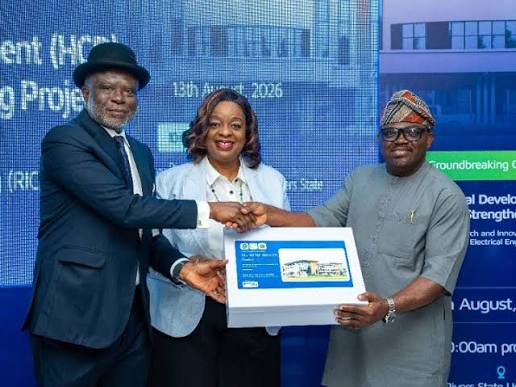
The Nigeria Liquified Natural Gas (NLNG) has launched the Research and Innovation Centre for Computer and Electrical Engineering (RICCEE), in the Rivers State University, a major research and development initiative jointly promoted by Nigeria LNG Limited (NLNG) and the Nigerian Content Development and Monitoring Board (NCDMB).
The project, valued at US$6.2 million, is being implemented under NLNG’s Human Capacity Development (HCD) Plan and forms part of the NCDMB Human Capital Development Institutional Strengthening Programme.
The centre is designed to strengthen the university’s capacity for advanced, industry-relevant research, specialised training, technology development and practical problem-solving in computer, electrical and electronics engineering.
The initiative is expected to promote industry-focused research and develop innovative solutions to operational challenges confronting Nigeria’s energy and industrial sectors.
The facility would be developed on approximately 9,336 square metres of land within Rivers State University and will comprise a three-storey building of more than 9,000 square metres, containing 18 specialised laboratories.
The laboratories would include facilities for Electronics and Signal Processing, Robotics and Embedded Systems, Software Engineering and Digital Forensics and Cybersecurity as well as provide offices, storage areas and technical administration spaces to support research, teaching and equipment management.
The building would incorporate sustainability features, including solar energy provisions, energy-efficient lighting and environmentally responsible systems designed to reduce operating costs and support reliable research activities.
A US$1.2 million Professorial Chair would also be established as part of the initiative to support advanced research, academic leadership, and industry collaboration.
Speaking at the groundbreaking ceremony, last Thursday, the Managing Director and Chief Executive Officer of NLNG, Adeleye Falade, who was represented by Dr Sophia Horsfall, General Manager, External Relations and Sustainable Development of NLNG, described the new engineering facility as more than infrastructure, noting that it would serve as a hub for equipping students, lecturers and researchers with the tools required for practical learning, applied research and innovation in computer, electrical and electronics engineering.
Represented by the General Manager, External Relations and Sustainable Development, NLNG, Sophia Horsfall, Falade stated that the centre would strengthen collaboration between academia and industry and ensure that research outcomes from Rivers State University directly address operational and societal challenges facing Nigeria.
He explained that the project is aimed at improving the capacity of institutions of learning through upgraded infrastructure, modern research facilities, technical equipment and industry-aligned training programmes that extend human capital development beyond the classroom.
According to him, the centre would help bridge the gap between academic knowledge and practical industry requirements by enabling researchers and professionals to collaborate on innovations with commercial and developmental relevance.
Falade emphasised that while infrastructure is important, people remain the greatest investment, noting that education delivers the highest return by building confidence, competence and capacity for national development.
He further announced that NLNG’s Research and Development Implementation Consultancy would be based at the centre upon completion adding that the consultancy would support the development of a robust research and development framework in line with the Nigerian Oil and Gas Industry Content Development Act, 2010 and facilitate commercially viable, industry-relevant research in partnership with selected tertiary institutions.
Falade commended the Nigerian Content Development and Monitoring Board (NCDMB) for its leadership in bringing industry and academia together and reaffirmed NLNG’s commitment to sustainable human capital development and indigenous technological advancement.
On his part, the Executive Secretary of NCDMB, Engr. Felix Omatsola Ogbe, who was represented by the Director, Capacity Building Directorate, Engr. Abayomi Bamidele, described the groundbreaking ceremony as a significant milestone in the implementation of the Board’s Human Capital Development objectives.
Ogbe confirmed that NCDMB is fully aligned with NLNG in the implementation of the RICCEE project and would work closely with all stakeholders to ensure its successful execution and completion, commending the NLNG for its commitment to the project.
He explained that the project forms part of NCDMB’s Institutional Strengthening Programme, which seeks to establish enduring partnerships with institutions of higher learning by providing infrastructure that enhances teaching, research, innovation and practical skills development.
He challenged the centre to become a vibrant hub of discovery, creativity, enterprise and technological advancement, where students would be inspired to innovate, researchers would develop solutions to real-world challenges and industry would find reliable partners for research and development.
He also commended NLNG for its commitment to the project and praised the Governing Council, Vice-Chancellor and management of Rivers State University for their dedication to academic ex.
In his address, the Vice-Chancellor of Rivers State University, Prof. Isaac Zeb-Obipi, described the occasion as a historic milestone for the institution and reaffirmed the university’s vision of becoming a leading institution focused on solving practical societal problems through research, innovation and human capacity development.
Prof. Zeb-Obipi stated that the RICCEE project aligns with the university’s 2026–2030 Strategic Development Plan, which prioritises the improvement of academic programmes and the strengthening of research collaboration, innovation and entrepreneurship.