
News
NIMET Warns Of More Flooding In July

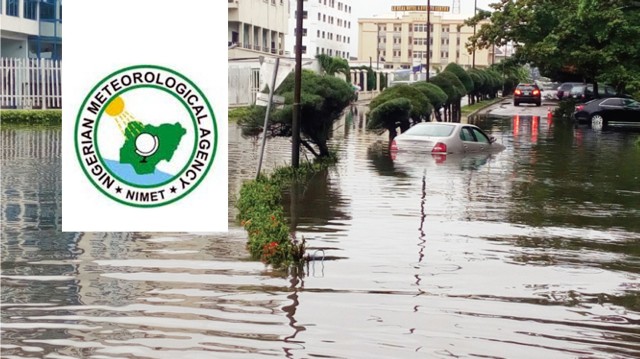
The Nigerian Meteorological Agency (NiMet), has warned that Nigerians should expect more flooding following the prospects of moderate to severe run-off of rains fall across some parts of the country.
Consequently, the agency has warned that the current soil moisture condition across Nigeria shows that Kaduna, Benue, Anambra, Delta, Gombe, Zamfara and Northern Yobe will experience moderate to severe run-off of rains between July and September.
In a statement in Abuja, Head of Public Relations Unit, Mrs Tessy Ushie, explained that NiMet made the prediction in its 2017 Seasonal Rainfall Prediction (SRP).
The agency had predicted that parts of Nigeria would be affected when the monsoon features becomes well established over the country.
It explained that the first decade of July, 2017, witnessed significant positioning of the monsoon features across the country.
It would be recalled that NiMET, had in the 2017 prediction, warned that Rivers State may suffer severe flooding as a result of heavy rain fall.
NiMET had said that many communities in the coastal areas of the state would likely witness heavy flooding.
It listed the local government areas most likely to be heavily affected to include, Ogba/Egbema/Ndoni, Ahoada West, PHALGA and Obio/Akpor.
The agency, however, assured that it was prepared to respond to any emergency situation arising from flooding, but also called on residents living in the flood-prone areas not to go to sleep with their two eyes closed.
While reacting to the NiMET prediction, the Head, National Emergency Management Agency (NEMA), South-South, James Eze Major, had blamed poor town planning administration and the penchant for property developers to ignore physical and urban planning codes and laws while erecting structures, as a major reason for the flash floods already witnessed by residents of some parts of Port Harcourt and Obio/Akpor LGAs.
Major said, “We are prepared to respond to any unusual situation in less than 24 hours. We have the ability to interface with impacted areas and victims within short notice. We are also ready to supply relief materials, when the need arises.
“I am appealing to people living in the local government areas listed above, especially those close to the River Niger and its major tributaries, not to sleep with their two eyes closed. They should always look out for and identify when the level of water threatens to overflow its bank.
“Also, the town planning officers should ensure that the standard rules and regulations are adhered to while residents should ensure that blocked water channels are cleared to avoid creating serious challenge for government,” the Major added.
In the current warning, NiMET said the line separating the dry Easterly winds and the moist South Westerly winds (Inter Tropical Discontinuity) oscillated between latitude 16 degrees North and 19.5 degrees North with mean position of 17.9 degrees North.
“The Northern Hemispheric High (Saharan High) weakened in the period with a gradual retreat to the Mediterranean Sea/Europe in favour of the northward push of the Inter Tropical Discontinuity.
“The Southern Hemispheric High encroached northwards with its 1015hPa (hemisphere per hour) Isoline extended to the coastal cities of Nigeria thus enhancing the influx of moisture inland at the surface.
“These were engulfed by moist maritime winds in the period except on July 4 that continental winds were observed at the 850hPa,” NiMet stated.
The agency also disclosed that the favourable monsoon conditions had led to adequate moisture in the atmosphere and subsequently precipitated in large amounts that the soil could not absorb.
It said the situation was responsible for the flooding that hit Lagos, Niger, Abuja and some other parts of the country with its attendant destruction of lives and property.
According to NiMet, it is pertinent to note that Victoria Island recorded one fall of 176.5mm rain on July 8 and Lagos Roof near Tafawa Balewa Square had 132.8mm the same day.
“Some stations had recorded heavy rainfall the previous day, July7, with 69.8mm and 65.6mm respectively which led to the reported flooding.
“In order to mitigate future occurrence of such flooding, the public should avoid blockage of water ways and flood plains and ensure clearance of drainage in their environment.
“NiMet will continuously monitor the weather conditions as they unfold and provide regular updates and advisories to the public,” NiMet said.
Meanwhile, the Federal Government has commiserated with all Nigerians on the damage caused by recent floods across the country, especially in Niger and Lagos states.
The Minister of Water Resources, Suleiman Adamu, conveyed the government’s sympathy at a news conference in Abuja.
He said that about 30 states and over 100 local government areas, which had been categorised as high flood risk areas, could expect flooding this year.
The minister, however, gave assurance that the flow of this water would be constantly monitored by the Nigeria Hydrological Services Agency (NIHSA), while flood alerts would continue to be issued across the country.
Adamu also advised that people should adhere to the advice in the recent Annual Flood Outlook issued by the NIHSA and other flood alerts by related agencies.
He said that the ministry would soon embark on a sensitisation campaign, in collaboration with NIHSA, to educate the entire citizenry on flood issues.
The minister called on the state and local governments to also embark on similar sensitisation campaigns on flooding, particularly at the grassroots level.
Adamu also advised that those living in urban cities to always refrain from constructing structures on drainages.
He, therefore, underscored the need for state and local governments to strictly enforce environmental laws and town planning guidelines so as to check uncontrolled physical development in their domains.
He, however, assured Nigerians that more dams and water reservoirs would be constructed across the country to avert recurrence of flood incidents in the future.
The minister’s statement coincided with Acting President, Prof Yemi Osinbajo’s approval of the immediate release of N1.6 billion to 16 states already affected by the flood.



The Rivers State chapter of the All Progressives Congress Christian Leaders Forum has expressed strong confidence in the capacity of All Progressives Congress (All Progressives Congress) candidates in the state to deliver effective governance if elected into office in the coming elections.
The State Coordinator of the forum, Archbishop Lucky Aroh, made this known during a breakfast and thanksgiving meeting held in Port Harcourt, where leaders gathered to pray for the stability of the party and the safety of its candidates ahead of the 2027 general elections.According to him, the meeting was convened to seek divine intervention for peace, unity, and security among APC candidates across Rivers State.
“Today we are praying for APC stability in Rivers State and the security of our candidates that have been elected to contest the 2027 elections. It is a breakfast meeting,” Aroh said.
He further expressed optimism that the party’s candidates would not disappoint the people if entrusted with leadership responsibilities.
“They will not fail when elected into office. We are here as fathers of the land to let them know, and I must tell you the truth that these are the authentic people that will do well in Rivers State,” he added.
Speaking earlier, the National Chairman of the forum, Professor Olanrewaju Abraham, commended the Rivers State chapter for organizing the programme, noting that the national body of the forum believes strongly in the power of prayer.
He stated that political leadership provides an opportunity to influence society positively, including advancing moral and spiritual values, while expressing confidence that APC candidates at all levels would emerge victorious in the upcoming elections.
Also speaking, the Rivers State Women Leader of the APC, Hon. Darling Amadi, praised the forum for its commitment to prayers for peace, stability, and the protection of party candidates.
Represented by the Deputy Women Leader of the party in the state, she described the initiative as commendable and urged other political and support groups within the party to emulate the gesture in promoting unity and stability.
By: John Bibor, Menebe Emmanuel & Fortune Paibi
Prominent businessman and philanthropist, Elder Anthony Osagwe-Ogo, was celebrated in grand style as he marked his 70th birthday anniversary, with distinguished Nigerians, business leaders, and golf enthusiasts gathering to honour his remarkable contributions to society.
The colourful celebration took place at the Port Harcourt Golf Club, where friends, associates, and well-wishers converged to pay tribute to the revered elder statesman.
Chairman of the occasion, High Chief (Dr.) Ikenna Okafor, described the celebrant as a detribalised Nigerian whose generosity, humility, and commitment to humanity have earned him admiration across different communities and backgrounds.
According to Dr. Okafor, Pa Osagwe-Ogo’s impact on society and the development of his community remains unparalleled. He noted that members of the golfing community are proud to be associated with a father figure who consistently promotes the welfare and well-being of those around him.
He further stated that the history and growth of the Port Harcourt Golf Club cannot be told without acknowledging the significant role played by the celebrant, whose wisdom, encouragement, and leadership have helped sustain the club over the years.
“We are here to celebrate a man who has impacted humanity positively, a peace-loving individual and an epitome of hope for the younger generation. We pray to emulate his virtues. Today, we celebrate a bridge-builder, a trailblazer, and an iconic leader whose life continues to inspire many,” Dr. Okafor said.
He expressed delight at the large turnout of guests from various walks of life, describing it as a testament to the respect and affection Pa Osagwe-Ogo commands within and beyond Rivers State.
In his response, the celebrant, Pa Anthony Osagwe-Ogo, expressed profound gratitude to God for preserving his life and granting him the privilege of attaining the milestone age of 70.
He also thanked members of the Port Harcourt Golf Club, family members, friends, and associates for identifying with him during the celebration and for their unwavering support over the years.
The event featured the cutting of the birthday cake, presentation of awards to deserving members of the club, goodwill messages, and moments of celebration among guests.
The ceremony was attended by notable personalities from the business community, the golfing fraternity, and other sectors, all of whom joined in celebrating the life and legacy of the respected elder statesman.
Rivers State Governor, Sir Siminalayi Fubara, and the Permanent Secretary of the Rivers State Ministry of Information and Communications, Dr. Honour Kuru Sirawoo, have been honoured with awards of recognition in connection with the 2026 Democracy Day celebrations held in Port Harcourt.
The awards, which formed part of activities marking Nigeria’s Democracy Day on June 12, were formally presented on Tuesday at the Ministry of Information and Communications in Port Harcourt.
Presenting the awards was Hon. Abdul Hameed Oladipupo Alli, popularly known as “Mr. Nigeria,” Publisher of Asiwaju Trumpet Magazine and Achievers World International Magazine.
Governor Fubara was recognised for his efforts in sustaining peace, stability, and a conducive political atmospherJohn Bibor / Menebe Emmanuel / Fortune Paibie in Rivers State. The organisers noted that his administration has fostered harmony and strengthened civic participation across the state.
Dr. Sirawoo, on the other hand, was honoured for his exemplary administrative leadership and significant contributions to effective information management within the Ministry of Information and Communications.
Representing Dr. Sirawoo at the presentation ceremony, Dr. Christian Davies received the award on his behalf and expressed gratitude for the recognition. He described the honour as a reflection of Dr. Sirawoo’s unwavering commitment to professionalism, excellence, and dedicated public service.
Dr. Davies assured the organisers that the award would be formally conveyed to the Permanent Secretary.
The event also featured the presentation of commemorative publications highlighting major governance and civic milestones in Rivers State, including Easter celebrations, Workers’ Day activities, the Governor’s third anniversary in office, and Democracy Day programmes.
Organisers of the awards commended the Rivers State administration for what they described as sustained peace, political stability, and improved civic engagement, noting that these achievements have contributed significantly to the state’s continued development.
By: Jessica Sambol