
Featured
That Alarm By Gov Wike …Why Police, INEC Must Act

No sane Nigerian can dispute the fact that the country is facing tough times. Times, so challenging, nothing short of financial discipline, political tolerance, prudent management of scarce resources and indeed selfless service are required of those the people look upon to offer leadership.
It is a period that demands optimum protection and maintenance of existing infrastructure, build capacity and inspire the people to give of their best in hope that the period will merely be a phase that would soon be history.
These indeed are times when governments and the people alike must unite in fight against unnecessary controversies likely to cause insecurity, strife and indeed further destruction of an already creeping economy.
Last week, Nigeria’s Finance Minister Kemi Adeosun said the dark days are over. But no Nigerian that patronises the market place would share same sentiment, for, it amounts to telling a blind man that there is salt in his soup, when there is none.
Truth is, many states cannot pay workers’ salaries. More than a bunch is in arrears of close to eight months, while others who manage to meet their obligations to their workforce do so at great pains and at the expense of other competing needs, like the much required infrastructural update necessary to attract investments and boost internal revenue generation.
These indeed are times when, even the Federal Government borrows to pay its staff, with doubts hanging around the full implementation of the 2016 budget. With the free fall of the Naira against other major currencies, a virtually dead manufacturing sector and with inflation rate hitting an all time 17 per cent high, it should dawn on all that all is not well.
At times like this, to allow any form of insecurity, protestations and violent conflicts would be putting salt upon injury. It indeed would be a perilous voyage to encourage any miscarriage of justice or promotion of partisanship that would push those denied justice seek alternative reliefs.
This is because such can threaten security and ultimately breed insecurity. Where such insecurity holds way, where crime blossoms where injustice reins, where lawlessness replaces rule of law and where impunity takes the place of order, all other positive efforts take back seat. Investors are threatened, and the local economy at the risk of getting stalled.
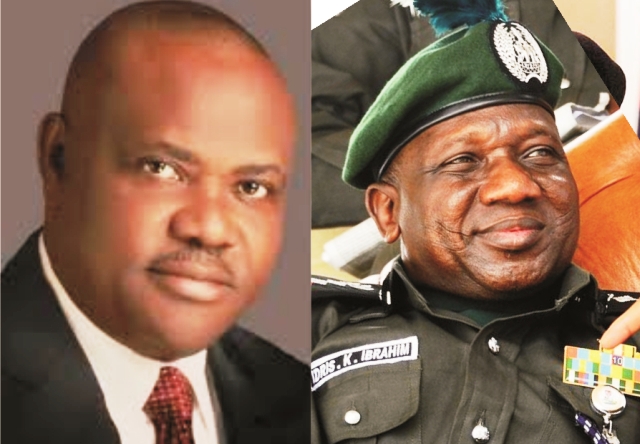
These are why none should venture any action or inaction capable of engineering chaos, crisis, insecurity and strife. These indeed are why the concerns recently expressed by Rivers State Governor Nyesom Wike concerning, ‘flawed’ police postings and ‘glaring efforts’ by the Independent National Electoral Commission (INEC) to rig the forthcoming re-run elections in Rivers State, must be addressed and fast too, to prevent the agitated from seeking alternative reliefs.
Last week, the governor pointedly accused the National Chairman of INEC, Professor Mahmud Yakubu of moves to scuttle credible re-run elections in the state by holding secret meetings with the state’s All Progressives Congress, with APC Chairman, Chief Davies Ikanya, Senator Magnus Abe and others on July 19, this year. According to the Governor, the INEC boss might have concluded plans to postpone the July 30 elections over fears of defeat expressed by the APC leadership, or rig the elections in favour of the APC.
Wondering why anyone would be happy to destroy Rivers State just because he or she wants to satisfy the politician who funded APC national elections through Rivers resources, the governor lamented:
“They are frustrating elections in Rivers State because of one man who sponsored APC. They have posted electoral officers from APC states to rig elections and they want to accede to the request of the Rivers APC to post out the Resident Electoral Commissioner.
“But the truth is that nobody can rig elections in Rivers State. The INEC Chairman only has the power to postpone elections but he has no power to rig elections here.
“As I speak to you, 7.30 to 8pm, on 19th of July, 2016, the APC Chairman, Davies Ikanya, Senator Magnus Abe and others, were with the National Chairman in his office.
“Rivers State is key to development of this country. Will they continue to deny us representation at the Senate and majority of the constituencies of the House of Representatives?”
These are serious concerns. Even more worrisome is the alarm raised by the governor over recent postings in the Police Command, which he described as politicized.
According to Governor Wike, the new Inspector General of Police (IGP) recently posted Mr. Akin Fakorede, a Police officer formerly in-charge of the state’s Special Anti-Robbery Squad and who allegedly distributed fake SARS uniforms to APC thugs during the March 19, re-run elections leading to the death of several innocent Rivers people. He also accused the same officer of embezzling N18 million meant for the rehabilitation of armoured personnel carrier before he fled the state, after the last re-run.
Governor Wike also accused the IGP of posting back to the state, one Mustapha who ran away from the state after giving false testimony at the Governorship Elections Petitions Tribunal. According to the governor, that ‘APC Witness’ has now been posted to head MOPOL 56 in Bori, one of the battle-ground locations, in the July 30, rerun elections.
He added that the Police High Command also reposted to the state, one Stephen Asin, an officer formerly in charge of the Special Anti-Robbery Squad, after same officer had allegedly declared publicly that he would destroy the security network in the state. That Asin, the governor alerted, is now to head the Police Operations Department in the state.
The governor said, ‘my interest is for the security of the state to be sustained. We are enjoying relative security in the state and I will not fold my arms and allow anyone destroy the security of the state through the posting of politicians who hide under Police uniforms’, he said.
These are serious accustations that ought to attract the urgent response of both the Police High Command and INEC. This is because one wants to resist the temptation of rushing to the natural conclusion that silence means acceptance. In this case, acceptance of the governor’s concerns as true in every material particular. Even so, I pray am wrong.
This is because, one of the greatest incentives to strife and conflict, is the attempt to impose one’s ambition on others, even when as one time United States President Abraham Lincoln once warned, ‘no one is good enough to lead another man without that other’s consent.’ The crises that characterised the elections in Bayelsa State last year, where, several lost their lives, is traceable to same conflict of interest.
Delta State is now boiling on account of renewed insurgency by a new group of militants, Bayelsa sleeps with only one eye closed, Cross River is facing challenges of criminal gangs. To push Rivers State into any form of disturbance would not be in the interest of the country, and its economy.
While one is reluctant to agree with the governor that APC leaders’ meeting with the INEC Chairman is wrong. What is wrong is the INEC chair’s refusal to grant same audience to the PDP leadership or even return the governor’s call, just as didn’t the new IGP.
Also curious is the timing of the postings and the calibre and character of those involved. The choice of officers, obviously APC-friendly, if records of the last Governorship Petitions Tribunal are any leads to go by; indeed raises eyebrows and portend a special assignment. Such job cannot be apolitical, unless INEC and the Police convince the people otherwise.
INEC in particular, must realise that once the populace loses confidence in its impartiality, it shall brew discontent which in turn gives birth to resistance. Such resistance very often rises up to become civil, even militant disobedience. As supposed umpire, INEC must resist the temptation to support one party against another or one candidate against the other.
Such would, without doubt, heat-up the polity; incite the civil populace against the institution and by extension government, a volatile scenario none should wish for. And not of all places, Rivers.
Rivers is a very strong factor in the economic equation of the country. Its peace should not be sacrificed on the altar of political compensation. The people should instead be allowed to vote according to their conscience and let the people alone determine who represents them.
In spite of what Abuja politicians may wish to accept, Rivers State has enjoyed relative peace and progress. That is why it has become a destination of choice for frontline professional bodies to hold their conferences in the state. The Nigeria Bar Association (NBA) and the Nigeria Guild of Editors (NGE) are merely two of such bodies that consider Rivers as peaceful.
This should not be sacrificed for the likely desire of a group to win the elections by hook or crook, through armed Policemen and soldiers and through fake election results. These can only elicit protests, even violence which scope and consequence cannot be predicted.
My Agony is that some politicians in Abuja still believe that election results written in hotel rooms can be declared, unpopular candidates can be made popular overnight and that elections can be rigged in Rivers State.
In my over 33 years in the business of minding others business, I have come to the conclusion that politicians can only rig successfully, where, they enjoy, at least a marginal majority of the electorate. To attempt to rig when the opposite is true, is to replay the Bayelsa governorship elections debacle. Not at these tough times, please.
Soye Wilson Jamabo

Featured
JUNE 12: Democracy Remains Nigeria’s Strongest Path To Unity, Progress, Says Fubara ….Extols Abiola, Wife


Governor of Rivers State, Sir Siminalayi Fubara, has reaffirmed that democracy remains the most effective system of government for Nigeria, given the country’s rich diversity of ethnic, religious, and cultural identities.
In a goodwill message to Nigerians on the occasion of the 2026 Democracy Day celebration, Governor Fubara said June 12 represents far more than a historic date; as it embodies the enduring struggle, sacrifice, and collective aspiration of Nigerians for freedom, justice, and representative governance.
The Governor extended warm felicitations to Nigerians at home and in the Diaspora, paying tribute to the heroes and heroines of the democratic struggle, particularly Chief MKO Abiola, his wife, Kudirat Abiola, and countless others whose courage and sacrifices helped secure the democratic freedoms Nigerians enjoy today.
According to him, “June 12 is a reminder of the price paid for the democracy we enjoy today. The sacrifices made by Chief MKO Abiola, Kudirat Abiola, and many other patriots who laid the foundation for the democratic journey we continue to enjoy today. Their commitment to the principle that power must ultimately reside with the people remains a source of inspiration for every generation of Nigerians.”
Governor Fubara noted that thirty-three years after the historic June 12, 1993 election, Nigeria’s democratic experiment has continued to evolve despite challenges and setbacks.
“Our democratic journey has not been without difficulties, but the resilience of our institutions and the determination of our people have kept the nation moving forward. The ability to express differing opinions, engage in constructive debate, and peacefully choose leaders through the ballot remains one of the greatest achievements of our nation,” he said.
Governor Fubara stressed that democracy provides the best framework for managing Nigeria’s diversity and transforming it into a source of national strength.
“Nigeria’s diversity should never be seen as a weakness. Properly harnessed, it is our greatest asset. Democracy offers us the opportunity to build consensus, promote inclusion, strengthen national unity, and create the conditions for sustainable development and shared prosperity,” he said.
Governor Fubara commended President Bola Ahmed Tinubu, for his commitment to the Renewed Hope Agenda and ongoing efforts aimed at economic revitalization, strengthening security, and deepening democratic institutions across the country.
He reiterated the readiness of Rivers State to continue partnering with the Federal Government in advancing policies and programmes that improve the lives of citizens through infrastructure development, job creation, enhanced security, quality education, healthcare delivery, and good governance.
The Governor further called on Nigerians, regardless of political affiliation, ethnic background, or religious belief, to use the occasion of Democracy Day to renew their commitment to the Nigerian project and the ideals that underpin democratic governance.
“Democracy must not be viewed merely as a periodic electoral exercise. It must be reflected in our daily commitment to accountability, transparency, tolerance, justice, respect for the rule of law, and responsible leadership. As citizens and leaders, we all share a collective responsibility to strengthen our democracy and build a nation that future generations will be proud to inherit,” he said.
Governor Fubara expressed optimism about Nigeria’s future, urging citizens to remain united, hopeful, and committed to the values of peace, dialogue, and national development.
“Together, we can build a stronger, more inclusive, and more prosperous Nigeria where every citizen has the opportunity to thrive and contribute meaningfully to national progress,” he said.

Governor of Rivers State, Sir Siminalayi Fubara, has reaffirmed the unwavering commitment of his administration to peace, unity, security, and inclusive development as Rivers State marked its 59th anniversary, last Wednesday.
In a goodwill message issued on Wednesday to commemorate the anniversary, Governor Fubara stated that despite the challenges faced over the years, the people of Rivers State have continued to demonstrate resilience, strength, and an enduring spirit of unity that has sustained the state since its creation.
The Governor noted that the strong bond of brotherhood among the various ethnic nationalities of the state, including the Ijaw, Ikwerre, Ogoni, Etche, Ekpeye, Andoni, Kalabari, and others, remains one of Rivers State’s greatest strengths and a critical foundation for peace, stability, and progress.
He further observed that Rivers State has remained a major driver of Nigeria’s economy for decades, not only because of its abundant oil and gas resources, but also because of the exceptional contributions of its people across diverse sectors including academia, jurisprudence, business, entertainment, public service, and sports.
Governor Fubara assured the people that his administration will continue to prioritize policies and programmes that promote peace, protect lives and property, and expand development across all parts of the state. He emphasized that governance must be people centered and impactful, with equal attention given to every Local Government Area of the state.
The Governor also paid tribute to the elders and founding leaders of the state for preserving the spirit of unity and coexistence over the years, while urging the youths to remain hopeful, responsible, and actively committed to building a greater Rivers State through innovation, hard work, and patriotism.
He equally acknowledged the invaluable role of women in strengthening families, communities, and society, describing them as indispensable partners in the continued growth and stability of the state.
Governor Fubara called on all Rivers people to use the occasion of the anniversary as a moment of reflection and renewed commitment to peaceful coexistence, mutual respect, dialogue, and collective progress, stressing that the unity and future of Rivers State must always rise above personal interests and political differences.
Rivers State was created on May 27, 1967, by General Yakubu Gowon.

-

 Niger Delta4 days ago
Warri Airport Manager Disputes Air Peace Bird Strike Claim
-

 News4 days ago
Nigeria Won’t Surrender Any Territory To Criminals -Tinubu
-

 News4 days ago
FG Begins Trial Of Over 600 Terrorism Suspects
-

 Politics4 days ago
Parties’ Deregistration: How Justice Lifu Overruled Appeal Court Justices
-

 Rivers4 days ago
79th IAUE Inaugural Lecture: Prof Anero Advoctes Tuition-Free Education For Children
-

 Politics4 days ago
ADC: Okonkwo Rejects Amaechi As Presidential Running Mate, Withdraws Support
-

 Politics4 days ago
2027: Tinubu’s Projects Give APC Edge In South East – Yilwatda
-
News4 days ago
Forum Expresses Confidence In APC Candidates’ Performance In Rivers