Connect with us

Maritime

NIMASA Urges China To Partner Nigeria On Maritime Sector Dev

Published

on

The Director-General of
the Nigerian Maritime Administration and Safety Agency (NIMASA), Dr Dakuku Peterside, has urged the Chinese Government to collaborate with the Nigerian maritime sector for economic growth.
This is contained in a statement by the Head of Corporate Communication of NIMASA, Hajia Lami Tumaka, obtained by our correspondent in Lagos recently.
The statement said that the director-general received the Acting Chinese Consul-General, Mr. Li Yong, who paid a courtesy visit to the agency
According to him, the Nigerian maritime sector holds the key to unlocking the opportunities of the sector in the whole of Africa because of our strategic location, population and volume of trade.
The statement said  if anyone wanted to do business in Africa, Nigeria is the place of choice.
The director-general also stated that the Agency was willing to partner with the Chinese Maritime Administration in the areas of ship  building and recycling, on-board training for cadets as well as technical support.
He said that collaboration with various stakeholders across the globe was fundamental to unlocking the maritime opportunities in Nigeria.
Peterside said that cooperation among the Global South countries was the way to drive emerging economies to the height of development.
He commended the Chinese Government for its willingness to strengthen the Nigerian-China relationship as evident in the major developmental projects across the country.
In his response, Yong said that he was happy with the China-Nigerian relationship, adding that the Chinese Central Government was willing to partner with Nigeria in the areas of technological advancement and information sharing.
The Chinese envoy also expressed his government’s determination to support Nigeria in the fight against piracy and other criminal activities at sea.
Meanwhile, the current administration of the Nigeria Maritime Administration and Safety Agency (NIMASA) has pledged to adhere to statutory due diligence in the administration of the Cabotage Fund.
The NIMASA Director-General (DG), Dr Dakuku Peterside, said that with the clamour for a national shipping line, there was every need to strengthen the administration of the fund.
Peterside told newsmen  on the sidelines of a news conference in Lagos on Sunday that the fund was set-up to encourage Nigeria ship owners to be able to acquire and maintain vessels.
The DG regretted the spate of maladministration that had become the lot of the fund in the recent past, which he said, had made it inoperative.
“We are aware of the complaints of the contributors (ship owners) of the fund and their predicament in accessing it.
“The fund, if well administered, will ensure that Nigeria has sea going vessels at all times, with a large number of Nigerian seafarers on board.
“It is a pride to see our national flag hoisted on transnational vessels,’’ Peterside said.
According to him, the idea will absorb many of the country’s trained but idle seafarers, thereby adding to the Nation’s Gross Domestic Product (GDP).
He added that the administration would tend to emulate countries like the Philippines in exporting seafarers to other countries, thereby stemming piracy on board.
Peterside said that the agency was training middle-cadre manpower at the maritime academy at Oron, while the senior officers were being trained abroad.
He noted that NIMASA’s primary objective did not include the setting-up of a Maritime University, as was being propelled by the ousted leadership of the agency.
“The Cabotage Fund, under the present leadership, will be channelled for what it is meant for and not for a university.


Continue Reading

Maritime

Inefficiency, corruption bane of Regional Trade,Says NACCIMA  Boss

Published

on

Chairman of the National Chamber of Commerce Industry Mines and Agriculture  Export group, Mr.Kolawole Awe has identified inefficiency and corruption as the two major factors responsible for poor implementation of government’s policies in the country.
Awe made this observation in a speech delivered at the 2nd annual Ports and Transborder international Discuss held at Sycamore Hotel ,Badagry-Lagos on Friday.
The NACCIMA Export group boss expressed regrets over what he described as the  poor treatment of Nigerians by those working in various government security agencies , whose services he said sometimes fell short of expectations and added that the twin forces of inefficiency and corruption had further worsened the woe bedeviling the country with attendant negative impact on its social economy development.
On ways to address the problem,Awe urged every stakeholders to imbibe a new attitudinal change in the work places , which should be in consonance with the Regional Trade principle .
Earlier,in his welcome address,the President,Badagry Chamber  of Commerce Industry Mines and Agriculture (NACCIMA),Alhaji Yahaya Oladiran Idris said the importance of the seminar with the theme:”Bridging Borders, Building National prosperity and strengthening Regional Trade” was part of the objectives of Baccima as the voice of business  society along the Lagos -ABIDJAN  trade corridor.
“Seme the most important border post in west Africa is to protect the interest of of it members and business community,see to the growth and development of economic activities in the region”,he said.
“It gladdens me to inform you today that one of our advocacy for easy movements of our citizens,traders and travellers across Seme border post on the issuance of Biometric identification was unveiled by the federal government through the Nigeria Immigration Services on Thursday in Abuja”
According to him, “the  ports and Transborder international trade discuss was meant to give stakeholders the platform to examine and share challenges collectively and to build bridges of understanding , cooperation and innovation.
In his contribution, co-organizer of the program,Mr. James Shodiya disclose that the the gathering was designed to shape the future of trade across the borders and strengthening the framework and support regional and global commerce.
He further explained that ‘in today’s interconnected world the efficiency the borders defined the strength of the economies from customs operations to port management , from transport logistics to digital trade systems, adding that the movement of goods across the boundaries effects every sector of national development.
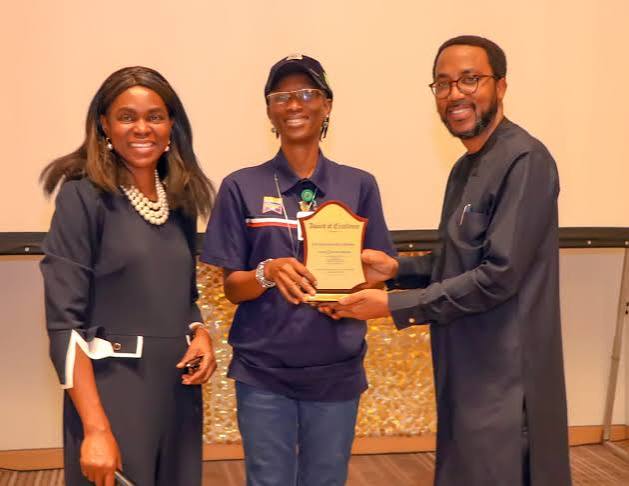
 Comptroller Frank Onyeka, Customs Area Controller of Tin Can Island Port  Customs Command and Sponsor of the Maritime Journalists Training Workshop 2025, receiving award of appreciation from Innocent Orok, CEO, Roam Media Group and Coordinator of 2025 Maritime Journalists Training Workshop held at the Tin Can Island Customs Conference Room on 17th November 2025.
By: Nkpemenyie Mcdominic, Lagos
Continue Reading

Maritime

Stakeholders Advocate Legal Framework For  NSW Project

Published

on

Ahead of the March 2026 takeoff of the National Single Window (NSW) project, maritime industry stakeholders have called for a robust legal framework to ensure the seamless rollout of the unified digital project.
 The stakeholders who made the call at the 10th Annual Seminar for Maritime Journalists and launch of the Centre for Maritime Media and Capacity Development in Lagos on Wednesday warned that without a unifying law, the NSW project risked being stifled by the conflicting mandates of various government agencies and the high cost of previous digital failures.
Speaking at the event organised by First Mediacon Network Limited, CEO of Wealthy Honey Investment and former Vice President of ANLCA, Dr. Kayode Farinto emphasized that the NSW must submerge the individual acts of various government agencies into a unified legal structure to prevent jurisdictional clashes.
 He said, “SON has its act. NAFDAC has its act. Quarantine and Customs have theirs. For us to house these government agencies, there must be a legal framework so that it will be sacrosanct and everybody will know that this is the armbit of law with which we must operate.
 “In the legal framework, there must be punishment for CEOs who deliberately circumvent, delay cargo and make officers to exploit traders or freight forwarders unnecessarily.
 ” Farinto also highlighted additional burdens imposed by regulatory agencies, citing examination fees charged by the Standards Organisation of Nigeria (SON) despite offshore certification. He noted that the NSW must address such problems including teething challenges of previous digital transitions such as the B’Odogwu platform failure, which he said cost importers over N7 billion due to connectivity issues.
 “Importers are charged between N3,000 and N7,000 per container for examinations, even when conformity certificates have already been issued. This discourages trade and encourages circumvention.
 “The NSW must not come with the same teething problems we suffered with B’Odogwu, which cost importers over N7 billion and nobody is saying anything. There must be attitudinal change among government agencies and licensed customs agents,” he said.
Also speaking, Vice President of ANLCA, Prince Segun Oduntan represented by Suleiman Ayokunle, Chief Executive Officer of SULA Logistics Limited noted that operators still contend with several government regulatory agency platforms, alongside multiple internal windows covering enforcement, scanning, gate operations, and cargo clearing processes.
 He cautioned that unless the NSW effectively harmonises agency roles and processes, such financial losses could persist, undermining the very efficiencies the reform seeks to achieve.
 In his remarks, maritime lawyer Dr. Emeka Akabogu SAN pointed out that Nigeria continued to perform poorly on the Global Logistics Index due to excessive manual intervention.
 He praised the Nigeria Customs Service Act of 2023 for domesticating WTO trade facilitation agreements but stressed that the NSW was the only way to achieve a single digital approval. In his remarks, the Executive Secretary and CEO of the Nigerian Shippers Council (NSC), represented by Director of Special Duties Moses Abere, stated that as the sector digitalizes, journalism must evolve to ensure transparency and accountability.
 “As the maritime sector grows more complex, driven by digitalisation, new trade realities, regulatory reforms, and global logistical shifts, journalism must evolve accordingly,” Akutah said.
 He reiterated the Council’s commitment, as the Port Economic Regulator, to promoting efficiency, transparency, and competitiveness in the sector. He added that the theme of the seminar—“A Decade of Collaboration for Impact: Strengthening Maritime Journalism for the Future”—reflects the critical role of partnerships in building a stronger maritime industry.
 “Over the years, maritime journalists have worked closely with regulators, operators, policymakers, and stakeholders to illuminate challenges and opportunities in the sector,” he said.
 “The media remains an essential partner in informing stakeholders, shaping public understanding, and strengthening accountability.
” In his welcome address, CEO of First Mediacon Network Limited, Sesan Onileimo highlighted the urgent need for maritime journalists to upscale their knowledge, particularly in an era dominated by artificial intelligence, digitalisation, and social media.
 “All of these developments have combined to put journalists under intense pressure to report factual information promptly while remaining relevant.
 “The Centre has been established to bridge this gap, ensuring maritime journalists, regardless of experience, remain equipped to deliver accurate, impactful reporting, ” he said.
By: Nkpemenyie Mcdominic, Lagos
Continue Reading

Maritime

Customs To Impose 3% Penalty On Commercial Banks Over Delay In Remittances Of Collected Revenue

Published

on

The Nigerian Customs Service has warned that commercial banks which fail to remit Customs revenue within contracted timeline will now pay a penalty of 3% above the prevailing Nigerian Interbank Offered Rate (NIBOR) for the duration of the delay.
The Customs in a statement on Wednesday said some banks designated to collect import and export duties on the B’Odogwu platform had turned on their delay tactics for too long, warning that such banks would pay heavily for the delay in remitting public funds collected through it.
The statement signed by the agency’s national spokesman, Dr Abdullahi Maiwada read in part: “The Nigeria Customs Service (NCS) has noted instances of delayed remittance of Customs revenue by some Designated Banks following reconciliation of collections processed through the B’odogwu platform. Such delays constitute a breach of remittance obligations and negatively impact the efficiency, transparency, and integrity of government revenue administration.
“In line with the provisions of the Service Level Agreement (SLA) executed between the Nigeria Customs Service and Designated Banks, the Service hereby notifies stakeholders of the commencement of enforcement actions against banks found to be in default of agreed remittance timelines.
“Accordingly, any Designated Bank that fails to remit collected Customs revenue within the prescribed period shall be liable to penalty interest calculated at three percent (3%) above the prevailing.
By: Nkpemenyie Mcdominic, Lagos
Continue Reading

Trending

Decoration sticker
Decoration sticker
Decoration sticker
Decoration sticker