
Business
Towards Reforming Nigeria’s Power Sector

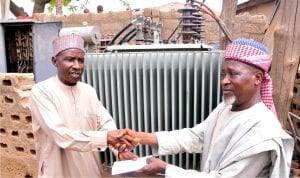
Representative of Senator Shehu Sani, Alhaji Suleiman Ahmed (left), presenting 500kva transfomer to the district Head of Badarawa Majalisa Kwaru, Alhaji Abdulhameed Giwa in Kaduna recently.
It is disheartening that in
spite of the partnership the Nigerian government has established with the private Electricity Distribution Companies (DISCOs) and the huge sums invested in the power sector by the previous administration, the DISCOs still lack the capacity to carry out their own mandates. That is the mandate of ensuring regular or steady electricity supply to the populace of Nigeria.
Prior to the handover of the power sector to the DISCOs, the Federal Government and the United States had on August 9, 2011 agreed on the critical nature of the sector to economic growth in Nigeria.
The agreement was reached at the second meeting of the Working Group on Energy and investment of the US – Nigeria Binational Commission in Abuja. Nigeria was represented at the meeting by top officials of the Federal Ministry of Petroleum Resources headed by the Permanent Secretary, Engr. Goni Sheikh, while the U.S. team was headed by the State Department’s Special Envoy for International Energy Affairs, Ambassador Carlos Pascual.
The two nations reaffirmed their commitments to continue to cooperate in implementing the reform of the power sector and instituting best practices to ensure optimal performance of the sector and to attract needed investment. Recognizing the need for private sector participation in power sector generation, transmission and distribution, both countries acknowledged that renewable energy has an important role to play in rural electrification. They also realized that by reducing gas flaring and monetizing its resources, Nigeria would enhance its clean electricity generation.
Both Nigeria and the US at the meeting stressed the importance of the Global Alliance of Clean Cooking Stoves and affirmed their support to introduce fuel-efficient cooking stoves, especially to rural communities in Nigeria.
The government of the US pledged to continue working through the US Agency for International Development to enhance capacity building in support of private sector participation in Nigeria’s power sector. The Nigerian government on its part pledged to work toward a timely and comprehensive reform of the petroleum sector, recognising the critical benefits to Nigeria of a stable and transparent investment framework that upholds global standards of sanctity of contracts and comparable taxation regimes.
The United States recognized Nigeria’s leadership in attaining the status of Extractive Industries Transparency Initiative (EITI) compliant country and both sides pledged to work together to continue the process of ensuring the adoption of transparent rules and regulations in the extractive industries sector. The US team briefed the Federal Government on developments in the United States, including the Cardin-Lugar Energy Security Through Transparency Provision to the 2010 Wall Street Reform and Consumer Protection Act, which complements the work of the Extractive Industries Transparency Initiative.
Diversification from the national grid system into other alternative energy sources is another solution advanced for the reform in the power sector of Nigeria. The Managing Director of Ola Electrical Nigeria, a solar energy company, Mr. John Sola while speaking in an interview with The Tide said if Nigeria breaks from the grid system and adopts other alternative sources, more persons would participate in the power distribution and supply thereby allowing consumers to make choice.
According to him, the rivers, good climate with adequate sunlight and coal, among other sources could be transformed to electricity to serve the people. He said “if people begin to tap the abundant electricity or power resources, Nigerians will enjoy sufficient and cheap energy sources without necessarily expecting light from the national grid.
Sola noted that technology and finance remained the major challenges confronting prospective investors and urged the government to support them to invest in alternative power sources.
“Until the issue of power supply is properly addressed, the idea of accelerated development will remain a mirage in the country”, he said.
In their effort, the new investors in the country’s electricity generation and distribution have injected over N300 billion into the power sector in the last two years. Egbin Power Plc on its own has invested N50 billion to rehabilitate line six of its Lagos plant to generate extra 240MW. The Director-General of the Bureau of Public Enterprises (BPE), Benjamin Ezra Dikki, who disclosed this when he featured on Nigeria Television Authority’s (NTA) live programme- Good Morning Nigeria last year, pointed out that the investment was for the upgrade of power infrastructure which had become obsolete over the decades, noting that new technologies evolving gains in the sector would not manifest overnight.
He explained that unlike reforms in other sectors, which brought immediate results, the situation in the power sector requires time due to its capital intensive profile. As he put it, “power equipment like turbines and other ancillary products cannot be bought off the shelf. The investors have to place orders after which it will take between three to four months to manufacture the equipment before shipping. This takes time. Before Nigerians will begin to see dramatic changes in the power sector, it will take between two to three years. But already, significant impact has been made”.
The BPE Director-General said that because of the infrastructural dev- elopement by the investors, power interruptions in the country had reduced to the barest minimum while over 2,000 engineers and technicians had been employed since takeover. Dikki noted with regret that for over 16 years as a public monopoly, Power Holding Company of Nigeria (PHCN) neither employed nor bought in new investments into the sector. He also regretted that gas vandalism was impacting negatively on the plans to privatize the Nigeria Independent Power projects in the country.
Dikki, however, expressed optimism that with the new initiative put in place by the former President Goodluck Jonathan’s administration to safe-guard the pipelines through technological devices, the challenge would soon be surmounted, adding that the complaint of non-availability of electric meters to consumers was hinged on the complex technology used in producing smart meters, which are currently being used the world over.
The Director-General of the National Power Training Institute of Nigeria (NAPTIN) Reuben Okeke announced that the German government has built a 25 kilowatts power plant for the training of Nigerian engineers in renewable energy.
Okeke who announced this at a meeting with management team of the Nigerian Society of Engineers (NSE) in Abuja said Nigeria is expanding its local capacity to train technical workforce for the power sector while aiming to become a regional hub for required expertise in the electric power drive. To achieve this, he disclosed that the nation is equipping its power training centres with state-of-the-art simulators and training equipment, including electricity laboratories.
According to him, the NSE is collaborating with the NAPTIN to check quackery in the power sector and explained that the institute aimed to promote local skills above their foreign counterparts. “Our training plant is stationed at the Kainji Power Plant, Niger State and we have acquired a unique 450 mega watts combined circle simulator stationed at the Afam Power Plant in Rivers State to train mechanical and electrical engineers from Nigeria and other African countries. The facilities are for teaching and learning for renewable energy. There are also three wind turbines of 5 kilowatts each, and 10.5 kilowatts of solar PV to be operated as a hybrid.
“Renewable energy is one of the things that the Federal Government has decided for rural access ‘Operation Light Up Nigeria’, and we have to have, as well as establish where those who will operate, manage and maintain these facilities will be trained”, he said, adding “we are as well getting a complete electrical training laboratory in Kano, and we currently have about 3-4 of our instructors in Italy to master how to use this to teach”.
Okeke noted that Nigeria has huge potentials as far as human resources are concerned.
“We cannot go anywhere to import cables. NAPTIN has to be positioned in such a way as to satisfy the market, and we have collaborated with NSE and entered a pact towards ensuring that engineers in the power sector go through rigorous tests and examination”.
He stated that both bodies signed a memorandum of understanding in 2014 to make sure that young engineers in the power sector are well trained and well evaluated, adding “no matter the investments the federal government makes in any endeavour, particularly in the power sector, without the human capital, without the workforce, well trained and capable workforce to maintain the infrastructure, it will not work”.
Shedie Okpara


-
Nation4 days ago
Asarama Kingdom Condemns Gruesome Murder of A Commercial Vehicle Driver
-
Rivers4 days ago
Monarch Raises Alarm Over Defamatory Politics … Urges For Unity In Ogoni
-
News4 days ago
Nigeria, Ethiopia Seal Agreement To Transfer 100 Nigerian Prisoners
-
News4 days ago
Nigeria No Longer Safe For Drug Cartels – Marwa
-
News4 days ago
Xenophobia: 268 Nigerian Returnees Arrive In Lagos From S’Africa
-

 News4 days ago
FG Declares Today Public Holiday To Mark Democracy Day
-
Women4 days ago
Nigerian Women And Dividends Of Democracy
-
Business4 days ago
FG Approves $1 Bn AFCFTA Credit Facility For Nigerian Exporters