
Nation
THE STATES

Adamawa
The Adamawa-German Medical Centre (AGMC) in Yola says
it has treated about 14,000 patients since inception in 2012.
The Administrator of the centre, Mrs Fadimatu Yakubu, made this known in an interview with newsmen.
Yakubu said the centre had at December 2015 handled 13,284 out-patients and 673 in-patients.
“Within the period under review, this centre which is rendering world class service carried out 220 surgeries, 107 mammography, 309 CT scan and 88 MRI, among others.
“A total of 8,345 patients had undergone various tests from March 2012 to December 2015. Our laboratory is fully equipped to carry out all kinds of medical test,” Yakubu said.
Borno
The Borno State Government, has awarded a N660 million
contract to three indigenous firms for the supply of medical equipment to public hospitals in the state.
The indigenous companies are Trans Sahara International Ltd, Kabiru Muhammad and Co Ltd and Kime International Ltd.
The Commissioner for Health, Dr Haruna Mishelia, signed the contract on behalf of the State government, while representatives of the firms signed on behalf of their companies.
Mishelia said that the contract would include the provision of medical equipment, beds and beddings, as well as additional wards at Maimusari Healthcare Clinic in Maiduguri.
The commissioner said that the contacts were awarded after approval of the state Executive Council.
FCT
National Association of Resident Doctors (NARD) has
called on government to improve existing response mechanism to ensure rapid response in cases of disease outbreaks in the country.
President of the association, Dr Muhammad Askira, made the call at a news conference in Abuja on the recent outbreak of Lassa fever.
Askira said the disease had so far claimed 43 lives in 10 states and the FCT Abuja.
He decried the emergency response arrangement set up by the government to tackle outbreak of any epidemic of this nature.
Jigawa
The Miyetti Allah Cattle Breeders Association of Nigeria
(MACBAN) has urged nomads to desist from grazing their livestock at night as the practice can raise suspicion among members of the community concerned.
The National President of the association, Alhaji Muhammad Kirowa, gave the warning in Dutse while speaking with newsmen.
According to Kirowa, the warning has become necessary in view of the current security challenges the country is facing.
He said that it had become necessary to warn the nomads against grazing at night because they had been accused of committing all sorts of crime during the night.
The president of the association also urged parents to desist from sending their under-aged children out to graze at night.
Kaduna
The Chairman, Southern Kaduna Christian Leader’s Council,
Bishop Joseph Bagobiri, has urged the people of the area to hold on to their faith and trust in God for deliverance.
Bagobiri gave the advice in a sermon delivered at the 15th Annual Southern Kaduna National Prayer Summit held at the Catholic Cathedral, Kafanchan.
The Bishop said that the message was against the backdrop of attacks witnessed in the area between 2012 and 2015 that led to wanton destruction of lives and property.
According to him, the Summit provides the platform and a rallying point for the people of the area to consolidate on the spirit of unity.
Kano
Kano State Government will host the forthcoming
conference on National Council on Agriculture scheduled to hold between February 8 and February 12.
The State’s Commissioner for Agriculture and Natural Resources, Dr Nasiru Gawuna, made this known in Kano in an interview with newsmen recently.
According to him, the local organising committee has been set up by the government to ensure the success of the event.
He said stakeholders from the 36 states and FCT as well as participants from outside the country are expected to attend the conference.
Katsina
The National Drug Law Enforcement Agency (NDLEA) in
Katsina State has intercepted a lorry loaded with cannabis sativa, psychotropic substances and cough syrups concealed in paint containers.
The NDLEA State Commandant, Hajiya Maryam Sani, who disclosed this to newsmen in Katsina, said that the vehicle was intercepted in Katsina on Friday, following a tip-off.
‘’The suspects placed real paints on top, whereas the others were below to deceive people into believing it was all paints that were being transported.
“When the vehicle was stopped by our men on duty, the some of the occupants of the vehicle took to their heels while two persons were arrested,’’ she said.
The commandant added that the items concealed inside the paint containers included cannabis sativa wrapped with polythene materials, hundreds of bottles of cough syrups, different types of psychotropic substances and other prohibited drugs.
Lagos
Alaguntan Community Development Association (CDA)
in Alimosho Local Government Area of Lagos State has commended Gov. Akinwunmi Ambode for approving the reconstruction of 114 inner roads across the state.
Our correspondent reports that the reconstruction of 114 inner roads, two in each of the 57 council areas, is an initiative of the Ambode administration.
The project, which is being fully funded by the State Government, is slated for completion in six months at a cost of N17.5 billion.
The General Secretary of the Alaguntan CDA, Mr Bada Saubana, said that the inclusion of Shotunde Street in the community among roads slated for reconstruction was a welcome development.
According to him, the reconstruction of the community roads will open up the areas for more socio- economic activities and improve the welfare of the people.
Nasarawa
The Karshi Development Area Council in Nasarawa State
has warned workers against truancy, absenteeism and other sharp practices for improved productivity.
The Director of Personnel Management (DPM) Mr Musa Adamu, of the council, gave the warning in an interview with newsmen in Karshi.
He advised the workers to buckle up to record optimal productivity in the council and justify the huge investment of government at the grass roots.
“I want to appeal to the staff of the council to be punctual, dedicated, diligent and be more committed to their duty and to contribute their quota to national development.
“I am also calling on the workers to shun non-chalant attitude to work and other sharp practices.
“Doing that, will not only move the council forward, it will also enable the public have trust in the council administration for grassroots development and the country at large,’’ he said.
Niger
The Coordinator of Fadama III project in Niger, Mr Aliyu
Kutigi, said that the state had acquired farm inputs worth N28.2 million for ten production clusters.
Kutigi made this known in Minna when he presented the report of project implementation to the Team Leader of the World Bank assisted Fadama III Additional Financing Project, Dr Adetunji Oredipe.
According to him, the agricultural inputs are of 30 metric tonnes of improved rice seeds, 2,300 litres of herbicides and 150 metric tonnes of fertilisers to farmers under Fadama project.
“I will like to inform you that the state has gone far in the implementation of Fadama III Additional Financing (AF) as one of core states.
“The state has 970 hectares of rice, comprising 700 hectares in 2015 rainy season and 270 hectares for dry season,’’ Kutigi said.
He said the state government was committed to the Fadama III Additional Financing Project, adding that benefitting communities were also cooperating.
Oredipe commended Niger Government for the success it had so far recorded in the project, but stressed the need to add value to the project.
Plateau
The Plateau State Commissioner for Housing and Urban
Development, Mr Samuel Gahe has urged contractors to step up effort and perform creditably.
Galadima, who gave the assurance wile interacting with contractors executing government projects in the state, said the current administration would also complete projects embarked upon by the previous administration.
The Commissioner said since the contractors had been fully mobilized financially, any excuse for non-performance would not be accepted.
“This government is very determined not to leave any project uncompleted.
“That is why it has given finances to the contractors handling various projects to ensure completion within the time frame”, he said.
Sokoto
Governor Aminu Tambuwal of Sokoto State, said that the
government would undertake a verification of all workers on the payroll of the state and local governments.
Tambuwal announced this when he received the National President of Nigeria Union of Local Government Employees (NULGE, Mr Ibrahim Khalil, in Sokoto.
The governor was quoted in a statement by his media aide, Imam Imam, as saying that the exercise was “to reposition the civil service.”
“We will carry out full verification to ascertain the number of workers we have at the state and local government levels.”
The governor said that the exercise would also end “the culture of truancy especially at LGAs where workers go to work late and in some instances, they don’t go at all.”
Tambuwal restated his support for full autonomy of local councils and urged NULGE to sustain its campaign to ensure amendment to the relevant sections of the Constitution.”
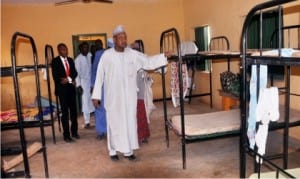
Governor Atiku Bagudu of Kebbi State (right), inspecting the dormitory of the Government Girls Science College in Dakingari on Wednesday.



Eight states across Nigeria have converged in Port Harcourt for the 2026 edition of the President’s Inter-Senior Secondary Schools Debate Championship, hosted by Rivers State Government.
The three_days championship, themed “27th Democracy & 3rd Year Anniversary of President Ahmed Tinubu Inter-Senior Schools Debate Championship,” opened on Monday at Government Girls Secondary School, Rumueme, Port Harcourt.
The participating states are Ebonyi, Abia, Delta, Sokoto, Yobe, Kwara, Enugu, and host state Rivers. Each state is represented by its top debaters selected through state-level contests.
Declaring the event open, the Rivers State Commissioner for Education, Dr. Peters Nwagor, said the championship goes beyond winning trophies. He described it as a national investment in the next generation of leaders.
“This platform is for nurturing young minds,” Nwagor said. “It builds critical thinking, research skills, confidence, effective communication, and the ability to engage constructively with views different from one’s own. These are the very qualities upon which responsible leadership and nation-building are founded.”
The Commissioner commended the organizers, participating schools, teachers, and coordinators for their commitment to promoting intellectual excellence among Nigerian youths.
He urged the students to compete with confidence, discipline, and respect. “Debate is not merely about winning an argument,” he noted. “It is about listening carefully, reasoning with clarity, presenting your evidence with honesty, and having the grace to learn from others. Let the quality of your ideas and the strength of your character define your participation here.”
Nwagor assured the participants that Rivers State is proud to play its part in raising a generation that will bring bold and innovative solutions to the country’s challenges. He wished all teams a rewarding, memorable, and successful championship.
Earlier in his welcome address, the National Coordinator of the President’s Schools Debate Nigeria, PSDN, Elder Dare Oritu, called the event a “gathering of minds” drawn from different parts of the country.
According to Oritu, debate is about three things. “It is about _unity_. It brings us together from different schools and backgrounds to learn from one another. It is about _broadening the mind_. It teaches you to think deeply, to listen well, to ask ‘why,’ and to defend your ideas with facts and respect. It is about _preparing you for leadership_. The problem-solvers and decision-makers of tomorrow are in this hall today.”
He reminded the students that debate is not a contest of aggression. “Debate is _not a fight_. We challenge ideas, not people. It is _not about who is better_. And it is _not do-or-die_. We win with grace, and we learn with humility,” Oritu said.
The PSDN National Coordinator encouraged all participants to compete with integrity, speak with clarity, and leave wiser than they came. He wished them the very best throughout the competition.
Highlights of the opening ceremony included the official draw for debate matches, administered by PSDN officials. The pairings will determine which states face each other in the preliminary rounds as the battle for the 2026 national title begins.
Amadi Akujobi

The National Institute of Information Technology (NIIT), Port Harcourt, has graduated 61 students from its six-month Cybersecurity training programme. The institute also inducted 48 new students for the new academic session during a brief ceremony held at its Port Harcourt centre on Monday.
Centre Manager of NIIT Port Harcourt, Mr. Precious Ogulu Tom, said the institute is always excited to induct students into cybersecurity because it is one of its flagship courses with strong international recognition. He noted that the centre’s performance has earned it high ratings from ICSS, adding that in the past academic year, more than 20 students passed ICSS certification exams.
According to him, beyond the NIIT certificate, which is globally recognized, students also proceed to ICSS and complete their courses without difficulty. He credited the faculty for maintaining standards and said NIIT remains the leading ICT training institute in Port Harcourt and Rivers State.
Tom said NIIT has a presence in all major cities in Nigeria and its headquarters in India, with training covering all areas of ICT. He added that every year the institute produces at least one first-class graduate in Software Engineering from partner universities such as Middlesex University and the University of Sunderland. He described the institute’s approach as practical and hands-on.
On fees, he addressed comments about cost online, saying quality training requires investment. “Does anything good come easy? Nothing good comes easy,” he stated. He explained that students receive industry-standard books and globally recognized certificates, and invited parents and prospective students to register with NIIT for value-driven training.
Also speaking, Principal Instructor for Cybersecurity and Ethical Hacking, Mr. Nyekwere TamunoTonye, said the cohort began in February with high expectations and completed the programme in six months. He said one notable achievement was that the class remained largely intact despite challenges, including system breakdowns and family issues. “At the end of this six months, we never lost anybody. That is the greatest. So, we give God the glory,” he said.
Nyekwere said students were exposed to multiple domains in cybersecurity and received strong practical training. He told the graduands that their real learning starts now and urged them not to relent. “This is no longer the time you go back to play,” he added.
He emphasized that the institute equipped them not only with technical and practical skills but also with character and a mindset for continuous learning. He noted that no institution, including Harvard or Yale, can teach everything, but good schools set the path, which NIIT has done.
He charged them to deploy their skills positively. “I don’t want to see any of you being arrested by the EFCC tomorrow. I don’t want to see any of you being arrested by the police. I don’t want to see any of you being arrested,” he said.
Senior IT Counselor and Head of Sales and Marketing, Mrs. Igbigbari Vincent-Eretoru, congratulated the graduands for completing the programme and defending their presentations according to NIIT academic standards. She said certificates are awarded in character and learning, and urged them to be good ambassadors of NIIT Port Harcourt by applying what they learned.
Responding on behalf of the graduates, Class Section Head Tamunotonyesia Epelle said many came in with questions and uncertainty about specializations but left with clarity, confidence, and technical competence gained through practical assignments, teamwork, and the instructor’s push to avoid mediocrity.

The Hydrocarbon Pollution Remediation Project (HYPREP) has commemorated the 15th anniversary of the release of the United Nations Environment Programme (UNEP) Environmental Assessment Report on Ogoniland, reaffirming its commitment to restoring the environment and improving the livelihoods of affected communities.
In a statement signed by the Project Coordinator, Prof Nenibarini Zabbey, to commemorate the anniversary, HYPREP described the anniversary as a significant milestone in Nigeria’s environmental restoration efforts, noting that the project has made remarkable progress in implementing the recommendations of the landmark UNEP report released on August 4, 2011.
The UNEP report had revealed extensive oil pollution across Ogoniland, severe environmental degradation, and serious public health risks resulting from decades of petroleum operations. It also recommended an initial $1 billion fund to commence the cleanup of the affected communities.
According to HYPREP, the Federal Government formally launched the Ogoni clean-up in 2016, while the Project Coordination Office was established in 2017 to drive the implementation of UNEP’s recommendations.
Zabbey said the current administration has continued to prioritise the project under the Renewed Hope Agenda.
Providing an update on the cleanup, the Project Coordinator disclosed that 30 of the 65 contaminated sites identified by UNEP have been fully remediated, while work is ongoing at several medium- and high-risk locations. It also stated that more than 1.5 million mangrove seedlings have been planted as part of what it described as the world’s largest restoration of oil-degraded mangroves, with over 1,000 hectares of shoreline already rehabilitated.
Zabbey further revealed that 49 Ogoni communities have been connected to potable water schemes through multiple water projects and booster stations aimed at providing safe drinking water across the region.
In the health sector, he said the 100-bed Ogoni Specialist Hospital in Kpite and the 43-bed Cottage Hospital in Buan are nearing completion, adding that several existing health facilities have been upgraded with modern medical equipment, while five ambulances have been donated to improve emergency healthcare services. The Project Coordinator also disclosed that a three-year human health biomonitoring study is being conducted in collaboration with the World Health Organization’s International Agency for Research on Cancer (IARC).
On economic empowerment, Zabbey stated that the Project has created more than 8,000 direct jobs and trained thousands of Ogoni youths and women in various vocational and technical skills, including software development, cybersecurity, aviation, commercial diving, seafaring, mechatronics, and creative arts. The project also reported awarding scholarships to more than 1,000 students, providing grants to small businesses, and supporting persons living with special needs through skills acquisition programmes.
The statement further highlighted ongoing legacy projects, including the Ogoni Power Project and the Centre of Excellence for Environmental Restoration, which it said is about 96 per cent complete. HYPREP also welcomed the recent designation of the Ogoni Wetland as a Ramsar Site of International Importance and pledged to continue promoting biodiversity conservation and sustainable management of the ecosystem.
Marking the anniversary, Zabbey said the progress achieved over the past 15 years demonstrates the collective commitment of government, development partners, stakeholders, and local communities to restoring Ogoniland. He called for renewed collaboration to sustain the cleanup effort, promote environmental sustainability, and support the long-term development of the region. 3
-

 News2 days ago
RSG Targets Nine Million Residents in Mosquito Net Distribution Campaign
-

 Oil & Energy2 days ago
Aiyedatiwa Signs New Electricity Bill
-

 Maritime2 days ago
Marine Minister Commends President Tinubu On NPERA Bill Assent
-

 Oil & Energy2 days ago
NLNG Commissions Research And Innovation Centre In RSU
-

 News2 days ago
KenPoly Holds Eight Convocations, August 29
-

 News2 days ago
RSG Begins Another Phase of Projects Commissioning Today
-

 News2 days ago
RMAFC Completes Revenue Sharing Review, Proposes New Pay
-

 Maritime2 days ago
NAGAFF Petitions IGP Over Alleged Maritime Police Harassment