
Environment
Pollution And Environmental Litigations’ Effects In N’Delta

The fact is that, it is only
few people that will dispute that environmental degradation is rampant throughout the oil producing region of Nigeria. Whether due to oil spills gas flaring, dumping of wastes associated with drilling artesenal refining or other related activities, the impacts on the environment and human livelihoods and health are widespread and severe.
Environmentally, the Niger Delta is sick and the inhabitants are poor. Moreover, there seems to be a rising tide of criminality and militancy in the region and this has made most communities, particularly in the riverine areas unsafe.
It is an obvious fact that the greatest casualties are the environment and the people.
It would be recalled that, in the past, the people of the Niger Delta have embarked on series of legal actions to seek redress on the pollution of their lands.
A publication recently released by the Centre for Environmental Human Rights And Development (CEHRD) revealed that over 38 environmental related cases have been prosecuted in the region since 1970.
The publication titled; “After Bodo: Effective Remedy And Recourse options for victims of environmental degradation related to oil extraction in Nigeria” showed that in many of these cases, the affected communities and individuals received compensations both monetarily and otherwise.
According to the report, the cases all bothered on pollution which include, pollution of water ways, and destruction of farmlands.
The first of these cases include; Mon Igara V. Shell BP 1970, San Ikpede V.SPDC PDC 1973, Atubie V. Shell BP PDC 1974 and Chinda v Shell BP PDC 1974.
Also mentioned in the report are; Umudje V. SPDC 1975, Nweke and others V. Nigerian Agip Oil Company in 1976. The report also said that in 1986, a number of oil companies were held liable in a case of crude oil pollution which occurred in the Calabar River and spread to Port Harcourt River damaging marine life and raffia palms.
Other cases also examined by the report includes; Nwadiaro V. SPDC 1990, Otoko V. SPDC, a case of oil spillage along the Andoni River 1990, SPDC V Ambah 1991, SPDC V. Enoch 1992 and Elf V. Opere Sillo 1994.
The publication also mentioned the cases of SPDC V. Farah 1995, SPDC V. Tiebo 1996, SPDC V. Amaro 2001, SPDC V. A. Otelemaba Max, SPDC V. Isaiah 2001, Mobil V. Monokpo 2003, SPDC V. Edamkue 2003 and NNPC V. Sele 2004.
The rest are; Gbemre V. SPDC seeking a declaration to stop gas flaring in 2007, Phyne V. SPDC 2006, Firibed V. SPDC also in 2006.
Also are Agadia and Uruesheyi SPDC .V. SPDC 2006, Chief Omu and others V. SPDC V. Ohaka 2008, Agbara V. SPDC 2001 – 2010 SPDC V. John 2011, John Holt Krebale and others V. SPDC and Barizaa M. T. Dooh V SPDC in 2012.
The report further mentioned other cases such as Ogbodo V. SPDC 2011, Batan, Delta State V. SPDC, Bodo Community V. SPDC, SERAP V. Federal Republic of Nigeria and the Bonga Oil Field coast of the Niger Delta.
The report which dwelt extensively on the Bodo V. SPDC case described it as the most successful.
According to the report, the well studied and highly publicized Bodo V. Shell cases began with two large spills in August and December 2008 affecting thousands of fishermen and farmers in Bodo and neighbouring communities.
“The oil company’s response to the spill was slow and it infact admitted liability”.
It noted that the case which greatly benefitted from legal expertise and scientific evidence led to an out of court settlement in which a whooping sum of 83.3 million dollars was paid to the communities.
Commenting on the report in an interview with The Tide, a Director in the Centre for Environment Human Rights and Development (CCHRD) Mr Laurent Dube, said that getting Justice for the communities have always been problematic except the case of Bodo.
Mr Dube said that, the situation shows the level of resistance to environmental pollution in the Niger Delta, adding that the resistance will continue for a longer time to come until the oil companies change their strategies in their operations.
The overall impacts was that while some of these communities got compensations, others never received any compensations.
The report also revealed that, some loop holes in our Judicial System were exploited by the companies to deny the communities of their rights. A case or point was that of Gbemre V. SPDC in Delta State, in which a declaratory injunction was sought for the stoppage of gas flaring on the Niger Delta by April 30 2007.
The Tide learnt that in the same year, the Judge was transferred to another court and the court file went missing.
SPDC however obtained a court order, thereby further delaying compliance and currently ruling has not been enforced.
The effect is that the non enforcement of the ruling has made gas flaring a common phenomenon in the Niger delta.
In the other cases, although compensations have been paid to the communities, but that has not stopped the companies from further polluting the environment.
An environmentalist, in the Niger Delta, Mr Thomas Ikaraba told The Tide in an interview that, the impacts of these litigations are yet to be felt in the region as after monetary compensations, the environment are left un-cleaned.
Mr Ikaraba cited the case of Bodo, where individuals and families received monies, but the community is yet to be clean up.
He urged for legislations that will make it crime for companies not to clean up polluted sites after paying compensations.
He views were also shared by across section of environmental Right Activities in the region.
In summary, the report showed the level of resistance by the people to pollution in the Niger Delta and the probable impacts.
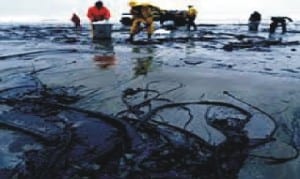
An oil spill polluted site in the Niger Delta



President, Nigerian Society of Engineers (NSE), Mrs Margaret Oguntala, has inaugurated the construction of 18 units residential terrace in highbrow Alausa area of Lagos toward bridging the nation’s shelter gap.

Ministry of Water Resources and Sanitation has launched the 1GOV Enterprise Content Management System (ECMS) to enhance digital governance and improve service delivery.
The launch, held on Thursday in Abuja, marks the ministry’s transition from paper-based operations to a smart, integrated and technology-driven work environment.
The Minister of Water Resources and Sanitation, Prof. Joseph Utsev, said the deployment aligns with the Renewed Hope Agenda of President Bola Tinubu.
Utsev said the system would improve data management, streamline workflows and strengthen transparency and accountability across the ministry.
According to him, the ECMS will enhance productivity, preserve institutional memory and reduce operational costs in the ministry.
Launching the platform, the Head of the Civil Service of the Federation, Mrs Didi Walson-Jack, said the initiative is a major step in public sector reform.
She said the ministry’s mandate affects Nigerians through water supply, sanitation, irrigation, river basin development and climate resilience programmes.
Walson-Jack said the 1GOV ECMS enables secure digital records management, automated workflows, electronic approvals and real-time collaboration across MDAs.
She added that the deployment aligns with the Federal Civil Service Strategy and Implementation Plan 2021–2025 and the directive for full digitalisation by December 2025.
“Effective governance cannot afford delays caused by manual bottlenecks or avoidable inefficiencies,” she said.
She directed that all official correspondence in the ministry must henceforth be processed through approved digital registry channels.
In her remarks, the Permanent Secretary, Dr Emanso Umobong, said the system would eliminate workflow inefficiencies and improve service delivery.
She urged staff to fully adopt the platform and engage in continuous capacity building.

Research shows that local communities and citizens living at the grassroots, particularly women, are directly impacted by the environmental degradation, flooding and others that result from these manifestations.
In the light of this, non-governmental organisation, Ese Usamali Foundation For Rural Development (EUFORDe), has held a forum for women and other members of oil impacted communities, tagged: ‘Voices from the Grassroots,’ and aimed at building their resilience and mitigation efforts against climate change and environmental degradation
The forum, with the theme: ‘Building Resilience for Oil Spill Impacted Ahoada Communities,’ organised with support from Global Green Grants, was held in Ahoada Community, Ahoada East Local Government Area of Rivers State, on December 5, 2025.
Executive Director of Ese Usamali Foundation For Rural Development, Mercy Elemchukwu-James, said women are at the forefront of efforts to mitigate the impact of climate change and environmental degradation.
The event, therefore, was “designed for community women impacted by oil spills, flooding and other environmental degradation,” she said.
Community women were enlightened by resource persons on new opportunities for sustainable agricultural practices and water management techniques that cushion the impact of oil spills.
Lectures were also delivered on Self-care and Trauma-care, with focus on physical and mental health of the population, and increasing access to health-related resources and services; as well as on Food security and women’s critical role in decision making in oil spill and flood situations in communities
Elemchukwu-James pointed out that the event created a forum for stakeholders, civil society actors and others to dialogue on measures at advancing inclusive and sustainable livelihoods of community women.
She stressed the need for collaborative efforts towards achieving mitigation efforts, while underscoring EUFORDe’s commitment to “fostering partnerships as a critical driver for achieving a healthy community and sustainable development.”
Elemchukwu-James described participants’ design of ‘Community Resilience Plan,’ to manage and combat environmental degradation and crises, as part of achievements recorded at the event.
The forum also witnessed the launching of EUFORDs’ Center For Resilience and Rights.
“This center is established to build resilience as Trauma-Care for victims of environmental degradation, support for survivors of Gender Based Violence (GBV) and a platform where victims of environmental injustice and other GBV cases can seek redress,” Elemchukwu-James said.
Participants celebrated the milestones achieved and charted a path toward greater impact in the coming years. They also described the event as “an inspiring and transformative experience.”
Elemchukwu-James said the awareness creation workshop “reaffirms EUFORDe’s mission to create an equitable society in which the rights and capacities of women, youth, children and underprivileged are integrated in the socio-economic planning and development of communities, for the attainment of equity and peace.
-

 News3 days ago
2026 Budget: FG Allocates N12.78bn For Census, NPC Vehicles
-

 Sports3 days ago
AFCON: Osimhen, Lookman Threaten Algeria’s Record
-

 Politics3 days ago
Wike’s LGAs Tour Violates Electoral Laws — Sara-Igbe
-

 Politics3 days ago
Rivers Political Crisis: PANDEF Urges Restraint, Mutual Forbearance
-

 Sports3 days ago
Arsenal must win trophies to leave legacy – Arteta
-

 Sports3 days ago
Palace ready To Sell Guehi For Right Price
-

 Sports3 days ago
Tottenham Captain Criticises Club’s Hierarchy
-

 Maritime3 days ago
MARITIME JOURNALISTS TO HONOUR EX-NIWA MD,OYEBAMIJI OVER MEDIA SUPPORT