
Nation
THE STATES

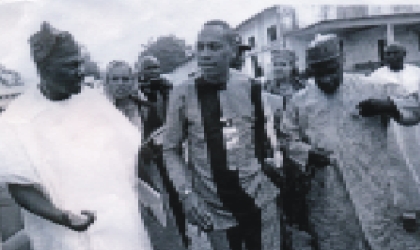
L-R: Convener, Coalition for Minority Rights (CMR), Mr Mark Lipo, representative of vice President, Joseph Malomo and representative of plateau Governor, Mr Stephen Gadong, at the commemoration of stefanos Foundation Internally displace persons (IDP) camp anniversary and launching of coalition for CMR in Jos on Saturday.
Borno
The Borno State chapter of the Nigeria Union of Teach
ers (NUT) has donated reading glasses to 140 teachers with eye problems after free medical treatment.
The state Chairman of NUT, Alhaji Bulama Abiso, disclosed this in Maiduguri in an interview with newsmen
He said 14 out of the beneficiaries would undergo eye surgery, while others were given free eyeglasses.
Abiso said the free eye screening was conducted by a team of medical experts from Afro Eye Foundation, a Non-Governmental Organisation (NGO).
He said patients with minor eye problems were treated at its medical centre, while those with surgical cases were referred to the University of Maiduguri Teaching Hospital for operation.
Abiso said that the gesture was part of the union’s efforts
Ekiti
An Ado-Ekiti High Court has sentenced one David
Olugboyega to death by hanging for armed robbery involving N14,570.
Justice John Adeyeye passed the judgment following the confessional statement of the convict and the conclusion of trial by the prosecution.
During trial, the prosecutor, Mr Alaba Adeyemi, told the court that the convict committed the offence on March 20, 2003 at Araromi Street, Ikere -Ekiti.
He said the convict, armed with dangerous weapons including gun and cutlass, robbed three people of N14,570.
Specifically, Adeyemi said the convict robbed Kola Owolabi of N8,000; Beatrice Olawumi, N5,000 and Idowu Abiodun, N1,570.
The prosecution called seven witnesses to prove the case.
The convict, who made confessional statement at the police station, opted to defend himself without a lawyer.
FCT
Director-General of Centre for Management Develop
ment (CMD), Dr Kabir Kabo has warned unaccredited management training institutions and uncertified consultants to close shop or face the wrath of the law.
Kabo gave the warning in a statement in Abuja by his Special Assistant on Media, Alhaji Abdulkadir Ibrahim.
Kabo said the Nigerian Council for Management Development Act gave it a regulatory role to sanction any management consultant or training institution that undertook training programme without accreditation.
CMD, which is a parastatal agency under the National Planning Commission, is the operational arm of the council.
The visit took Kabo to some organisations, including Jheyah Nig. Ltd., PAN Training Centre, Shehu Shafi’i and Co. and Rafisa Safety and Management Consultants.
The DG added that the council was determined to ensure quality assurance, control and intervention in the operations of manpower and management developers.
Jigawa
The Pension Transitional Arrangement Directorate
(PTAD) has commenced the verification of federal pensioners in Jigawa State.
This is contained in a statement by the PTAD Director-General, Nellie Mayshak, in Dutse. The statement stated that the verification, which began on November 2 with pensioners in the North-West – Jigawa, Kano, Kebbi, Sokoto, Katsina, Kaduna and Zamfara, would end on November 14.
It stated that South-East – Anambra, Enugu, Ebonyi, Abia and Imo would hold between November 30 and December 12, while North-East, South-West, South-South and North-Central would hold in the first quarter of 2016.
Kaduna
The Independent Petroleum Marketers Association of
Nigeria (IPMAN), Kaduna branch, has appealed to the Department of Petroleum Resources to urgently address the current fuel scarcity in the area.
The IPMAN Spokesperson, Alhaji Sani Yushau, made the appeal in an interview with newsmen.
Yashau said the problem had been worsened by the inability of the refinery in Kaduna to produce as well as the non transportation of fuel from Lagos by marketers.
Kano
The Department For International Development (DFID),
has promised to partner the Kano State Government in addressing the problem of unemployment in the state.
The Manager in charge of DFID’s training programme in Kano, Dr Muhammad Sagagi, stated this in an interview with newsmen in Kano.
Sagagi had had an audience with Alhaji Kabir Rurum, the Speaker of the Kano State House of Assembly.
He said the programme focusing on Kano, Kaduna and Katsina States was tagged Way Out ‘Mafita.’
According to him, the three states have the highest number of unemployed people in the country.
Katsina
Senator Mustapha Bukar (Katsina North), has rolled out
his free eye treatment for no fewer than 7,000 people in his constituency.
Speaking at the inauguration of the free eye programme, Bukar noted that the beneficiaries were selected from the 12 local government areas of the senatorial district.
He said the free eye treatment and surgery was instituted as part of welfare programmes for the people.
“Many of the beneficiaries could not afford such medical treatments or operations due to financial constraints.
“We engage 20;qualified doctors for the exercise and it is expected to be completed within one month.”
He restated his commitment to introduce more programmes that would improve the living standards of the people.
Lagos
The Senior Staff Association of Nigerian Universities
(SSANU), has called on the Federal Government to find ways of improving the working conditions for its members.
The National President of SSANU, Mr Samson Ugwoke, made the appeal in an interview with newsmen in Lagos.
According to him, rather than relieving workers in the system, the government should seek means of improving the living conditions in the universities.
It will be recalled that members of the association had in June, protested a circular directing Vice-Chancellors of Federal Government universities to stop accommodating their staff school teachers in their emolument structure.
Nasarawa
Governor Tanko Al-Makura of Nasarawa State has of
fered free medical services to all persons living with disabilities in the state. Al-Makura disclosed this during the commemoration of World Disability Day in Lafia.
He said the state government had embarked on a census and registration of all persons with disabilities across the 13 local government areas to enable them to access the service and other gestures from the government.
He said the state had tried the free medical services in the past without success due to activities of saboteurs.
Oyo
An Alternative Therapy Medical Practitioner and Nutri
tionist, Dr Ayelara Oni, says lemon is an anti-cancer food.
Oni made the disclosure in an interview with newsmen in Ibadan. She said lemon was acidic to taste but was an alkaline-forming food, explaining that this was why it was good for balancing a highly acidic condition in the body, thereby balancing the body’s pH.
She added that lemon contained 22 anti- cancer compounds, including limonene, which was the natural oil that help to slow or halt the growth of cancer.
Oni, who is also a Director at a herbal store, said lemon had a substance called flavonol glycosides which could stop cell division in cancers.
Plateau
The Executive Chairman, Plateau State Universal Basic
Education Board, Prof. Mathew Sule, has called for the establishment of health clubs in public schools to enlighten children on prevention of HIV/AIDS.
Sule made the call in an interview with newsmen in Jos.
He said such clubs would be good platforms to enlighten pupils and students on the ultimate target of eradicating the pandemic in the society.
He added that “the best time to inculcate knowledge in children is when they are minors; that is the time such awareness could be firmly rooted in their subconscious.’’
The SUBEB boss explained that the health clubs, which were already part of school curriculum activities in Plateau, should serve as platforms for enlightenment on AIDS and the dangers it posed to the society.
He exressed regret that many children had been made orphans by the scourge, pointing out that such persons were worst hit because they would find it difficult to acquire education and other neccesities of life.
Sokoto
Former Treasurer of APC in Sokoto State, Alhaji Muktari
Mapia, has advised the state independent electoral commission to use card readers in the forth coming local government election.
Mapia told newsmen in Sokoto that using card readers would enhance the credibility of the conduct of the election.
He called on the commission to provide a level playing field for the conduct of transparent election to usher in democratically elected leaders at the grassroots.
The former treasurer also called on leaders of political parties in the state to sensitise their followers to the dangers of involvement in political violence and thuggery.
He advised security agencies to brace up for the challenges by providing a peaceful atmosphere for the conduct of the election in the state.



Rivers State University and the Otonti Nduka Foundation for Values Education jointly hosted a two-day National Conference on 8 and 9 May 2026 to examine the state of values in Nigeria.
The two days conference held at Rivers State University convocation arena brought together academics, policymakers, legal experts and education leaders under the theme _“Trends and Challenges in Upholding Values in Nigeria.”_
The gathering focused on policy gaps, curriculum reform, and the role of ethics in public service and education.
The event opened on Friday with remarks from Vice Chancellor Prof. Chief Isaac Zeb-Obipi, who stressed the need to address declining moral and civic values across Nigeria’s education and public sectors. A book of abstracts for the plenary sessions was also presented to participants.
Key speakers included former Attorney General Chief Dr Kanu Agabi, SAN; NERDC Executive Secretary Prof. Shehu Salisu; Prof. Hauwa Imam, FNAE, of the University of Abuja; former Rivers SUBEB Chairman Ven Dr Fyneface Akah, ; former NIMASA DG Dr Hon. Dakuku Adol-Peterside; and RSU Director of ICT Prof. Sunny Orike.
Discussions centered on integrating values education into schools, tertiary institutions and public institutions, alongside the impact of technology on moral development among young Nigerians. Panel and plenary sessions produced practical recommendations for curriculum and policy reform.
On Saturday, the foundation marked its centenary with the unveiling of the book _Otonti Nduka in History_, launched by Chief Engr. Grant Offor, FNSE. The Nigerian Academy of Education held a ceremonial procession led by its President Prof. Olu Jegede and the Ikwerre Professors Forum.
In a communiqué, participants called for stronger collaboration between government, civil society and academia to mainstream values education nationwide. They recommended reviewing teacher training curricula and expanding digital platforms to promote ethical civic engagement, with the foundation pledging to share the outcomes with education authorities for implementation.
Dignitaries present included Ogbakor Ikwerre Worldwide as Chief Host, Prof. Emeritus Chief T. Uzodimma Nwala, the Ikenga 1 of Mbaise and first philosophy student of Prof. Otonti Nduka, alongside scholars and community leaders.
Amadi Akujobi

The Shell Nigeria Gas Limited, in partnership with the Manufacturers Association of Nigeria, has reaffirmed support for efforts to expand gas distribution infrastructure in Rivers State as part of initiatives aimed at improving access to affordable, cleaner and more reliable energy for industries across the South-South region.
The commitment was highlighted during the SNG–MAN Business Forum held in Port Harcourt, where stakeholders from the industrial and public sectors examined the role of natural gas in driving industrialisation, boosting local production and strengthening energy security.
Speaking at the forum on behalf of the Managing Director of Shell Nigeria Gas Limited, the company’s Head of Gas Distribution, Mr. Chukwuka Amos Ejesi, described natural gas as a critical component of Nigeria’s energy mix and a key driver of sustainable industrial growth.
According to him, Nigeria’s gas development agenda has reached a stage where policy direction must be matched with practical implementation capable of addressing the energy challenges confronting manufacturers.
He noted that pipeline gas offers industries a cleaner, more dependable and cost-effective energy alternative capable of supporting uninterrupted operations, reducing emissions and improving production efficiency.
“Gas is the backbone of manufacturing, and we are encouraged by the growing recognition among stakeholders of the need for cleaner and more reliable energy solutions,” he said.
Ejesi stressed the need for sustained collaboration among energy providers, government institutions and industrial stakeholders to maximise the country’s gas resources for economic development.
He added that improved gas infrastructure would strengthen manufacturing value chains, enhance productivity and promote more competitive industrial operations across Rivers State and the wider South-South region.
Participants at the forum also emphasised the importance of expanding energy infrastructure as a pathway to unlocking industrial capacity, reducing operating costs and promoting sustainable industrial development.
Representing Governor Siminalayi Fubara, the Director-General of the Rivers State Investment Promotion Agency, Dr. Chamberlain Peterside, reaffirmed the state government’s commitment to partnering with private sector investors to revitalise industrial activities in the state.
He identified key projects targeted under the initiative to include the revival of the Ahoada Industrial Park, the New Port City project and the proposed Bonny Industrial Park, all aimed at stimulating economic growth and expanding industrial opportunities along the Bonny corridor.
According to the governor, the long-term vision is to position Rivers State as a leading manufacturing hub in Southern Nigeria through strategic public-private partnerships.
Governor Fubara also commended Shell Nigeria Gas and MAN for sustaining engagements geared towards improving industrial energy access, noting that gas infrastructure development remains central to the state’s economic recovery plans.
He further observed that the gas sector presents enormous opportunities for economic growth, especially as global energy systems continue to shift towards cleaner energy sources.
The governor called on stakeholders to work collectively towards developing a practical and sustainable gas framework capable of supporting the state’s industrial and energy development objectives.
Chairman of MAN, Rivers and Bayelsa Branch, Elder Vincent Okuku, described gas as indispensable to industrial operations, noting that many manufacturers continue to struggle with the high cost of alternative energy sources.
Similarly, President of the Port Harcourt Chamber of Commerce, Industry, Mines and Agriculture, Dr. Chinyere Ngozi Nwoga, said the transition to natural gas had become increasingly necessary for businesses seeking stable and cost-efficient operations.
“Pipeline natural gas provides a more cost-effective and reliable source of energy for industries,” she stated.
Also speaking, former Chairman of MAN in Rivers and Bayelsa States, Mrs. Emilia Akpan, stressed the need to align energy infrastructure development with investment in human capacity.
She maintained that rebuilding the state’s economy would require not only reliable energy supply but also the development of technical skills needed to support long-term industrial growth.
By Kevin Nengia
-
News1 day ago
Obuah’s Victory Excites Former Lawmaker as APC Primaries Conclude in Rivers West
-

 Politics3 days ago
APC PRIMARIES: FUBARA’S WITHDRAWAL, HISTORIC SACRIFICE FOR NATIONAL STABILITY ……. GROUP
-

 News3 days ago
Court Sentences Seven To Death Over Murder Of Cleric In Rivers
-
News1 day ago
105 Nigerians Killed In S/Africa In Seven Years
-

 Sports3 days ago
PH Arsenal Community Set For Streets Procession, Saturday
-

 Politics3 days ago
IPAC Flays INEC Over Election Guidelines Judgement
-

 Politics3 days ago
NDC To Adopt Electronic Voting For Future Primaries
-

 Niger Delta1 day ago
Royal Father Endorses PH Arsenal Community, Pledges To Support