
Nation
THE STATES

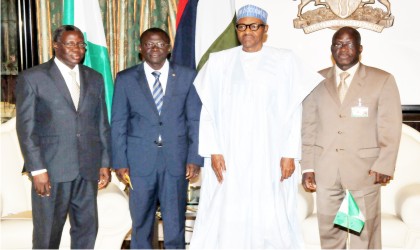
L-R: Bukina-Faso Ambassador to Nigeria, Mr Piabe Ndo, Bukina-Faso’s Special Envoy, Mr Rene Bagoro, President Muhammadu Buhari and the Permanent Secretary, Ministry of Foreign Affairs, Ambassador Paul Lolo, during the visit of the Special Envoy to the Presidential Villa in Abuja last Thursday.
Adamawa
The National Emergency Management Agency (NEMA)
has said it had united 5,000 families in Adamawa and Borno States following the liberation of some communities from Boko Haram insurgents in the North East.
The Director-General, NEMA, Alhaji Sani Sidi, disclosed this while presenting relief materials to Internally Displaced Persons (IDPs) returnees in Uba, Adamawa..
Sidi said the integration programme was initiated by the agency to support displaced persons, who returned to their various villages.
Sidi, represented by Alhaji Sa’ad Bello, NEMA camp coordinator in Adamawa, said the agency would provide necessary assistance to the returnees in parts of the affected states.
He said some of the displaced persons who fled their villages in Mubi North, Mubi South and Maiha local government areas of Adamawa had returned to their respective villages.
Benue
The Governing Council of Benue State University, has
resolved to take proactive measures to cut down cost for the sustenance of teaching and research in the institution.
The decision is contained in a statement issued by the Pro-Chancellor and Chairman of the Council, Prof. Ode Ojowu, made in Makurdi.
The statement quoted Ojowu as saying that contract staff whose tenure had expired would no longer be renewed, except contracts that were based on citizenship or critical needs.
He stated that employment into the university which was not required for accreditation purposes would be suspended forthwith and urged the school management to work out modalities to curtail overhead expenditure.
He said university funds would no longer be used to sponsor foreign trips of staff until further notice and appealed to those concerned to bear the cost.
Ekiti
Worried by the spate of kidnapping, the Ekiti State House
of Assembly, has unanimously passed a resolution calling on security agencies to be more proactive in their duties.
The lawmakers decried the ugly development, urging the Commissioner of Police, Mr John Etok, and other security agencies to ensure that they end the development.
Contributing during plenary, the members called for the enactment of law that would give a stiffer penalty for convicted kidnappers.
Messrs Olusanya Aladeyelu, Samuel Omotoso, Sunday Akinniyi and Gboyega Aribisogan, contributed to the debate.
The House charged members of the public to be more vigilant, security conscious and report any strange movement in and around their environment to security agencies around them.
FCT
The Pan-African Cultural Congresses (PACC) has said that
Africans are optimistic that implementing the continent-wide diversification policy will promote development.
The PACC Chairman, Mr Ferdinand Anikwe, made this know in an interview with newsmen in Abuja.
Anikwe said that African leaders were aware that extraction and exportation of raw materials would not grow the continent’s economy.
“Most African countries are currently implementing diversification policies to make sure that the extraction and exportation of raw materials do not become the only economic activity driving growth.
“At the Pan African Congress, we encourage positive diversification policies, especially in the area of Culture and Arts as well as other economically viable areas.
Kaduna
A United States-based lecturer, Prof.. Aondover Tarhule,
has urged the management of the Kaduna State University (KASU) to establish a research proposal development centre.
Tarhule made the call on Wednesday in Kaduna while presenting a paper titled, “ Writing a Successful Grant Proposal“ during the university’s Faculty of Science monthly seminar.
Tarhule, Chairman; Department of Geography and Environmental Sustainability, University of Oklahoma, United States of America, said the centre when established, would address the challenges facing writing research proposals to get approval for funding.
He said international organisations and foreign government agencies are interested in funding researches, particularly in developing countries like Nigeria.
Kano
The Kano State Government has approved over N39 million
for clearing of drains in Kano metropolis.
The state Commissioner for Information, Malam Muhammad Garba , announced this while briefing newsmen on the outcome of the State Executive Council meeting in Kano on Thursday.
Garba said the exercise was necessary to prevent possible flooding and to guard against possible outbreak of communicable diseases in the area.
According to him, the council has also approved N61 million for the revalidation of approval in respect of teaching skills programme.
He also said that the state government had approved N18 million for three rounds of polio Immunisation Plus Days campaign in the state.
Lagos
The Lagos State House of Assembly on Thursday,
constituted an eight member Ad Hoc Committee to review the circumstances that led to impeachment of former Deputy Governor Femi Pedro.
This followed an appeal made by the former Deputy Governor in a letter read on the floor of the House by the Clerk, Mr Ganiyu Abiru.
The ex-deputy governor urged the House to revisit his impeachment in a compassionate manner.
The Clerk also stated that the letter from Pedro was attached with his letter of resignation while leaving office.
Pedro appealed to the 8th Assembly to revisit the impeachment sanction levelled against him by the 5th Assembly in 2007.
Nasarawa
Governor Tanko Al-Makura of Nasarawa State has
promised to reconstruct the collapsed federal bridge along Abubakar Burga road in Keffi within two weeks.
Al-Makura made the pledge while inspecting the collapsed bridge.
He appealed to the residents of Keffi and motorists plying the route to be patient, assuring that government is doing everything possible to fix the bridge in order to reduce their hardship.
He said: “Although this is a Federal Government road, my administration is committed to initiate people’s oriented projects in order to better their living standard.
According to him, the reconstruction of the bridge if completed would go a long way in improving the socio-economic activities of the people.
Al-Makura also said that the state government was seriously worried by the hardship being experienced by the people as a result of the collapsed bridge which he said has cut off the city into two.
He added that his administration would do everything possible to ensure that the people of the state enjoy the dividends of democracy.
Sokoto
The United Nations’ Children’s Fund (UNICEF) has urged
medical personnel in hospitals to continue to partner with community health workers to prevent disease outbreak in the country.
The Sokoto State Incident Manager for UNICEF, Dr Aminu Shehu, made the call on Thursday, in a presentation at a two-day sensitisation workshop organised for media practitioners by the Fund.
He said doctors in hospitals were largely concerned about individual cases brought before them by patients but failed to report same to the disease surveillance units for research and investigation.
He added that although, community health workers use effective disease surveillance on communities, they were sometime unable to trace possible outbreak of likely communicable diseases which could only be known when patients reported at the hospital.
Taraba
The newly-posted Commandant of the Nigerian Security
and Civil Defense Corps (NSCDC) in Taraba State, Mr Kamilu Isah, has vowed to deal decisively with hoodlums in the state.
Isah, who said this at his maiden media briefing in Jalingo, said there would be no sanctuary for miscreants throughout his tenure in the state.
The commandant said he would form a synergy with other security operatives to combat criminal activities in the state.
Isah said the command would not relent in its mandate of tackling criminal activities and protecting lives and property.
“I’m here to complement other security agencies and to curb criminality,” he said.
Yobe
The Yobe State Primary Healthcare Management Board,
has said it used 40 health facilities to immunise children displaced by insurgency, to ensure that the routine immunisation chain was not broken.
An Assistant Director in the board, Dr Umar Ciroma, disclosed this in Damaturu at an interactive session with newsmen on the Expanded Programme on Immunization (EPI) activities in the area.
He said the board had conducted follow-up activities by visiting Internally Displaced Persons in communities where they took refuge.
He said the board had been working round the clock to ensure that every displaced child was covered and immunized.
Zamfara
An NGO, Association of Reproductive and Family Health
(ARFH), has trained 568 women on different family planning methods in Birnin-Magaji local government area of Zamfara, according to an officer of the body.
The association’s Project Officer in the state, Mr Bamidele Oluwaseun, made this known at Birnin-Magaji during the Second Child Spacing Day.
Oluwaseun said the training was provided under the organisation’s Expanded Social Marketing Project in Nigeria (ESMPIN) project.
He added that the women were mobilised across the local government through the use of Community Based Distribution Agents (CBDAs) with support from the state’s Ministry of Health.
The project officer said that part of the child spacing methods taught the women included Implanon, Jaddel, Inter Urinary Device (IUD), Depo and the use of condom.
Other‘methods, he added, included long acting methods such as counselling, injection, insertions, as well as oral pills.
The officer then called for more support from traditional and religious leaders in addressing the myths and misconceptions regarding child spacing and commended the efforts of the Zamfara Ministry of Health and the Emir of Birnin-Magaji for supporting the programme.
He expressed the hope that the overall goal of increasing access, knowledge to women and men of reproductive age would be achieved if government played its role and if partners increased their commitment and support.

Nation
Rumuaholu Community Denies Land Grabbing Allegations, Accuses Obio/Akpor Chairman of Interference in Land Dispute


The Rivers State Commissioner for Education, Dr. Peters Nwagor, has commended the orderly conduct of the ongoing 2026 West African Senior School Certificate Examination in the state and urged schools to sustain the standard.
Dr. Nwagor gave the commendation on Tuesday during a monitoring tour of selected secondary schools in Port Harcourt and environs where the WAEC exam is ongoing.
The commissioner, who was accompanied by directors and monitors from the Ministry of Education, said he was impressed with the peaceful atmosphere at the centres visited.
“The students conducted themselves properly and wrote their papers under conducive conditions. Invigilators and supervisors also performed their duties professionally,” he stated.

Nwagor noted that the Rivers State Government had invested heavily to ensure the smooth and credible conduct of the examination across the state
He urged candidates to reciprocate government’s effort by shunning all forms of examination malpractice and focusing on their studies.
“Government has done so much to ensure successful examinations in our schools. Students should take advantage of it by remaining focused,” the commissioner said.
While no case of malpractice was recorded in the centres inspected, Dr. Nwagor warned that any principal, teacher, invigilator, or official caught aiding malpractice would face strict sanctions in line with regulations.
He also commended school administrators, teachers, WAEC officials, and security personnel for upholding the integrity of the process.
Centres visited included County Grammar School, Ikwerre/Etche; Government Comprehensive Secondary School, Borokiri; Government Secondary School, Borokiri; and Pabod Model Secondary School.
-

 Niger Delta2 days ago
Warri Airport Manager Disputes Air Peace Bird Strike Claim
-

 News2 days ago
Nigeria Won’t Surrender Any Territory To Criminals -Tinubu
-

 News2 days ago
FG Begins Trial Of Over 600 Terrorism Suspects
-

 Rivers2 days ago
79th IAUE Inaugural Lecture: Prof Anero Advoctes Tuition-Free Education For Children
-

 Politics1 day ago
Parties’ Deregistration: How Justice Lifu Overruled Appeal Court Justices
-

 Politics1 day ago
ADC: Okonkwo Rejects Amaechi As Presidential Running Mate, Withdraws Support
-

 Politics1 day ago
2027: Tinubu’s Projects Give APC Edge In South East – Yilwatda
-
Politics2 days ago
2027: Rivers PFN To Mobilise 600,000 Votes