
Oil & Energy
Pipeline Vandalism: Operators Task FG On Modern Technology

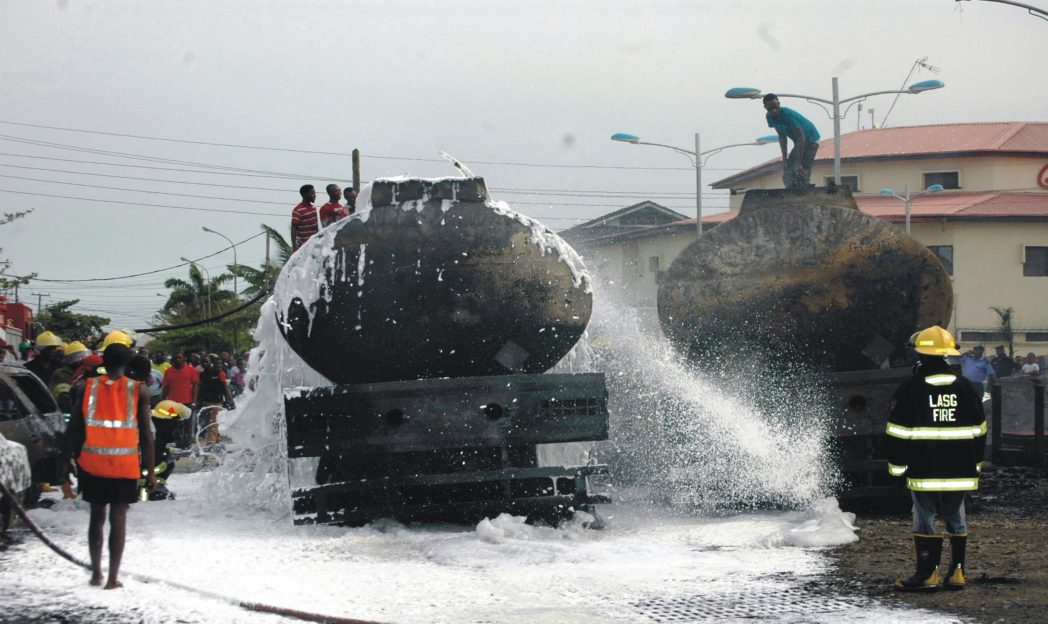
Fire fighters battling to put out fire from two burning fuel tankers loaded with petrol at ascon filling station on Lekki road 13 in Lekki, Lagos, recently. Photo: NAN
Some oil and gas experts
have urged the Federal Government to deploy modern technology in combating the activities of crude oil thieves in the Niger Delta area of Nigeria.
They told newsmen in Lagos that such technology should include Closed Circuit Television and other electronic devices that could indicate that a pipeline was being tampered with.
They also said that such devices gave timely images and reports to the Nigerian National Petroleum Company (NNPC) and other relevant bodies monitoring the pipelines to promptly tackle the problem.
The experts in the industry added that deploying such electronic monitoring devices would assist in reducing the huge national revenue loss through illegal bunkering of crude oil.
Managing Director, Tec Flow Oil and Gas Ltd., Mr Simon Francis, said the issue of oil theft was a serious challenge that needed to be dealt with through a new mechanism.
Francis said that the use of technology would contribute immensely to combating crude oil theft and incessant vandalism in the nation’s pipeline network.
He also urged the government to encourage private sector participation in the oil sector, adding that the organised private sector participation would expand the profit outlay of operators.
“Crude oil theft remains a big challenge to the socio-economic development of the country.
“Government should also deregulate the downstream sector of the oil and gas. This is the only way to address fuel scarcity,’’ he said.
Former National Publicity Officer, Petroleum, National Gas Senior Staff Association of Nigeria (PENGASSAN), Mr Seyi Gambo, said that government should focus more on ways to liberalise the downstream petroleum sub-sector.
According to Gambo, the passage of the Petroleum Industry Bill remains the only way to address sector’s challenges.
He said that the bill identified specific reforms needed to be championed by the NNPC and operators in the entire sector.
He advised the government to privatise the country’s refineries since government could no longer maintain them adequately.
“Government can embark on modular refineries in some state as such investments could be part of the investments that will create jobs for Nigerians,” he said.
Contributing, Director of Operations, IPMAN, Mr Mike Osatuyi, also lamented the non-passage of the Petroleum Industry Bill by the National Assembly.
Osatuyi said that the bill would have gone a long way to address the problems in the petroleum industry, adding that the industry should be handed over to private investors.
The IPMAN boss urged the government to diversify its sources of power generation, adding that it should exploit other alternative sources of energy.
“Government should tap into other cleaner and renewable sources of energy, like solar, wind and other renewable energy sources.
“The incessant vandalism of gas pipelines and other electricity apparatus remains a big challenge for government to tackle.
“The government should also arrest and prosecute anybody caught in the act of vandalism to serve as a deterrent to other criminals.




-
Rivers3 days ago
Rivers Police Uncovers Firearm Concealed In Loaf Of Bread
-

 Niger Delta2 days ago
Pro-Chancellor Hands Over Okey Onuchuku Peace, Conflict Institute Building
-
Sports3 days ago
Six Nigerians To Play For NBA Teams
-

 News3 days ago
Fubara Reaffirms Commitment To Blue Economy, Private Sector Growth …Calls For Protection Of Marine Resources
-
Business3 days ago
Gas Economy: Decade of Gas, Pi-CNG/ EV Deepen Media Engagement
-
 Business3 days ago
IPMAN Raises Concern Over Delay In Chinese Refinery Deal …Predicts Lower Fuel Prices Through Competition
-
Sports3 days ago
NPFL Warns Newly Promoted Clubs
-

 Politics3 days ago
Senate Defends Passage Of State Police Bill