
Politics
National Confab: Matters Arising

There is truly hardly any
misgiving regarding the need to have a dialogue, a national dialogue, in order to decide how Nigeria should be governed. In fact, Nigerians are really itching to talk about their future as many agree that th country is inching towards failure in terms of governance, equitable distribution of the nation’s resources, rule of law and other sundry issues.
What is, however, doubtful is the genuine purpose of the dialogue and whether at the end of the day it can truly pass for the type of national conference that a truly democratic mind anticipates. For instance, would the talk lead to the resolution of the nagging issues that are believed to be creating friction in the polity?
Such issues as true federalism, resource control, state police, rotational presidency, federal character or even the outright disintegration of the country, which some have suggested as the most reasonable way to go for the country given its highly multi-lingual nature.
Or would it, in the words of William Shakespeare, be full of sound and fury but hardly signifying anything meaningful to the common man as previous ones? These are the questions that require urgent answers before delegates from all shades of views about Nigeria converge for the national dialogue which President Goodluck Jonathan surprisingly promised during his Independence Day address as part of events marking the country’s 53rd anniversary.
In the speech, President Jonathan announced the formation of an advisory committee to steer the process leading to the conference, which he has momentarily christened “National Dialogue”. The committee is headed by a chieftain of the Yoruba socio-cultural organisation, Afenifere, and a Second Republic Senator, Femi Okurounmu, while a former Political Adviser to the President, Akilu Sani Ndabawa, is secretary.
Other members of the committee include: former Nigeria Ambassador to the United States (U.S.), Professor George Obiozor; respected constitutional lawyer, Professor Ben Nwabueze (who declined the appointment citing age as reason); Senator Khairat Gwadabe, Senator Timothy Adudu, Col. Tony Nyiam (rtd.), Professor Funke Adebayo, Dr. Mairo Ahmed Amshi, Dr. Abubakar Sadiq , Dauda Birma, Buhari Bello and Tony Uranta.
Inaugurating the members, President Jonathan noted: “Fellow Nigerians, our administration has taken cognisance of suggestions over the years by well-meaning Nigerians on the need for a national dialogue on the future of our beloved country. When there are issues that constantly stoke tension and bring about friction, it makes perfect sense for the interested parties to come together to discuss.
“In demonstration of my avowed belief in the positive power of dialogue in charting the way forward, I have decided to set up an advisory committee whose mandate is to establish the modalities for a national dialogue or conference. The committee will also design a framework and come up with recommendations as to the form, structure and mechanism of the process.
The full membership of the committee will be announced shortly. I expect its report to be ready in one month, following which the nation will be briefed on the nomenclature, structure and modalities of the dialogue.”
The President’s decision to convoke a National Conference or Sovereign National Conference (whichever he finally settles for) is a remarkable departure from his earlier stance. This is because he was one of the opponents of such conference on the ground that the National Assembly remains the valid representative of the people because, as he noted, the members were elected to discuss on behalf of their people.
This is the crux of the matter. It has also been, from all indications, the only reason for the unnecessarily prolonged dilly-dallying of the presidency on the issue of not only naming, but also making the proposed conference sovereign. The situation is not made any easier by the position of many within the corridors of power who have vowed to ensure that the word “sovereign” is never included in the conference.
One of them is Senate President, David Mark, who recently said “I’ll crush the bid to add ‘sovereignty’ to the National Conference”. In 2001, when pressed on the issue of the virtues of convening a sovereign national conference, President Olusegun Obasanjo unequivocally said something similar: “I cannot surrender the sovereignty that was given to me by the Nigerian people”.
As it stands, while the North is vehemently opposed to a sovereign national conference, the South, East and a majority of the West are clamouring for it. Some northern Governors have, in fact, been reported to refuse to send people from their State to “any conference”, while some leaders from the area have started singing war songs to counter calls for national conference.
Also, pundits from the North have not ceased to argue that “our constitution is not the problem. It is the people that use the constitution that needs to be upgraded”. It is therefore not surprising that just as President Jonathan was announcing that the final destination of the outcome of the conference is the National Assembly, spokesman for the most authoritative socio-cultural organization in the North, the Arewa Consultative Forum (ACF), stated its stand unequivocally:
“The ACF does not believe that the problem with Nigeria is the structure of the country or the pattern of governance … for now, we do not have any position to present to them (the Advisory Committee) because we did not ask for a conference in the first place”, a statement quoted the leadership of the ACF.
The seeming indifference of the North over what has become a desperate quest by a majority of the parts that constitute the Nigerian state, and the almost sarcastic confidence with which the leadership of the ACF states its stand is an apparent indication of their knowledge that without cooperation from the northern members in the National Assembly, there can be no two-thirds to alter a single sentence in the current constitution, no matter the number of conferences.
Is this the reason behind the current rigmarole of sending the outcome of the proposed conference to the National Assembly for vetting? If this is true, as it obviously seem, then the rest of the country is, to say the least, endangered. This is because if the reverse was the case in the call for the sovereign national conference, the decision would have been made easily, probably with little thought about its implications on the rest of the country.
This explains why key stakeholders in the country have expressed the belief that the current proposed national conference will end up in the waste bin as previous ones because like President Obasanjo, the Presidency and National Assembly would not want to surrender the sovereignty that was given to them by the Nigerian people, since that is the implication of a “sovereign” national conference.
In the words of the former Vice Chancellor of the Ahmadu Bello University, Zaria, Professor Ango Abdullahi, “a sovereign national conference will create a new level playing field for Nigerians to decide their future.
“In doing so, everyone, including the President, governors, and lawmakers at national and state council levels must vacate their offices and allow for a truly sovereign national conference to take over the running of the country”.
The extent to which this can be achieved remains to be seen.
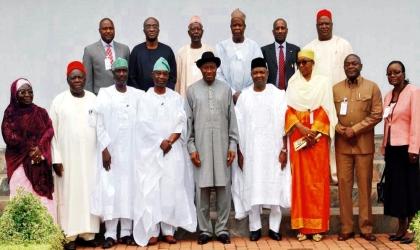
President Goodluck Jonathan (middle), Vice-President Namadi Sambo (4th right) with members of the Presidential Advisory Committee on National Dialogue after their inauguration in Abuja , recently. Photo: NAN



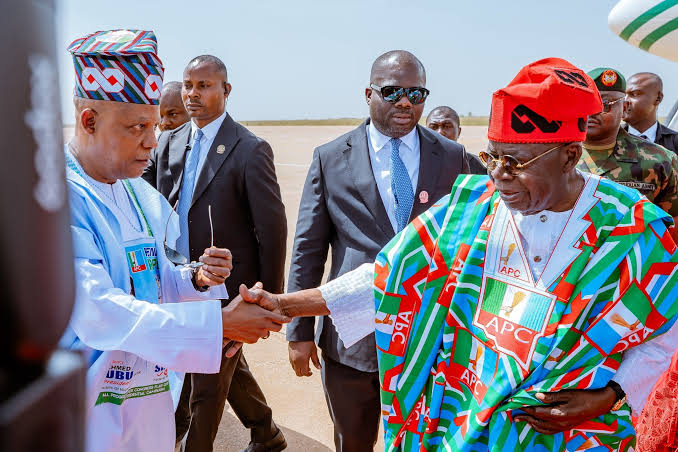
The campaign rally, held at the Kaduna Township Stadium, attracted Vice-President Kashim Shettima, APC governors, party leaders, federal and state lawmakers, political stakeholders and supporters from across the country.
The flag-off marks the beginning of the APC’s drive to secure a second presidential term for President Tinubu, with the party expected to promote its achievements, defend its economic reforms and outline its policy priorities under the proposed Renewed Hope 2.0 agenda.
Kaduna’s selection for the campaign launch underscores the strategic importance of the North-West, a region with a substantial voting population and considerable influence on presidential election outcomes.
The APC faces a significant challenge in Kaduna, where the Peoples Democratic Party’s presidential candidate, Alhaji Atiku Abubakar, defeated President Tinubu in the 2023 election. The rally therefore provides the ruling party an opportunity to strengthen its grassroots structures and regain electoral support in the state.
Addressing supporters, Vice-President Shettima appealed to Northern voters, highlighting President Tinubu’s political relationships with prominent Northern leaders, including Alhaji Abubakar, Mallam Nuhu Ribadu and the late President Muhammadu Buhari.
The Vice-President’s appeal reflects the APC’s determination to consolidate its support in the North as the party intensifies preparations for the presidential contest.
The Renewed Hope 2.0 agenda is expected to feature prominently in the campaign, providing a platform for President Tinubu to explain his administration’s economic policies and outline plans for another term.
However, the President’s record on economic reforms, rising living costs, petrol prices, employment, infrastructure and insecurity is expected to attract considerable scrutiny during the electioneering period.
-
 Education19 hours ago
FCE Yola Graduates 3,555 Teachers , Seeks Upgrade to University
-
 Niger Delta21 hours ago
Diri Restates Stance On Lagos-Calabar Coastal Highway
-

 Sports18 hours ago
Nigerian Trio Target Titles At PFL Africa Finals
-
 Niger Delta21 hours ago
C’River, NUJ Pay Tribute To Late Guardian Editor
-

 News22 hours ago
NDLEA Recovers Tons Of Illicit Drug Consignments In Nine States
-
 Opinion21 hours ago
Checking Voter Apathy In Nigeria’s Electoral Process
-
 Politics18 hours ago
2027: DICKSON’S EX-ALLY VOWS TO WORK AGAINST NDC INTEREST IN BAYELSA
-
 Politics18 hours ago
2027: GROUP PLEDGES 40,000 SUPPORTERS FOR COALITION CANDIDATES IN RIVERS