Connect with us

Politics

RVHA To Streamline TIMARIV Operations

Published

on

Following outcry at the Public Hearing on the bill to amend the Rivers State Traffic Law 2009, the Chairman of the House Committee on Transport, Hon. Victor Ihunwo, has assured that the lawmakers would streamline fines for offenders.

Hon. Ihunwo said the amendment to the Traffic Law became imperative because of several lapses in the principal law which the current amendment is determined to address.

The Transport Committee chairman who stated this Wednesday during a public hearing on a bill to amend the State Traffic law No. 6 of 2009, to regulate Road traffic, said the forum was an opportunity for interaction in the process of improving the wellbeing of Rivers people.

He said the gathering would help the committee to find out what will be best for Rivers people and urged the public to make useful contributions.

In his presentation a representative of the Road Transport Employers Association of Nigeria (RTEAN), Mr. Emperor Ogbuka, urged the Assembly to redefine the operations of TIMARIV as the present body has been grossly abused.

Mr. Ogbuka lamented a situation where TIMARIV would recruit agents who adopt all sorts of tricks to exploit motorists in the state, citing a situation where the establishment impounded a vehicle for failure of the driver to wear seat belt and the owner made to pay between N20,000 to N30,000.

He called on the lawmakers to caution the outrageous fines charged by TIMARIV to enable the public accord them the respect they deserve and the multiplicity of task forces that harass motorists.

Comptroller General of TIMARIV, Mr. Nelson Jaja, said the Authority should be a service-oriented organi-sation but the law establishing it, confers punishment.

Mr. Jaja noted that despite the punishment, nature of the Authority had not been able to control the madness on the roads, acknowledging that some of its officials abuse the functions of the body.

A representative of Trade Union Congress (TUC), Mr. Chima Igwe, solicited for inclusion of various fines for traffic offenders, stressing that TIMARIV as presently constituted has a one sided penalty whereas the law should stipulate that any officer that contravenes should also be liable.

Mr. Igwe argued that the establishment is today seen as a revenue agent rather than the good services the public expects from it and advised that penalty and fines should be reasonable considering the economic realities of the time.

Mr. Sanye Antioch of the Ministry of Transport called for International best practices in traffic management in the state.

The zonal legal officer of the Federal Road Safety Commission (FRSC), Mr. B.O. Nwanani, said the law should exclude person below 18 years and above 70 years from being issued driving licence and suggested inter agency relationship.


Continue Reading

Politics

NBA Faults Senate, Demands Mandatory E-Transmission of Results

Published

on

The Nigerian Bar Association (NBA) has faulted the Senate’s decision to reject a proposed amendment mandating electronic transmission of election results, warning that the move undermines electoral transparency and democratic accountability.
The position was contained in a report presented by the President of the Association, Mr. Afam Osigwe, and formally adopted by the National Executive Council (NEC) of the NBA at its meeting held in Maiduguri, Borno State.
The NBA NEC expressed deep concern over the Senate’s refusal to amend Clause 60(3) of the Electoral Amendment Bill, which sought to compel presiding officers of the Independent National Electoral Commission (INEC) to electronically transmit polling unit results in real time to the INEC Result Viewing (IREV) portal immediately after the completion of Form EC8A.

Instead, the Senate opted to retain the existing provision of the Electoral Act, which states that results shall be transmitted “in a manner as prescribed by the Commission.”

Reacting to this, the NBA said the discretionary wording weakens the legal framework for credible elections.

“The current provision leaves room for manipulation, ambiguity and post-election disputes,” Mr Osigwe said, stressing that only a clear statutory mandate can guarantee transparency and protect the integrity of votes cast by Nigerians.

In adopting the NBA President’s report, NEC resolved that the National Assembly must urgently revisit and pass the proposed amendment to expressly mandate electronic transmission of results from polling units.

According to the NBA, enforceable electronic transmission provisions are no longer optional in a modern democracy.

“Credible elections are the bedrock of constitutional democracy, and continued resistance to mandatory electronic transmission undermines public confidence in the electoral process,” the Council noted.

The Association further emphasised that technology-backed transparency aligns with global best practices and is critical to restoring trust in Nigeria’s electoral system.

Consequently, NBA NEC called on members of the National Assembly to show legislative responsibility and statesmanship by voting in favour of the amendment compelling real-time electronic transmission of election results.

The Council reaffirmed the NBA’s commitment to sustained advocacy and engagement to ensure that Nigeria’s electoral laws truly reflect the will of the people as expressed at the ballot box.

Continue Reading

Politics

We’ve Not Recognized Any PDP Faction — INEC

Published

on

The Independent National Electoral Commission (INEC) has dismissed speculation around giving official recognition to a faction of the Peoples Democratic Party (PDP) at its recent engagement with political parties in Abuja, the nation’s capital.

According to the electoral body,  the Senator Samuel Anyanwu-led National Working Committee (NWC)’s attendance at the meeting does not necessarily amount to its recognition of one faction over another.

In explaining the reason behind having only the Senator Anyanwu group at the meeting, with the Dr Turaki-led group conspicuously absent, the Commission said the PDP was formally invited as a party and not any so-called faction within it.

INEC’s Deputy Director of Publicity, Mr Wilfred Ifogah, who spoke in an interview with journalists, said: “Invites are sent to the party, not to individuals,” noting that such letters are usually addressed to the party Chairman and Secretary.

He said since INEC does not determine which officials attend its meetings, it always accepts whoever a party presents as its representatives, adding: “Whoever the party sends as their representative is okay by the commission, because the letters are sent to the party, not the individual”

On concerns raised that only the Senator Anyanwu-led working committee were at the meeting, Mr Ifogah dismissed suggestions that INEC recognised that group to the exclusion of others, saying, “I didn’t know, you people are the one calling it faction”.

Further maintaining that INEC doesn’t meddle in internal party divisions, the Deputy Director acknowledged that party representatives usually introduce themselves at such meetings, often stating whether they are standing in for substantive officers.

Hear him: “Most times, if you are there at the opening ceremony, you find out that it’s either the person will say he’s representing the chairman, or the person is the chairman, and the other person is probably standing in for the secretary.”

While pointing out that INEC does not verify or question such representations, as long as the party responds to the invitation, he said: “As far as the party is concerned, we are not sure who comes. It’s just the party that sends people.”

Speaking on the crisis rocking the PDP, Mr Ifogah said internal disputes are outside INEC’s mandate, stressing further that: “The internal crisis has nothing to do with us. We don’t bother about that. Whenever they settle, we work.”

He said INEC would always encourage parties to resolve leadership disputes ahead of critical electoral activities, adding; “The only advice we give them is that whatever issue or internal crisis they have, they should settle it before we have activity.”

Admitting that prolonged internal disputes could affect a party’s participation in time-bound processes, Mr Ifogah said: “Whoever the substantive leadership of the party is should sign those documents so that they can be part of the process If not, when the activity is time-bound and they need something, that’s their cup of tea.”

He said the essence of party engagements is participation, not factional validation, and further explained that, “It’s just the Elections and Political Parties Monitoring Department that knows how to send invitations to them. They come for the meeting. I think that’s what is paramount”.

Senate Won’t Be Intimidated Into Passing Faulty Electoral Law — Akpabio

President of the Senate, Godswill Akpabio, has defended the removal of the provision for “real-time” electronic transmission of election results from the Electoral Bill 2026, insisting that the National Assembly would not be bullied into enacting a law that could endanger Nigeria’s democracy.

Sen. Akpabio said the Senate deliberately deleted the phrase to give the Independent National Electoral Commission (INEC) the discretion to determine the most appropriate mode of transmitting election results, warning that making real-time transmission mandatory could plunge the country into crisis in the event of network or power failures.

He spoke on Saturday in Abuja at the unveiling of a book, The Burden of Legislators in Nigeria, authored by Senator Effiong Bob.

According to the Senate President, “technology must save and not endanger democracy,” adding that rigid provisions could invalidate elections in areas affected by poor connectivity or grid collapse.

“All we said was to remove the word ‘real-time’ to allow INEC decide the mode of transmission. If you make it mandatory and there is a system failure, there will be a serious problem,” Sen. Akpabio said.

He argued that official election documents, including Form EC8A, should remain the most reliable basis for declaring results, stressing that elections must not be jeopardised by technological limitations.

“Real-time means that if there are nine states where there is no network, does it mean elections will not take place there? Or in any part of the country where there is a grid breakdown, does it mean there will be no election?” he asked.

Reacting to widespread criticism of the Senate’s action, Sen. Akpabio said lawmakers had been subjected to unwarranted attacks and abuse, particularly on television panels and social media, but maintained that the legislature would not succumb to pressure from opposition parties, civil society organisations or non-governmental organisations.

“We will not be intimidated but will do what is right for Nigeria, not what one NGO says. A retreat is not law-making,” he said.

He criticised the notion that positions agreed upon at stakeholder retreats must automatically be adopted by the Senate, arguing that such views may not reflect the interests of all parts of the country.

“Why do you think that the paper you agreed to in Lagos must be what we must approve?” he queried.

Sen. Akpabio, however, noted that the legislative process on the bill had not been concluded, assuring that there was still room for amendments. He explained that as long as the Votes and Proceedings of the Senate had not been approved, any senator could move to amend the bill.

“We can amend anything before we approve the votes and proceedings. Why abuse the Senate when what we have is incomplete?” he said.

He further observed that provisions rejected by the Senate could still be reinstated by the Conference Committee of the Senate and the House of Representatives, urging critics to exercise patience.

In a swift response, former Senate President and National Chairman of the African Democratic Congress (ADC), Senator David Mark, who chaired the occasion, cautioned Sen. Akpabio against speaking on behalf of the Independent National Electoral Commission (INEC).

“The position of the ADC is clear: pass the bill and let INEC decide whether it can implement real-time electronic transmission or not. Don’t speak for INEC,” Sen. Mark said.

Other speakers at the event, including Akwa Ibom State Governor, Pastor Umo Eno, and the book reviewer, Professor Maxwell Gidado, commended Senator Bob for documenting the challenges faced by Nigerian legislators, describing the book as a courageous and timely intervention.

In his remarks, Sen. Bob highlighted issues confronting lawmakers, including electoral disputes, conflicts with governors and political godfathers, judicial annulment of electoral victories, and the pressure of addressing constituents’ private concerns.

“The courage to defend democracy is in the legislature and the legislators,” he said.

Continue Reading

Politics

I DEFECTED  OUT OF CONVICTION  …NO ONE COULD’VE IMPEACHED MY LATE DEPUTY ~ DIRI

Published

on

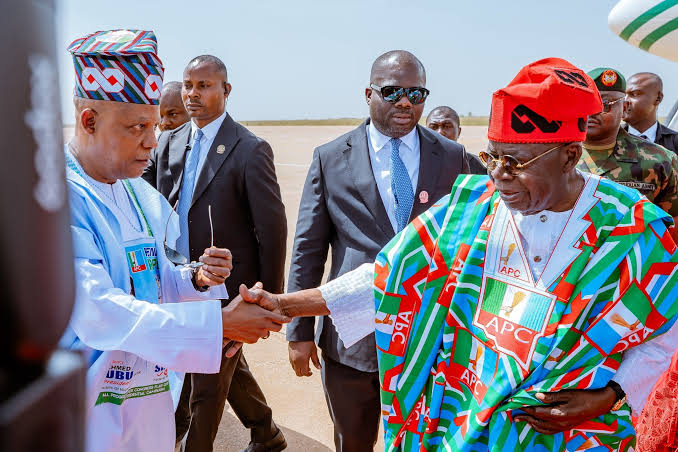
Bayelsa State Governor, Senator Douye Diri, has said he defected to the All Progressives Congress (APC) from his former Party, the Peoples Democratic Party (PDP) based on his personal conviction at the time.
The Tide reports that Governor Diri announced his resignation from the PDP on October 15, 2025, and was formally received by bigwigs of the APC, including Vice President Kashim Shettima, in Yenagoa, the state capital, on November 3, 2025.
Speaking during the January edition of the monthly Praise Night in Government House, Yenagoa, he stated that politics was dynamic and politicians should learn to accept change in the overall interest of the people they serve.
Mr. Daniel Alabrah, the Chief Press Secretary to Governor Diri in a statement quoted him as saying: “There is no static nature in politics because we have alignments and re-alignments. The development and progress of our state is the reason we are in politics.
“I do not just take decisions. l consult, l pray and my spirit tells me where l should go.
“Most of you know my political trajectory. I have moved from one party to another. I have moved from the National Solidarity Movement, and when the party was dying, we moved to the PDP and then to the Labour Party.
“In the Labour Party, we realised that we had met a brick wall and that was when l was invited to join the PDP again. Assuming l did not move, maybe l would not have become governor today.
“So, in politics, movement is allowed. Changing camps is allowed, but do it out of conviction. Do not be a slave to anyone. Your destiny and the next person’s destiny are not the same.
“If you are convinced and still following that person, please go ahead. But there is no static nature in politics. In political science, we have alignments and re-alignments. The reason we are politics is for the development and progress of our state.
“What are we doing to hand over this state to our children?  Do we hand over confusion, misunderstanding and enmity to our children because of somebody’s personal interest?”
The Bayelsa helmsman said his administration was working hard to consolidate on development efforts in order for the state to rise above prevailing challenges in all ramifications.
He also appreciated the clergy, Bayelsans, security personnel, and other sympathisers from within and outside the state for their support, goodwill and show of love that ensured the peaceful burial of his deputy, late Senator Lawrence Ewhrudjakpo.
“There was no problem I had with my late deputy following my defection to the APC.
“He did not inform me before going to court for fear of impeachment. But he later apologised and agreed to withdraw the case. Nobody could have impeached him (Ewhrudjakpo) if I did not approve of it,” he stated.
By: Ariwera Ibibo-Howells, Yenagoa
Continue Reading

Trending