
Politics
How Bamanga Tukur Emerged PDP Chairman

Amidst intrigues, suspense, backstabbing and eventual denouement, the Peoples Democratic Party (PDP) in last Saturday’s National Convention proved its stance as a colossus, with master strokes that doused what otherwise appeared a time bomb waiting to explode.
Although reports from the wards, LGA and state congresses of the party indicated that there was relative peace in the choice of party leaders at those levels, a deadly contest and angling for supremacy were the hallmark of the choice of the national leadership of the party.
Acting National Chairman of the PDP, Abubakar Baraje acknowledged the challenges of maintaining internal cohesion ahead of the contentious National Convention, while inaugurating the National Convention Planning Committee.
The acting chairman stated; “PDP has found its foots rigidly in the annalls of this country, all eyes are on the PDP to see if it could hold a free and fair congress, I have no doubt that members of the committee have the ability and credentials to deliver a free and fair congress”.
It is no doubt that the PDP had held sway conspicuously in Nigerians Political scene for the past one decade. Expectedly, Nigerian waited agitatedly as the party arranged a change of guard in its leadership at all levels.
It was glaringly evident that the ruling party was equally confronted with the challenges of convincing Nigerians that they were not only in firm grip of the Political Structures of the country, but that their internal mechanism was intact.
Interestingly, the 2012, National Convention became a period of self assessment of its internal cohesion and expression of its inherent political will, to re-affirm its dominance in Nigeria’s politics.
The option for Concensus became a political variable to stabilise its structures and save the party from the unwinking scrutiny of Nigerians. Apart from the wards, local government and state congresses, which were predicated on existing internal agreements among the party stakeholders, the Concensus option had its roots essentially at the choice of National leadership of the party. The option was also believed to have emanated from the presidency to forestall division and dissenting views in the choice of National leadership of the party. However, about 11 candidates threw their hats into the ring for the Coveted National Chairmanship Position of the party.
The contenders included: Prof Rufai Alkali, Idris Waziri, Alhaji Shettima Mustapha, Musa Babayo, Adamu Bello, Gambo Lawan, Adamu Muazu, Sen Abba Aji, Bunu Sherif, Ibrahim Birma, and Bamanga Tukur, all from the North East Geo-Political zone of the party where the chairmanship was zoned.
Among all the contenders, Bamanga Tukur, who emerged as the National Chairman of the party at the end of the National Convention, was the most favoured in the Concensus deal.
In the build-up to the National Convention of the party, the decision on concensus was however, seen by many Party Stalwarts as a skewed decision, not in the overral interest of the party, but to serve some vested partisan interests ahead of 2015.
This put paid to the humiliating defeat suffered by the new National chairman, Bamanga Tukur, in his North East zone were the party chairmanship was zoned. But the presidency was said to have insisted on clearing the bumps on the political highway to the emergence of the preffered candidates for the party’s National executive.
Sources attributed the humiliating defeat of Tukur in his political zone to the antics of the North East Governors, who felt his emergence as a National Chairman of the Party was not in the best interest of the zone. The North East Governors, apparently said in Tukur a compromising stance against the interest of the zone ahead of the 2015 general election.
But the presidency was said to have re-acted swiftly to their decision as “sheer ingratitude” and lack of compliance of their own side of the bargain, inspite of conceding the National Chairmanship of the party to the zone.
Apparently jilted by the revolt of the North East Governors, in the choice of Tukur, the presidency was said to have adopted a deft move to nib in the bud further embarrassment in the eventual outcome of the National Convention.
Finally, the North East Governors and other dissenting voices in the choice of leadership of the party bowed to submission as the National executive emerged on concensus.
It was obvious that the North East Governors succumbed to the deft move of the party through intense lobbying and persuation to avoid further balcanisation and the prospect of incurring the wrath of the presidency.
Prior to the voting by delegates from across the 36 states of the federation, the Governors of the North East states, took turn to register their solidarity and support for the preffered presidential choices for the various National executive positions.
The contenders for the National chairmanship, and secretary positions also bowed out in support of Bamanga Tukur, and Olagunsoye Oyinola respectively.
The past vice chairman South East of the party, Chief Olisa Metu emerged the sole candidate for the National Publicity Secretary of the Party, while former Aviation Minister, Kema Chikwe emerged as the National women leader of the party.
Against the backdrop of being arm twisted to step down for favoured candidates, most of the top contenders for the prime administrative. Positions said they gave up their ambition in the interest of the party.
Ebenezer Babatope, a contender for the Post of Secretary, in a reluctant step down declaration said, “I am not withdrawing for any body, but for the party, I have been prevailed upon by friends to step, but I was determined to go ahead even if I was going to get one vote”.
The intense power play and political permutations that characterized the PDP National Convention, was also evidently masterminded by the Governors forum, which took it upon itself to ensure that the decision of the party went through smoothly.
PDP Governors were visibly spotted around the convention arena trying to convince contestants for the various positions to drop their stance. Sources, revealed that the moves of the Governors were the fallout of a midnight meeting held with the presidency and leadership of the party to perfect the strategies of concensus.
The eventual emergence of Bamanga Tukur as the National Chairman of PDP, apart from its purported close link with, the presidency, is also seen by many party supporters as an opportunity to redefine the leadership posture of the party.
Tukur is seen by many PDP members as a man with the requisite knowledge and experience to deliver the party to its expected political Eldorado.
“For the PDP to forge ahead in its control of political powers in Nigeria, and bring internal democracy in the party, it needs people like Tukur”, said a top party official.
Tukur, a former governor, of defunct Gongola state, had in his acceptance speech, after being sworn-in by Joe Gadzama (SAN), vowed to put in place dedicated and transparent leadership that will rekindle the faith of all party members and Nigerians in the party.
He said; “I will build a bridge across faith, generations, and tendencies, and lay the foundation for a new Nigeria. I will be guided by the constitution and manifestoes of the party, I will also adhere to the principle of separation of powers, check and balances and the rule of law”.
The New National Chairman of the party, also called on those who contested for various positions to throw their weight behind him to enable the party grow from strength to strength.
However, inspite of the successful emergence of party leaders from the wards to the National executive, a major lesson from the just-concluded PDP Convention is the ability of its big umbrella to accommodate all interests, no matter whose ox is gored.
The convention reconciled hitherto political foes within the party and also created new internal animosities among the political players. Political jobbers also took advantage of the political scenario, to coast home on personal gratifications and vested interests.
But in the final analysis , President Goodluck Jonathan redefined the new vision and road map of the party when, at the end of the convention, he declared the convention will churn out a stronger and more disciplined PDP, were party interest will supercede personal interest.
Taneh Beemene



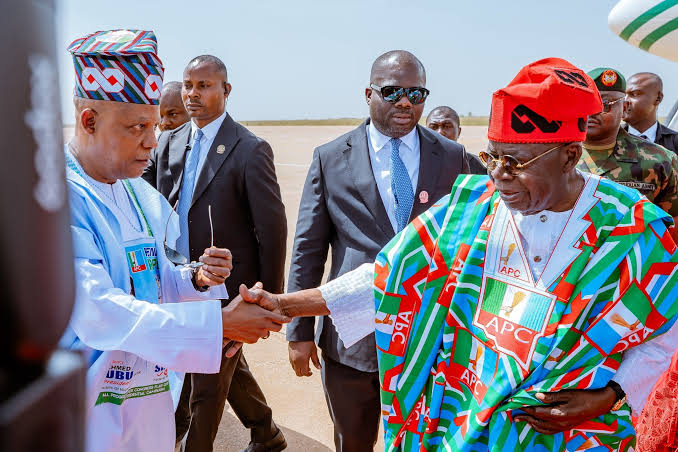
The campaign rally, held at the Kaduna Township Stadium, attracted Vice-President Kashim Shettima, APC governors, party leaders, federal and state lawmakers, political stakeholders and supporters from across the country.
The flag-off marks the beginning of the APC’s drive to secure a second presidential term for President Tinubu, with the party expected to promote its achievements, defend its economic reforms and outline its policy priorities under the proposed Renewed Hope 2.0 agenda.
Kaduna’s selection for the campaign launch underscores the strategic importance of the North-West, a region with a substantial voting population and considerable influence on presidential election outcomes.
The APC faces a significant challenge in Kaduna, where the Peoples Democratic Party’s presidential candidate, Alhaji Atiku Abubakar, defeated President Tinubu in the 2023 election. The rally therefore provides the ruling party an opportunity to strengthen its grassroots structures and regain electoral support in the state.
Addressing supporters, Vice-President Shettima appealed to Northern voters, highlighting President Tinubu’s political relationships with prominent Northern leaders, including Alhaji Abubakar, Mallam Nuhu Ribadu and the late President Muhammadu Buhari.
The Vice-President’s appeal reflects the APC’s determination to consolidate its support in the North as the party intensifies preparations for the presidential contest.
The Renewed Hope 2.0 agenda is expected to feature prominently in the campaign, providing a platform for President Tinubu to explain his administration’s economic policies and outline plans for another term.
However, the President’s record on economic reforms, rising living costs, petrol prices, employment, infrastructure and insecurity is expected to attract considerable scrutiny during the electioneering period.
-

 Education19 hours ago
FCE Yola Graduates 3,555 Teachers , Seeks Upgrade to University
-

 Niger Delta21 hours ago
Diri Restates Stance On Lagos-Calabar Coastal Highway
-

 Sports18 hours ago
Nigerian Trio Target Titles At PFL Africa Finals
-

 Niger Delta21 hours ago
C’River, NUJ Pay Tribute To Late Guardian Editor
-

 News23 hours ago
NDLEA Recovers Tons Of Illicit Drug Consignments In Nine States
-

 Opinion21 hours ago
Checking Voter Apathy In Nigeria’s Electoral Process
-

 Politics19 hours ago
2027: DICKSON’S EX-ALLY VOWS TO WORK AGAINST NDC INTEREST IN BAYELSA
-

 Politics19 hours ago
2027: GROUP PLEDGES 40,000 SUPPORTERS FOR COALITION CANDIDATES IN RIVERS