
Editorial
Ending Fire Disasters At Rivers Waterfronts, Jetties

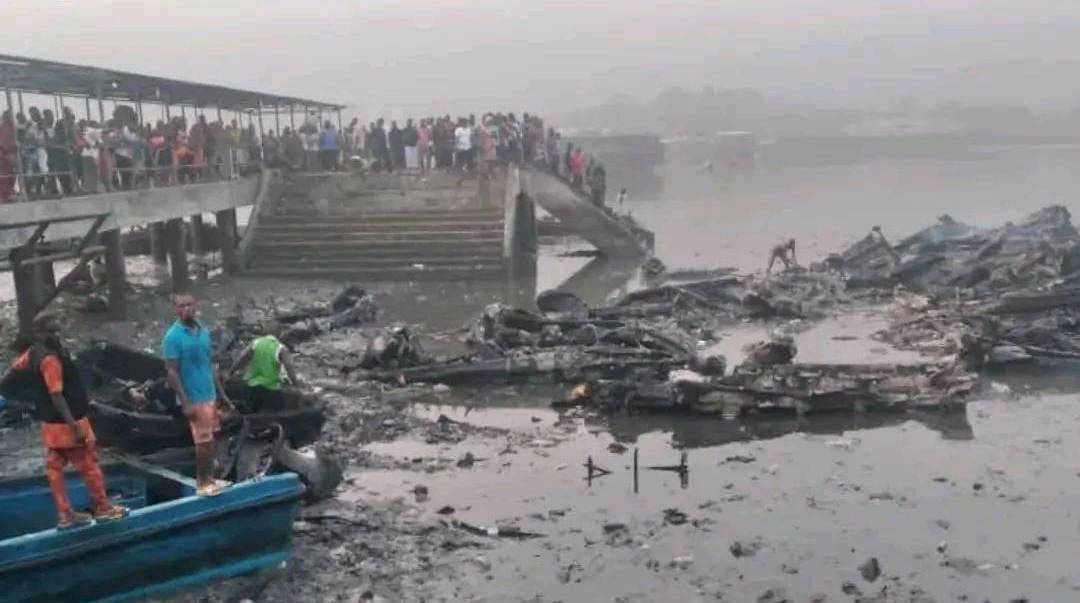
Last Monday’s multiple explosions at the Bonny/Bille/Nembe jetty in Port Harcourt, the Rivers State capi-
tal, have left many still counting their losses. The disaster caused far-reaching damage to goods and property worth millions of naira. Several people were feared dead with many bodies still missing in the depths of the river. The explosions and subsequent fire further engulfed six market boats, leaving passengers trapped.
The Bonny/Bille/Nembe jetty serves as a prominent transit point for riverine people travelling beyond Port Harcourt and the state. While the exact cause of the fire remains uncertain, some eyewitnesses have attributed it to the haphazard storage and transportation of unlawfully refined petroleum products in the vicinity.
An observer’s account of the incident stated that the fire allegedly originated from an explosion. It is believed that certain houseboats were transporting liquid substances, possibly refined petroleum products, at the time of the incident. The initial explosion triggered two ensuing detonations within the boats. Adjoining makeshift buildings and structures near the site were also impacted by the fire, said the source.
The State Governor, Sir Siminalayi Fubara, expressed profound concern and sympathy for the unfortunate victims, and pledged to collaborate with jetty operators to prevent annual infernos in the area. The Secretary to the State Government, Dr. Tammy Danagogo, confirmed the governor’s assurance during a visit to the scene of the inferno.
Recall that in November 2021, a wooden passenger boat caught fire at the jetty, killing five people, including three children. In April 2022, a pregnant woman, a two-month-old baby, and two others died in an early morning fire caused by individuals loading illegally refined substances called ‘kpofire’ at the same location. The fire destroyed over 40 boats.
Port Harcourt residents have suffered prodigious losses following illegal petroleum activities, resulting in the destruction of valuable property worth millions of naira. The increase in illicit petroleum product pursuits had previously worsened the presence of airborne particulate matter known as ‘soot’, causing residents to feel marginalised and neglected in rural Niger Delta communities.
Unfortunately, criminal activities at the jetties and waterfronts are widespread and deeply rooted, with felons illegally ferrying refined products with the help of security agents. The corruption extends beyond the military and police force, with alleged weekly financial payoffs to heads of security agency. This endemic decadence hinders progress and greatly undermines the state.
There is a need for the Rivers State Government to work with citizens and security operatives to combat illegal crude oil refiners, who have caused severe environmental pollution and fire outbreaks at the various waterfronts and jetties in the state. Media and civil society organisations should also launch public awareness campaigns to eradicate these villainous activities.
Governor Fubara’s commitment to addressing the constant fires at the Bonny/Bille/Nembe jetty is remarkable. His concern for the victims and determination to find a long-term solution to the intractable problem characterise him as a particularly true leader. However, desperate and decisive actions, realisation of strategic mitigative measures, and the effective establishment of necessary machinery to contain the menace are essential to back up this resolve.
The state government must invest in modern firefighting technology and equipment, train personnel, and strategically build state-of-the-art firefighting stations across jetties and waterfronts prone to frequent fire outbreaks. Collaborating with firefighting agencies and humanitarian relief organisations is essential for garnering the requisite knowledge and support.
The Bonny/Bille/Nembe jetty and others need strict regulations enforcement mechanism, including regular inspections, heavy fines, and penalties for non-compliant operators. Monitoring material loading and unloading protocols and safety procedures is critical. The government should adopt a zero-tolerance stance on wharf stakeholders’ negligence, as their dereliction has contributed to recurring fires.
The authorities can collaborate with private oil and gas firms in the Bonny/Bille/Nembe region to promote Corporate Social Responsibility (CSR) initiatives, focusing on safety measures, infrastructure, environmental sustainability, and fire disaster management. This collective approach will reduce the burden on the government and ensure an inclusive approach to addressing the matter.
Encouraging research into the root causes of the fires at the wharfs would be a proactive step. The Rivers State Government can partner with academic institutions to delve deeper into other possible causes and effects of the fires and propose plausible solutions. This step would be especially pertinent as it will deploy a knowledge-based approach towards dealing with the awful predicament, ensuring that no stone is left unturned.
Incessant fires at our wharfs remain a ticking time bomb that calls for prompt neutralisation. While inadvertent fire surges might not be preventable, the frequency and impact can be decimated. Preventive measures should be integrated into the operating ethos of jetties to save lives, properties, and the environment. As a state perforated by multiple waterfronts and jetties because of its littoral and deltaic characteristics, it is incumbent on all residents to imbibe best practices in marine safety, good health, security and environmental sustainability to guarantee the future of the people who live and do business around those vulnerable communities.
Also, the state authorities must muster the political will to address this issue. Investing in safe marine transport system, through quality infrastructure and manpower development would be key in remedying this challenge. Further standardising the business environment in such a way that fire resistant structures are built several meters away from the jetties would savd lives and property of jetty users.
We believe that if these steps are taken, Rivers State would become a model of efficient, people-centric governance. It would also reassure the people living in the riverine communities that the government seriously cares about their lives, and appreciates their contributions to the prosperity of the state. We think that this is the right way to go!



Nigeria stands at a critical juncture as the world marked World Press Freedom Day (WPFD) on May 3. This annual observance is a reminder that a free press is central to democratic life, good governance, and public accountability. For Nigeria, it is also a moment for sober reflection on how far the country has come and how far it still has to go in safeguarding the independence of its media.
World Press Freedom Day exists to highlight the fundamental importance of freedom of expression and to honour journalists who risk their lives in pursuit of truth. It underscores the idea that without a free press, societies cannot function transparently, nor can citizens make informed decisions. In countries like Nigeria, where democracy continues to evolve, the observance carries particular urgency.
This year’s theme, “Shaping a Future at Peace: Promoting Press Freedom for Human Rights, Development and Security”, places journalism at the heart of global stability. It emphasises that a peaceful society cannot be built on silence, fear, or manipulated information. Rather, it depends on the free flow of accurate, timely, and independent reporting.
At its core, the theme highlights the role of journalism in fostering accountability, dialogue, and trust. These are not abstract ideals. In Nigeria, where public confidence in institutions is often fragile, the media remains one of the few platforms through which citizens can question authority and demand transparency. When press freedom declines, so too does public trust.
Journalism serves as a foundation for peace, security, and economic recovery. Countries with robust media systems tend to attract greater investment, maintain stronger institutions, and resolve conflicts more effectively. Nigeria’s economic challenges, ranging from inflation to unemployment, require open scrutiny and informed debate, both of which depend on a free press.
However, the issue of information integrity has become increasingly complex in the digital age. Artificial Intelligence (AI) and online platforms have amplified the spread of misinformation and disinformation. In Nigeria, where internet penetration has grown rapidly, false narratives can travel faster than verified facts. This makes the role of credible journalism more vital than ever.
The challenge is not only technological but also ethical. AI-driven manipulation of information threatens to distort public discourse, influence elections, and deepen social divisions. In such an environment, professional journalism must act as a stabilising force, ensuring that truth prevails over sensationalism and propaganda.
Equally troubling is the safety of journalists. Across Nigeria, reporters face growing levels of online harassment, judicial intimidation, and physical threats. Self-censorship is becoming more common, as media practitioners weigh the risks of reporting sensitive issues. This trend undermines the very essence of journalism.
A particularly alarming incident involved a serving minister in the present administration, who openly threatened to shoot a journalist during a televised exchange. Such conduct, broadcast to the public, sends a dangerous signal that hostility towards the press is acceptable. It erodes the norms of democratic engagement and places journalists in harm’s way.
This year’s theme aligns closely with the United Nations Sustainable Development Goal (SDG)16, which promotes peace, justice, and strong institutions. Freedom of expression is a cornerstone of this goal. Without it, institutions weaken, corruption thrives, and justice becomes elusive. Nigeria’s commitment to SDG 16 must therefore include genuine protection for the media.
Historically, the Nigerian press has been a formidable force. From resisting colonial rule to challenging military dictatorships, our journalists have played a central role in shaping the nation’s political landscape. Today, however, that legacy appears to be under strain, as the media operates under what can best be described as a veneer of freedom.
Beneath this facade lies a troubling reality. Journalists are routinely harassed, detained, and prosecuted for performing their constitutional duties. Reports from media watchdogs indicate that dozens of Nigerian journalists face legal threats or arrest each year, often for exposing corruption or criticising those in power.
The Cybercrimes (Prohibition, Prevention, etc.) Act of 2015 has become a focal point of concern. Originally intended to combat cyber threats, it has increasingly been used to silence dissent. Sections 24 and 27(1)(b), in particular, have been invoked to target journalists, bloggers, and social commentators.
Although amendments introduced in February 2024 were meant to safeguard journalists, concerns persist. The law continues to be wielded in ways that stifle investigative reporting and restrict freedom of expression. Legal reforms must go beyond cosmetic changes to address the root causes of misuse.
To safeguard the future of journalism in Nigeria, decisive action is required. The Cybercrimes Act must be revisited to ensure it cannot be weaponised against the press. Law enforcement agencies must operate free from political influence, upholding the rule of law and protecting journalists’ rights. Civil society and international partners must also strengthen independent media through funding, training, and platforms for wider reach.
In this rapidly evolving world shaped by artificial intelligence and digital innovation, Nigeria faces a clear choice. It can either allow press freedom to erode under pressure, or it can champion a truly independent media landscape. The path it chooses will determine not only the future of journalism, but also the strength of its democracy and the peace it seeks to build.

-

 Featured5 days ago
WASSCE: RSG Distributes Science Materials To Secondary Schools
-
News5 days ago
Xenophobic Attacks: Nigerian Lives More Important Than Foreign Investment – Oshiomhole
-
Rivers5 days ago
MBA Forex Trial Adjourn To June 3, Amid Bereavement … As Court Declines Cost Application
-
News5 days ago
ActionAid Demands Probe Of Govs Using Public Funds For Campaign
-
Aviation5 days ago
Passengers Stranded As Delta Airline From Atlanta Route Back Eight Hours After
-
Business5 days ago
Customs Impound N2.35bn Cocaine, 15 Trailers of Rice
-
Politics5 days ago
2027: Bayelsa Senator Gets Critical Endorsement For Second Term
-

 Politics5 days ago
INEC Sets Rivers South-East Senatorial By-Election For June 20