
Editorial
As S’ Court Upholds Fubara’s Victory …

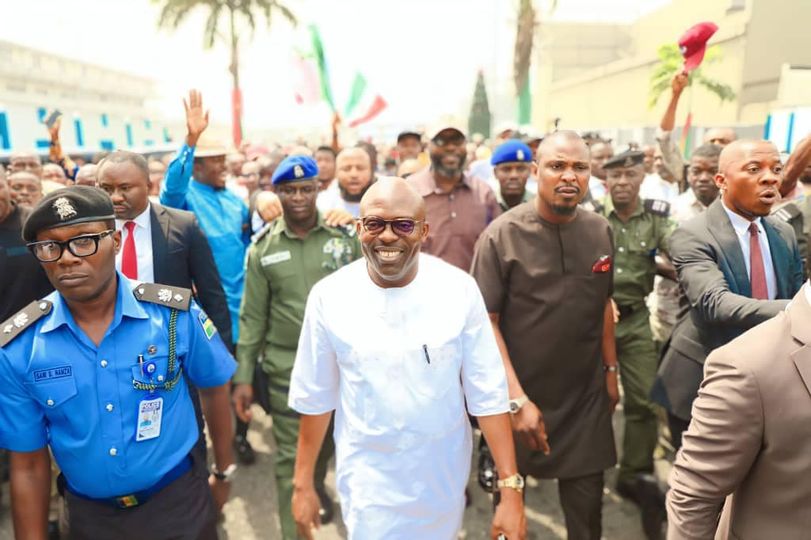
Yesterday, Rivers State experienced widespread celebrations as the Supreme Court upheld Sir Siminalayi
Fubara of the Peoples Democratic Party (PDP) as the duly elected Governor of the state. The highest court in the land rejected the case presented by the candidate of the All Progressives Congress (APC) over the March 18 governorship election. In a unanimous ruling, a panel of five judges concluded that the appeal made by Tonye Cole of the APC lacked merit.
The judgment was delivered after several adjustments, giving room to sundry speculations. In the lead judgment, Justice Ibrahim Saulawa concluded that Cole and the APC did not substantiate their case with satisfactory evidence. Justice Saulawa addressed and resolved all four issues raised for consideration in the appeal against the appellants. Consequently, he proceeded to reject the appeal.
An elated Fubara, in his response, conveyed his appreciation to God, President Bola Tinubu, his predecessor, and Minister of the Federal Capital Territory (FCT), Chief Nyesom Wike, as well as the people of Rivers State, for their support in achieving victory. He extended an appeal to the opposition to collaborate with him in the development of the state. Furthermore, he affirmed his unwavering dedication towards fulfilling his elected duties, and assured the people that no distractions would interfere with governance.
Fubara stated that his victory at the Supreme Court had effectively resolved the legal disputes that contributed to the various challenges encountered by his administration over the past eight months. Besides the legal tussle, the governor has been embroiled in a political crisis with his predecessor, Wike. The situation led to the factionalisation of the state House of Assembly with members loyal to Wike filing impeachment notice against the governor.
The governor said: “About an hour ago, the Supreme Court revalidated our mandate in the election. It is a victory for the entire state. It is important for us to note that we need this victory to consolidate the purpose of governance. Prior, we have had a few distractions here and there. And the good news that came to us this morning is a refreshing strength that will encourage us to continue the good works in governance.”
The governor called on everyone to join hands with his administration to build a competitive state that will be reckoned with as truly prosperous in all ramifications. According to him, “We have a dream of making it a highly competitive state that will measure, if not up to Lagos but close to becoming like Lagos. We can only achieve this in an atmosphere of peace.
“So, I am calling on everyone, not just on our internal issue but those members from other parties, the issue is settled, come and let’s build the Rivers State of our dream. We will continue to protect and provide the basic needs of governance to everyone who is doing business and who lives in Rivers State.”
The Tide extends its heartfelt congratulations to the governor on his highly merited triumph. The recent ruling by the Supreme Court is undoubtedly a tremendous source of solace, revitalising the administration in the state. Siminalayi Fubara’s success further affirms the timeless proverb that those in positions of power often shoulder great burdens. The immense stress and disruptive effects caused by numerous legal battles and the political turmoil were undeniably significant.
Recall that in the midst of the ongoing political crisis, Mrs Beatrice Itubo, who is the candidate representing the Labour Party (LP), made a declaration, stating that the party had decided to withdraw its petition against the election of Governor Fubara at the Supreme Court. Initially, the LP had contested Fubara’s victory by filing a petition with the Appeal Court in Lagos. However, the court dismissed the LP’s petition, and confirmed the win of the PDP candidate. Several weeks later, Mrs Itubo revealed that the LP had chosen to drop the case.
Also, on New Year’s day, the governorship candidate of Accord Party in the March 18 election, Chief Dumo Lulu-Briggs, announced his withdrawal of the appeal filed at the Supreme Court against the victory of the Governor. The Appeal Court had earlier dismissed Lulu-Briggs’ case at its ruling in Lagos.
Yesterday’s judgment has lifted the burden from the well-meaning people of Rivers State. We strongly urge the governor to respond to this act by implementing an all-encompassing government. Rivers people eagerly awaited this favourable decision with great anticipation. Therefore, Fubara should not underestimate the importance of his victory, and must provide the state with an administration that is honest, transparent, and focused. Rivers people deserve nothing less.
The apex court’s judgment is indeed a triumph for our democratic system, and serves as a reaffirmation of the rightful authority bestowed upon the state governor by the innate will of the people. We express our gratitude to the court for diligently upholding the integrity of the people’s mandate. Undoubtedly, this ruling will greatly contribute to the restoration of hope and trust among Rivers people as well as Nigerians in the unwavering integrity of the judicial system.
We call on all citizens of Rivers State, including the opposition, as well as the governor’s political adversaries, to collaborate with him in the pursuit of the peace and development of the state. It is crucial that those who are instigating the political crisis reconsider their actions, as such endeavours will not benefit their own personal or collective interests. This court’s decision marks the conclusion of all gubernatorial contests in Rivers State, and for the betterment of the people, governance cannot be pigeon-holed.
Furthermore, we express our appreciation for the maturity exhibited by the governorship candidate of the All Progressives Congress (APC) in the election, Architect Tonye Cole. Cole gracefully accepted the Supreme Court’s verdict, and conveyed his best wishes to the governor. We strongly urge him and his supporters to partner with the governor in his efforts to elevate the state to new levels of success.
In life, it is true that we will encounter a significant amount of both positive and negative experiences. Fubara’s arduous journey towards triumph serves as a testament that even amidst challenges, there is always room for positivity. We must all develop the ability to gracefully accept both victory and defeat. As residents of the state, it is crucial for us to resist being entangled in acrimonious political conflicts fueled solely by the financial gain of any politician or the inordinate ambition to acquire and appropriate the people’s commonwealth with a view to further assert an utopian empire.




Nigeria stands at a critical juncture as the world marked World Press Freedom Day (WPFD) on May 3. This annual observance is a reminder that a free press is central to democratic life, good governance, and public accountability. For Nigeria, it is also a moment for sober reflection on how far the country has come and how far it still has to go in safeguarding the independence of its media.
World Press Freedom Day exists to highlight the fundamental importance of freedom of expression and to honour journalists who risk their lives in pursuit of truth. It underscores the idea that without a free press, societies cannot function transparently, nor can citizens make informed decisions. In countries like Nigeria, where democracy continues to evolve, the observance carries particular urgency.
This year’s theme, “Shaping a Future at Peace: Promoting Press Freedom for Human Rights, Development and Security”, places journalism at the heart of global stability. It emphasises that a peaceful society cannot be built on silence, fear, or manipulated information. Rather, it depends on the free flow of accurate, timely, and independent reporting.
At its core, the theme highlights the role of journalism in fostering accountability, dialogue, and trust. These are not abstract ideals. In Nigeria, where public confidence in institutions is often fragile, the media remains one of the few platforms through which citizens can question authority and demand transparency. When press freedom declines, so too does public trust.
Journalism serves as a foundation for peace, security, and economic recovery. Countries with robust media systems tend to attract greater investment, maintain stronger institutions, and resolve conflicts more effectively. Nigeria’s economic challenges, ranging from inflation to unemployment, require open scrutiny and informed debate, both of which depend on a free press.
However, the issue of information integrity has become increasingly complex in the digital age. Artificial Intelligence (AI) and online platforms have amplified the spread of misinformation and disinformation. In Nigeria, where internet penetration has grown rapidly, false narratives can travel faster than verified facts. This makes the role of credible journalism more vital than ever.
The challenge is not only technological but also ethical. AI-driven manipulation of information threatens to distort public discourse, influence elections, and deepen social divisions. In such an environment, professional journalism must act as a stabilising force, ensuring that truth prevails over sensationalism and propaganda.
Equally troubling is the safety of journalists. Across Nigeria, reporters face growing levels of online harassment, judicial intimidation, and physical threats. Self-censorship is becoming more common, as media practitioners weigh the risks of reporting sensitive issues. This trend undermines the very essence of journalism.
A particularly alarming incident involved a serving minister in the present administration, who openly threatened to shoot a journalist during a televised exchange. Such conduct, broadcast to the public, sends a dangerous signal that hostility towards the press is acceptable. It erodes the norms of democratic engagement and places journalists in harm’s way.
This year’s theme aligns closely with the United Nations Sustainable Development Goal (SDG)16, which promotes peace, justice, and strong institutions. Freedom of expression is a cornerstone of this goal. Without it, institutions weaken, corruption thrives, and justice becomes elusive. Nigeria’s commitment to SDG 16 must therefore include genuine protection for the media.
Historically, the Nigerian press has been a formidable force. From resisting colonial rule to challenging military dictatorships, our journalists have played a central role in shaping the nation’s political landscape. Today, however, that legacy appears to be under strain, as the media operates under what can best be described as a veneer of freedom.
Beneath this facade lies a troubling reality. Journalists are routinely harassed, detained, and prosecuted for performing their constitutional duties. Reports from media watchdogs indicate that dozens of Nigerian journalists face legal threats or arrest each year, often for exposing corruption or criticising those in power.
The Cybercrimes (Prohibition, Prevention, etc.) Act of 2015 has become a focal point of concern. Originally intended to combat cyber threats, it has increasingly been used to silence dissent. Sections 24 and 27(1)(b), in particular, have been invoked to target journalists, bloggers, and social commentators.
Although amendments introduced in February 2024 were meant to safeguard journalists, concerns persist. The law continues to be wielded in ways that stifle investigative reporting and restrict freedom of expression. Legal reforms must go beyond cosmetic changes to address the root causes of misuse.
To safeguard the future of journalism in Nigeria, decisive action is required. The Cybercrimes Act must be revisited to ensure it cannot be weaponised against the press. Law enforcement agencies must operate free from political influence, upholding the rule of law and protecting journalists’ rights. Civil society and international partners must also strengthen independent media through funding, training, and platforms for wider reach.
In this rapidly evolving world shaped by artificial intelligence and digital innovation, Nigeria faces a clear choice. It can either allow press freedom to erode under pressure, or it can champion a truly independent media landscape. The path it chooses will determine not only the future of journalism, but also the strength of its democracy and the peace it seeks to build.
-

 News11 hours ago
Group Hails Tinubu, Chinda Emergence
-

 Comment4 hours ago
Rivers @59: Progress Through Tough Times
-

 News3 hours ago
Fubara Promises To Deliver State Secretariat Early 2027
-

 News3 hours ago
Fubara Assures Completion Of Ongoing Projects In Rivers …As Airport Road Bypass Hits 65% Completion
-

 News3 hours ago
Court Clears Jonathan To Contest 2027 Presidential Election
-

 News3 hours ago
INEC Appeals Judgement Voiding 2027 Election Timelines
-

 News3 hours ago
IGP pledges police protection for major projects
-

 News3 hours ago
Our Reforms Yielding Results, Tinubu Boasts On Eid-el Kabir