
Featured
Vote Against Candidates In Support Of Naira Redesign Policy Implementation -Wike …Challenges Sekibo To Disclose Why Obasanjo Sacked Him As Minister

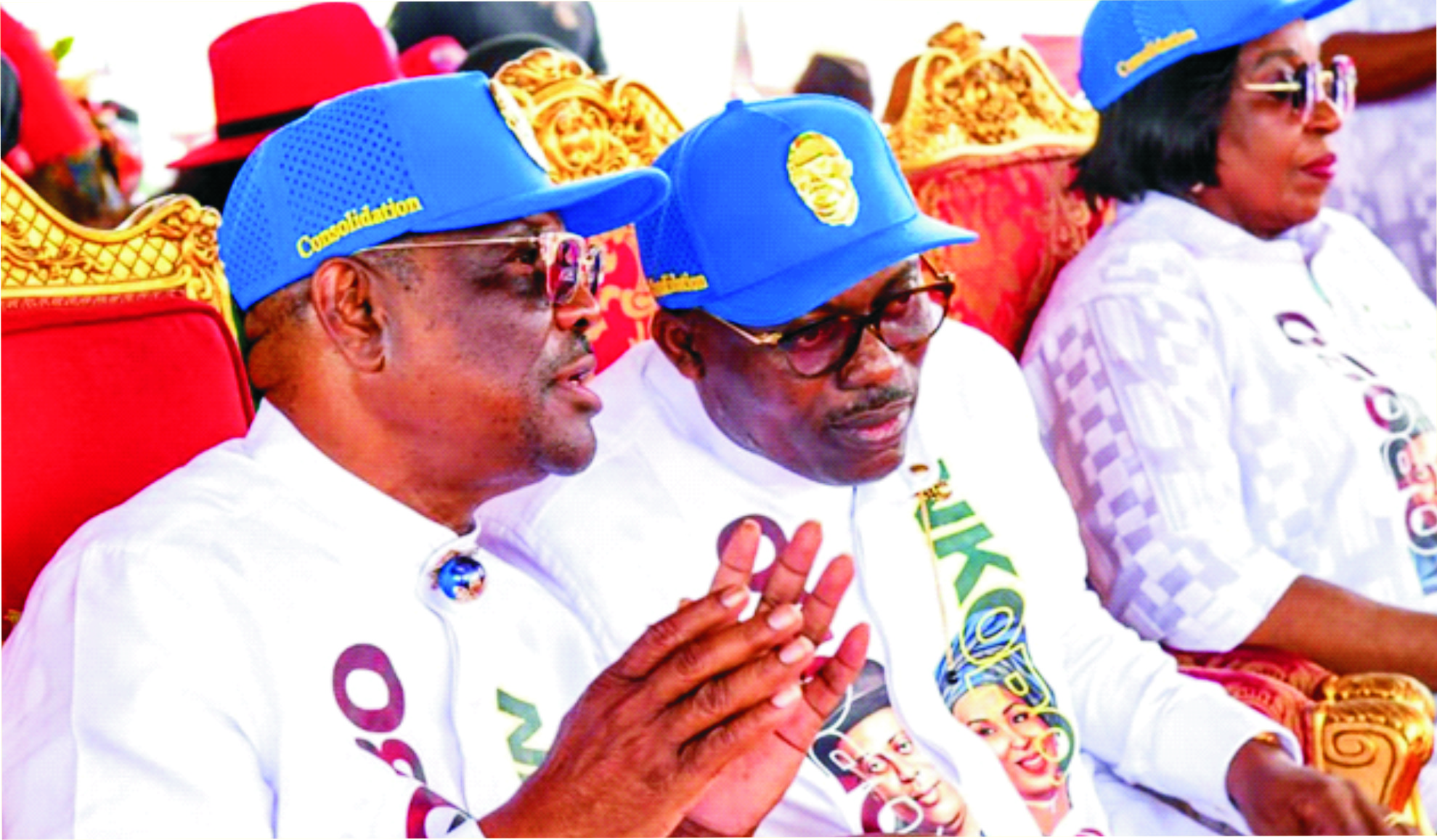
Rivers State Governor, Chief Nyesom Wike, has urged Nigerians not to vote for any candidate that supports the way the currency redesign policy is being implemented, in the forthcoming election.
Governor Wike spoke at Opobo Town Sandfield during the Rivers State Peoples Democratic Party (PDP) campaign flag-off rally for Opobo/Nkoro Local Government Area at the weekend.
The governor, in a statement by his Special Assistant on Media, Kelvin Ebiri, explained that such candidate is an enemy of Nigerians, who are already plunged into inexplicable economic hardship with nonavailability of both the old and new Naira notes to enable them buy food for their households and fuel for their cars.
Governor Wike said he is convinced that President Muhammadu Buhari, who may not have been properly briefed on the hardship the Naira swap is causing Nigerians, is already getting feedback on the ill advised policy and will review the implementation.
“Anybody who claims he loves Nigeria and is contesting election but is supporting this CBN policy. Will you people vote for such person? It is only the enemies of Nigeria that are supporting this anti-people policy. I believe President Muhammadu Buhari was not properly briefed about this policy”, he said.
Governor Wike insisted that the policy is being implemented to provoke the civil populace into embarking on public protests that could be used as an excuse to postpone the forthcoming election.
The governor pointed out that there is a cabal behind the policy implementation who are pushing to install an interim government, thereby prevent Nigerians from using their Permanent Voters Cards to determine their next leaders.
“The primary target of this policy is to provoke Nigerians to embark on civil disturbance which they will capitalise on to say they cannot conduct election and push for enthronement of an interim government. No matter the provocation, I urge everyone to be calm. This election must hold because nothing will stop an Opobo man to become governor”, he vowed.
Wike challenged the former Minister of Transport, Dr Abiye Sekibo, to explain why former President Olusegun Obasanjo sacked him from his cabinet.
The governor described himself as a man of integrity who served as minister under President Goodluck Jonathan and later resigned honourably to contest governorship election and won.
He also asserted that he is not among those who had caused crisis in their local governments and has blood on their hands, daring Sekibo to also make similar assertion.
Canvassing votes for the PDP governorship candidate in the state, Sir Siminialayi Fubara, Governor Wike enjoined Opobo people not to undermine the opportunity they have now to produce the next governor of the State.
He assured of signing the contract for the construction of Opobo Ring-Road, which will be completed by Fubara when he wins the election and assumes office as governor.
Governor Wike also told the electorate to deliver their votes for all PDP candidates in the state and await instructions from their leaders on the presidential candidate to cast votes for.
Sir Fubara, in his speech, restated his promise to the leadership of the party to never disappoint the confidence reposed in him to fly the party’s gubernatorial flag.
Fubara urged Opobo people to deliver their votes as an appreciation of the opportunity given to their son to become the next governor of the State.
He acknowledged the benevolence of Governor Wike in delivering road infrastructure and land reclamation projects in Opobo town, and assured that they would benefit more when he wins.
Presenting flags to PDP candidates, Chairman of the party in Rivers State, Ambassador Desmond Akawor, enjoined Opobo people to ensure that they deliver winning votes for their son and all the candidates of the party.
In his speech, Senator Adawari Pepple, expressed gratitude to Governor Wike for deeming it necessary to support their son to emerge PDP governorship candidate in the state.
Senator Pepple asserted that a true Opobo citizen is a loyal person and that Fubara will not disappoint the confidence reposed in him.
He assured that the entire Opobo people would follow Governor Wike wherever he goes and vote as he directs.
Dr. Sam Jaja acknowledged that Governor Wike has used his position to give prominence to an Ijaw son of Ibani extraction.
According to him, they have resolved that their votes will be wholesomely delivered for the PDP governorship candidate and the entire consolidation team.
Speaking on behalf of the candidates, Senator Barinada Mpegi, said the entire Rivers South East Senatorial District is fully ready to vote massively for all PDP candidates in the state.
Earlier, Governor Wike, Fubara and other PDP leaders had paid a courtesy visit to the palace of His Majesty, King (Dr.) Dandeson Douglas Jaja, Jeki V, Amanyanabo of Opobo Kingdom.
The King, in appreciation of the governor’s benevolence to the Opobo kingdom, conferred on him ‘Amafurotuo’ which means son of Opobo.



Governor of Rivers State, Sir Siminalayi Fubara, has reaffirmed the unwavering commitment of his administration to peace, unity, security, and inclusive development as Rivers State marked its 59th anniversary, last Wednesday.
In a goodwill message issued on Wednesday to commemorate the anniversary, Governor Fubara stated that despite the challenges faced over the years, the people of Rivers State have continued to demonstrate resilience, strength, and an enduring spirit of unity that has sustained the state since its creation.
The Governor noted that the strong bond of brotherhood among the various ethnic nationalities of the state, including the Ijaw, Ikwerre, Ogoni, Etche, Ekpeye, Andoni, Kalabari, and others, remains one of Rivers State’s greatest strengths and a critical foundation for peace, stability, and progress.
He further observed that Rivers State has remained a major driver of Nigeria’s economy for decades, not only because of its abundant oil and gas resources, but also because of the exceptional contributions of its people across diverse sectors including academia, jurisprudence, business, entertainment, public service, and sports.
Governor Fubara assured the people that his administration will continue to prioritize policies and programmes that promote peace, protect lives and property, and expand development across all parts of the state. He emphasized that governance must be people centered and impactful, with equal attention given to every Local Government Area of the state.
The Governor also paid tribute to the elders and founding leaders of the state for preserving the spirit of unity and coexistence over the years, while urging the youths to remain hopeful, responsible, and actively committed to building a greater Rivers State through innovation, hard work, and patriotism.
He equally acknowledged the invaluable role of women in strengthening families, communities, and society, describing them as indispensable partners in the continued growth and stability of the state.
Governor Fubara called on all Rivers people to use the occasion of the anniversary as a moment of reflection and renewed commitment to peaceful coexistence, mutual respect, dialogue, and collective progress, stressing that the unity and future of Rivers State must always rise above personal interests and political differences.
Rivers State was created on May 27, 1967, by General Yakubu Gowon.


The Rivers State Government has distributed science equipment and materials to all senior secondary schools across the state to support students during the ongoing West African Examinations Council exams and to strengthen practical learning.
Flagging off the distribution at the Rivers State Senior Secondary Schools Board premises in Port Harcourt, on Monday, the State Commissioner for Education, Dr. Peters Nwagor, said the move demonstrates Governor Siminalayi Fubara’s commitment to improving education standards in the State.
Nwagor said the materials were approved and provided by the state government specifically to boost the teaching and learning of science subjects, describing science education as the foundation for technological advancement, innovation, and national development.
“No society can compete globally without deliberate investment in science and technology,” the Commissioner stated.
He commended the governor for consistently prioritising the education sector by providing tools needed for effective teaching and hands-on learning.
The Commissioner directed principals to ensure that the equipment are used strictly for practical lessons in their schools, warning that any principal or administrator found diverting, hoarding, or selling the materials wil face disciplinary action under public service regulations.
Nwagor also warned against examination malpractice, saying any principal found aiding or encouraging malpractices will be decisively sanctioned.
“We must collectively restore the dignity and credibility of our educational system,” he said.
Also speaking, Chairman, Rivers State Senior Secondary Schools Board, Tony Egwurugwu, urged school heads to make judicious use of the materials for students’ benefit.
He thanked the State Government for providing the resources, and assured that monitoring mechanisms would be put in place to ensure the materials serve their intended purpose.
In his own remarks, a Board Member for Technical Education, Nwisabari Bani Samuel, expressed appreciation to the governor for prioritising education and acknowledged the Commissioner’s role in advancing education development in the State.
He said the distribution covers all senior secondary schools in the State and is intended to improve students’ performance in both internal and external science examinations.
Akujobi Amadi
-

 Rivers3 days ago
Police arrest 3 suspects over killing of driver in Rivers
-
Politics2 days ago
I DIDN’T PROMISE YOU TICKETS, AKPABIO TELLS APC SENATORS WHO FAILED PRIMARIES
-

 News3 days ago
FUBARA ASSURES NUT OF SECURITY OF SCHOOLS IN RIVERS
-

 News3 days ago
NDLEA Arrests Four Notorious Female Drug Dealers In Four States
-
Politics2 days ago
POST PRIMARIES: IKWERRE MONARCHS ADVOCATE ISSUES-BASED POLITICS IN RIVERS
-
Politics2 days ago
Court Dismisses Rivers PDP Members’ Suit Over LG Election Candidates
-

 Sports2 days ago
Okpekpe Road Race Gets Mobility Solutions, Fan Engagement
-
Politics2 days ago
Don’t Risk Your Legacy, Citizen Begs Jonathan Against 2027 Presidential Race