
Nation
Emirates Resumes Flights To Nigeria, June 23

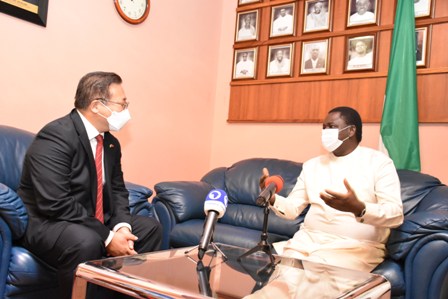
The UAE carrier, Emirates Airlines, would start carrying passengers from South Africa, Nigeria and India from June 23, the UAE Embassy said as it announced revised rules on Covid-19.
“We look forward to facilitating travel from these countries and supporting various travellers’ categories,” the airline said in a separate statement, yesterday.
“Residence visa holders from India and travellers from South Africa should’ve taken two doses of a vaccine approved by UAE authorities and carry RT-PCR tests reports from labs approved by the federal governments of these countries.
“But for Nigerians vaccination is not made mandatory but all other conditions apply.
“In addition to the above, Indians have to take a rapid PCR test four hours prior to their travel.
“While there are four vaccines in the UAE for use on eligible individuals against the Covid-19 infection – Sinopharm, Pfizer-BioNTech, Sputnik V and Oxford-AstraZeneca, it is unclear if the UAE has approved vaccines administered on Indian, South African and Nigerian citizens in their countries,” it stated.
“All travellers are also required to present a negative Covid-19 test result taken within 48 hours before departure.
“UAE citizens are exempted.
“Only QR coded PCR test result certificates are accepted.
“All passengers must take a rapid PCR test four hours prior to flight departure.
“All passengers must undergo a PCR test on arrival at Dubai Airport.
“Passengers should undergo institutional quarantine until they receive their PCR test result, which is expected within 24 hours.
“Passengers should produce a negative PCR test certificate with a QR Code from labs approved by the Nigerian government.
“All passengers must undergo a PCR test on arrival to Dubai Airport.
“Transit passengers should comply with entry protocols of final destinations.
“Entry will now be permitted to residents who have received two doses of UAE-approved vaccines,” the state said.
The revised procedures for travellers coming from the Republic of India, South Africa and Nigeria were issued by the Supreme Committee of Crisis and Disaster Management in Dubai.
They are effective from June 23, the Dubai Media Office said.
It said the updates are part of the committee’s keenness to protect passengers and ease hassles for them without compromising on Covid-19 preventive measures, said the Chairman of the Supreme Committee, Sheikh Mansoor Al-Maktoum.
The Media Office announcement said the updated travel protocols are part of a normal process of revising and optimising preventive measures based on the latest local, regional and international developments.



The Rivers State Commissioner for Education, Dr. Peters Nwagor, has commended the orderly conduct of the ongoing 2026 West African Senior School Certificate Examination in the state and urged schools to sustain the standard.
Dr. Nwagor gave the commendation on Tuesday during a monitoring tour of selected secondary schools in Port Harcourt and environs where the WAEC exam is ongoing.
The commissioner, who was accompanied by directors and monitors from the Ministry of Education, said he was impressed with the peaceful atmosphere at the centres visited.
“The students conducted themselves properly and wrote their papers under conducive conditions. Invigilators and supervisors also performed their duties professionally,” he stated.

Nwagor noted that the Rivers State Government had invested heavily to ensure the smooth and credible conduct of the examination across the state
He urged candidates to reciprocate government’s effort by shunning all forms of examination malpractice and focusing on their studies.
“Government has done so much to ensure successful examinations in our schools. Students should take advantage of it by remaining focused,” the commissioner said.
While no case of malpractice was recorded in the centres inspected, Dr. Nwagor warned that any principal, teacher, invigilator, or official caught aiding malpractice would face strict sanctions in line with regulations.
He also commended school administrators, teachers, WAEC officials, and security personnel for upholding the integrity of the process.
Centres visited included County Grammar School, Ikwerre/Etche; Government Comprehensive Secondary School, Borokiri; Government Secondary School, Borokiri; and Pabod Model Secondary School.

Rivers State University and the Otonti Nduka Foundation for Values Education jointly hosted a two-day National Conference on 8 and 9 May 2026 to examine the state of values in Nigeria.
The two days conference held at Rivers State University convocation arena brought together academics, policymakers, legal experts and education leaders under the theme _“Trends and Challenges in Upholding Values in Nigeria.”_
The gathering focused on policy gaps, curriculum reform, and the role of ethics in public service and education.
The event opened on Friday with remarks from Vice Chancellor Prof. Chief Isaac Zeb-Obipi, who stressed the need to address declining moral and civic values across Nigeria’s education and public sectors. A book of abstracts for the plenary sessions was also presented to participants.
Key speakers included former Attorney General Chief Dr Kanu Agabi, SAN; NERDC Executive Secretary Prof. Shehu Salisu; Prof. Hauwa Imam, FNAE, of the University of Abuja; former Rivers SUBEB Chairman Ven Dr Fyneface Akah, ; former NIMASA DG Dr Hon. Dakuku Adol-Peterside; and RSU Director of ICT Prof. Sunny Orike.
Discussions centered on integrating values education into schools, tertiary institutions and public institutions, alongside the impact of technology on moral development among young Nigerians. Panel and plenary sessions produced practical recommendations for curriculum and policy reform.
On Saturday, the foundation marked its centenary with the unveiling of the book _Otonti Nduka in History_, launched by Chief Engr. Grant Offor, FNSE. The Nigerian Academy of Education held a ceremonial procession led by its President Prof. Olu Jegede and the Ikwerre Professors Forum.
In a communiqué, participants called for stronger collaboration between government, civil society and academia to mainstream values education nationwide. They recommended reviewing teacher training curricula and expanding digital platforms to promote ethical civic engagement, with the foundation pledging to share the outcomes with education authorities for implementation.
Dignitaries present included Ogbakor Ikwerre Worldwide as Chief Host, Prof. Emeritus Chief T. Uzodimma Nwala, the Ikenga 1 of Mbaise and first philosophy student of Prof. Otonti Nduka, alongside scholars and community leaders.
Amadi Akujobi

