
Nation
THE STATES

FCT
The National Population Commission (NPC) says it has
purchased 91 new vehicles worth N600 million to enhance the productivity and welfare of its workforce.
Dr Sam Ahaiwe, the Acting Chairman of NPC, said this in Abuja during the official presentation of the vehicles.
He said that 39 vehicles would be dispatched to the states, while nine Sports Utility Vehicles (SUV) would be given to directors at the headquarters.
He said that 40 vehicles would be given to the Federal Commissioners, while three buses were earmarked for workers’ transportation at the headquarters.
Ahaiwe, however, said that the Hilux cars, which were formerly used by the commissioners, would be given to the State Directors to enhance their productivity.
“The current management of the commission, when it was inaugurated, was confronted with numerous challenges relating to the welfare of the staff.
“These include poor salary structure, housing problems, lingering backlog of promotions and the lack of staff buses,” he said.
Jigawa
The Malammadori Local Government Council of Jigawa
State has warned farmers against indiscriminate bush burning to check the spate of fire disaster in the area.
Alhaji Abdu Ilu, the Head of Agriculture Department (HOD), made the call when he visited Kashindila grazing reserve in Malammadori.
Ilu said the call was imperative to guard against bush burning and protect the forest resources.
‘’It is good for the farmers to eschew bush burning especially in the harmattan season.
‘’Apart from damages to the forest resources, it also results in fire disaster in the society.’’
Ilu also called on farmers to evacuate their farm produce on time, to guard against clashes between them and herdsmen.
The director said that the state government rehabilitated grazing lands and demarcated cattle routes to check incessant farmers and Fulani clashes in the state.
‘’The grazing reserve was equipped with pasture and wind pumps to enhance access to safe drinking water to humans and animals,’’ Ilu said.
Kaduna
The Coordinator of Interfaith Forum of Muslim and Chris
tian Women Association, Hajiya Amina Kazaure, has called for the protection of women against gender-based violence.
She made the call at a seminar tagged “Extremist Violence,Women and Security” holding in Kaduna.
Kazaure said women should be treated as equals in the search for peace in Nigeria as they bear the brunt of most conflicts.
According to her, the seminar is to provide an opportunity for women and top security chiefs to meet and agree on steps to promote peace in the country.
She also said that the seminar would focus on the impact the current security challenges on women, and the role women could play in ending it.
Kazuare added that women needed to be equiped to respond to extreme violence such as the insurgency in some parts of the country.
Also, Mrs Comfort Fearon, a member of the organisation, cautioned youths against all forms of negative tendencies.
Katsina
Former Inspector-General of Police (IG), Alhaji Ibrahim
Coomassie has called for amendment of the country’s constitution to make the protection of social and economic rights of citizens justifiable.
He made the remarks in Katsina in an interview with newsmen.
Coomassie said the purpose of government was not only to provide security for the people but also sustain their economic and social rights.
He added that “if government fails to provide those rights, citizens should be allowed to sue and claim for damages.’’
The former police chief said “I believed such action will compel those vested with leadership to do the right things, be more patriotic and respond to the needs of the people.
Kogi
Teens Educational Development and Information Network
(TEDIN), a non-governmental organisation (NGO), has advised rural dwellers to use long-lasting insecticide-treated nets so as to reduce child and maternal mortality.
The organisation’s President, Mr Titus Alonge, gave the advice in Odo-Ere, while speaking at a public awareness programme organised for some communities in Yagba West Local Government Area of Kogi.
The programme was organised by some NGOs to complement the government’s efforts to reduce child and maternal mortality through structured community health programmes.
Alonge said that the best way to reduce maternal mortality, which was induced by malaria attacks, was for pregnant women to avoid mosquito bites by using insecticide-treated nets.
Lagos
A cobbler, Kunle Fashanu,32, was docked before an
Apapa Magistrates’ Court in Lagos, for damaging and stealing the property of one Mr Emmanuel Omokhomon.
The accused, who resides at Festac Town area of Lagos, is facing a two-count charge of stealing and unlawful damage.
The prosecutor, Sgt. Uche Simon, told the court that the accused stole the sum of N45,000 and unlawfully damaged a jeep valued at N2 million belonging to Emmanuel Omokhomon.
Simon said that the accused committed the offences on September 29 at the same address.
The prosecutor said that the offences contravene sections 285 and 337 of the Criminal, Law of Lagos State, 2011.
Nassarawa
A Mararaba Upper Area Court in Nasarawa State, has
remanded a 27-year-old hair dresser, Ojochide Isaac of Kabayi in Mararaba, in prison custody for alleged intimidation and causing grievous hurt.
The presiding officer, Mr Habila Abundaga, ordered the accused to be remanded in prison custody pending final investigation of the matter after the prosecutor, Insp Joseph Ahua, had prayed the court to remand the accused.
Abundaga, in his ruling, ordered that the accused be remanded in prison till January 13, 2014, to enable the police conclude its investigations.
Earlier, Ahua had told the court that the matter was reported by Zainab Yahaya of the same address at the A’ Division Police Station on December 13.
The prosecutor said the accused assaulted Yahaya and inflicted deep injuries on her right eye with razor blade and that she was still receiving treatment at a Medical Centre in Mararaba.
He said that the offence contravened sections 397 and 241 of the Penal Code, which provide for a maximum of 10 years’ imprisonment, or fine or both, for anyone convicted of the offences.
Ogun
A 28-year-old man, Monday Emmanuel, has ben charged
before an Ota Magistrate’s Court in Ogun for allegedly stealing four packets of cigarettes and bottles of Alomo and Osomo drinks.
Emmanuel was also accused of stealing one radio set, four pieces of tiger battery, 40 pieces of assorted hot drinks, some sachets of Milo and milk, Schnapps and kerewa drinks.
The accused, who lives at 16 Ogunmefun St., Off Idi-Iroko Rd., Ota, is facing a one-count charge of stealing.
The Police prosecutor, Insp Olumide Awoleke, told the court that the accused committed the offence on December 13, at about 2:00 a.m. at Long Bridge, along Lagos/Ibadan Expressway, Isheri Olofin, Ota, Ogun.
Osun
A 27-year-old petrol attendant, Oladipupo Oluwasina,
was docked before an Osogbo Chief Magistrate’s Court in Osun for allegedly stealing N813, 000 from his employer.
The Police Prosecutor, Insp Isiaka Ajadi, told the court that the accused committed the offence on July 25, at about 10:30 p.m. at Mobil Filling Station, Oke-Fia in Osogbo.
Ajadi added that the accused, being a petrol attendant, stole the money which belonged to one Mrs Olabisi Ige, his employer, from her office, after the close of work.
He said the accused had, however, been on the run since committing the crime, only to be apprehended on Monday.
Sokoto
The Sokoto State Government, has commenced the dis
tribution of 2.5 million treated mosquito nets to households across the 23 local government areas of the state.
Dr Halliru Alhassan, the State Director, Medical Services and Public Health, disclosed this in Sokoto during a news conference.
Alhassan said the nets obtained under the National Malaria Elimination Programme, would be distributed at 854,000 designated centres in the state between December 17 and December 21.
“Net cards that entitle a household to collect at least four nets had been distributed across the state.
“Efforts were made to cover difficult areas and Fulani settlements to ensure that eligible households collect the nets,” he said.
The director said measures had been taken to prevent the nets from being sold by either the officials or the beneficiaries.
According to him, security agencies have been directed to arrest anyone one found sabotaging the effort.
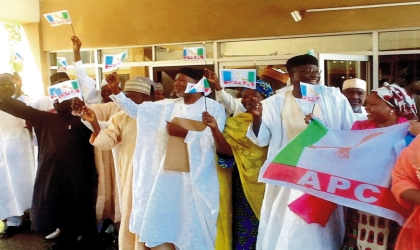
Some of the 37 members of the Adamawa State Executive Council declaring for All Progressives Congress (apc), at a ceremony in Government House in Yola last Wednesday. Photo: NAN




The Hydrocarbon Pollution Remediation Project (HYPREP) has commemorated the 15th anniversary of the release of the United Nations Environment Programme (UNEP) Environmental Assessment Report on Ogoniland, reaffirming its commitment to restoring the environment and improving the livelihoods of affected communities.
In a statement signed by the Project Coordinator, Prof Nenibarini Zabbey, to commemorate the anniversary, HYPREP described the anniversary as a significant milestone in Nigeria’s environmental restoration efforts, noting that the project has made remarkable progress in implementing the recommendations of the landmark UNEP report released on August 4, 2011.
The UNEP report had revealed extensive oil pollution across Ogoniland, severe environmental degradation, and serious public health risks resulting from decades of petroleum operations. It also recommended an initial $1 billion fund to commence the cleanup of the affected communities.
According to HYPREP, the Federal Government formally launched the Ogoni clean-up in 2016, while the Project Coordination Office was established in 2017 to drive the implementation of UNEP’s recommendations.
Zabbey said the current administration has continued to prioritise the project under the Renewed Hope Agenda.
Providing an update on the cleanup, the Project Coordinator disclosed that 30 of the 65 contaminated sites identified by UNEP have been fully remediated, while work is ongoing at several medium- and high-risk locations. It also stated that more than 1.5 million mangrove seedlings have been planted as part of what it described as the world’s largest restoration of oil-degraded mangroves, with over 1,000 hectares of shoreline already rehabilitated.
Zabbey further revealed that 49 Ogoni communities have been connected to potable water schemes through multiple water projects and booster stations aimed at providing safe drinking water across the region.
In the health sector, he said the 100-bed Ogoni Specialist Hospital in Kpite and the 43-bed Cottage Hospital in Buan are nearing completion, adding that several existing health facilities have been upgraded with modern medical equipment, while five ambulances have been donated to improve emergency healthcare services. The Project Coordinator also disclosed that a three-year human health biomonitoring study is being conducted in collaboration with the World Health Organization’s International Agency for Research on Cancer (IARC).
On economic empowerment, Zabbey stated that the Project has created more than 8,000 direct jobs and trained thousands of Ogoni youths and women in various vocational and technical skills, including software development, cybersecurity, aviation, commercial diving, seafaring, mechatronics, and creative arts. The project also reported awarding scholarships to more than 1,000 students, providing grants to small businesses, and supporting persons living with special needs through skills acquisition programmes.
The statement further highlighted ongoing legacy projects, including the Ogoni Power Project and the Centre of Excellence for Environmental Restoration, which it said is about 96 per cent complete. HYPREP also welcomed the recent designation of the Ogoni Wetland as a Ramsar Site of International Importance and pledged to continue promoting biodiversity conservation and sustainable management of the ecosystem.
Marking the anniversary, Zabbey said the progress achieved over the past 15 years demonstrates the collective commitment of government, development partners, stakeholders, and local communities to restoring Ogoniland. He called for renewed collaboration to sustain the cleanup effort, promote environmental sustainability, and support the long-term development of the region. 3
-

 News2 days ago
RSG Targets Nine Million Residents in Mosquito Net Distribution Campaign
-

 Oil & Energy2 days ago
Aiyedatiwa Signs New Electricity Bill
-

 Maritime2 days ago
Marine Minister Commends President Tinubu On NPERA Bill Assent
-

 Oil & Energy2 days ago
NLNG Commissions Research And Innovation Centre In RSU
-

 News2 days ago
KenPoly Holds Eight Convocations, August 29
-

 News2 days ago
RSG Begins Another Phase of Projects Commissioning Today
-

 News2 days ago
RMAFC Completes Revenue Sharing Review, Proposes New Pay
-

 Maritime2 days ago
NAGAFF Petitions IGP Over Alleged Maritime Police Harassment