
News
Financial Times’ Article On Nigeria Enrages Presidency

The Presidency has rebuked the Financial Times’ Africa Editor, David Pilling, over an article on President Muhammadu Buhari government published on January 31, 2021.
In an open letter to The Editor, Financial Times, Senior Special Assistant to the President on Media and Publicity, Garba Shehu, said, “The caricature of a government sleepwalking into disaster (What is Nigeria’s government for? January 31, 2022) is predictable from a correspondent who jets briefly in and out of Nigeria on the same British Airways flight he so criticises.
“He highlights rising banditry in my country as proof of such slumber.
“What he leaves out are the security gains made over two presidential terms.”
According to Shehu, “the terror organisation, Boko Haram, used to administer an area the size of Belgium at inauguration; now, they control no territory”.
He said, “The first comprehensive plan to deal with decades-old clashes between nomadic herders and sedentary farmers-experienced across the width of the Sahel–has been introduced: pilot ranches are reducing the competition for water and land that drove past tensions.
“Banditry grew out of such clashes. Criminal gangs took advantage of the instability, flush with guns that flooded the region following the Western-triggered implosion of Libya.
“The situation is grave. Yet as with other challenges, it is one that the government will face down.”
In his article titled, ‘What is Nigeria For?’, Pilling had written:”On the British Airways flight between London and Nigeria’s administrative capital of Abuja, one of the airline’s most profitable routes, nearly all the space is taken up with flatbeds. The unfortunate few making their way to a crunched economy section at the back must trudge through row after row of business class.
“Evidently, there is plenty of money to be made in Abuja’s corridors of power. Nigeria’s economy may be flat on its back, but the political elite flying to and from London will spend the flight flat on theirs, too.
“Next year, many of the members of government will change, though not necessarily the bureaucracy behind it. Campaigning has already begun for presidential elections that in February, 2023, will draw the curtain on eight years of the administration of Muhammadu Buhari, on whose somnolent watch Nigeria has sleepwalked closer to disaster.
“Buhari has overseen two terms of economic slump, rising debt and a calamitous increase in kidnapping and banditry—the one thing you might have thought a former general could control. Familiar candidates to replace him, mostly recycled old men, are already counting their money ahead of a costly electoral marathon. It takes an estimated $2billion to get a president elected. Those who pay will expect to be paid back.
“There are some promising candidates. If Yemi Osinbajo, the technocratic vice-president, were miraculous to make it through the campaign ticket and emerge as president, the hearts of Nigerian optimists would beat a little faster.
“But that may be to underestimate the depth of Nigeria’s quagmire. The problem is not so much who leads the government as the nature of government itself.
“Nigeria’s administration is fuelled by oil — though not its economy; more than 90per cent of output is generated from non-oil activities. But for decades, the business of government — whether military or, since 1999, democratic — has been to control access to oil revenues and earn patronage by spreading petrol-dollars to federal and state supplicants.
“Outside oil, government raises a petty amount of revenue, proportionally much less than other African states. Since the provision of services is so dire, no one who can afford to pay taxes is willing to do so. Nigerians with money opt out of the system.
“They send their kids to private school, attend private hospitals, employ their own private security and generate their own power. The state borrows ever more heavily to fund what little capital expenditure there is and service mounting debts. Like a giant leech at the top of the body politic, government is essentially there to fund itself.
“This thwarts the aspirations of millions of highly capable Nigerians. Officials extract ‘rent’ by controlling access to business opportunities. The objective thus becomes to slow down investment not speed it up.
“Almost all the energy, drive and wealth creation in Nigeria happens outside government. New unregulated businesses in the booming tech sector, fashion, design and the creative arts are flourishing. Every day, tens of millions of Nigerians somehow get by, despite the efforts of those supposedly looking out for them.
“As is said of India, Nigeria grows at night while the government sleeps — hardly surprising that some libertarian tech entrepreneurs want the government to withdraw and leave the private sector in charge.
“In reality, the government is not too big. It is too small. The federal budget — not counting money transferred to states — is about $30billion, derisory for a population of more than 200million people. Only trust in government — and a willingness to pay taxes — can redress this balance.
“Nigeria desperately needs an administration whose energies go not into preserving its own privilege but into providing public goods — basic education and health, rule of law, security, power, roads and digital infrastructure. It must remove distortions and subsidies that direct entrepreneurial activity from production to arbitrage.
“The chances of a corrupt system reforming itself are slim. But if Nigeria’s ruling class cannot manage it, any remaining faith Nigerians have in their system of government will evaporate. That way lies disaster.”



The National Drug Law Enforcement Agency (NDLEA) has intercepted 1.63 million pills of tramadol concealed in two long trailers heading for Kano as it intensified efforts to dismantle a transnational drug trafficking syndicate operating along the Togo-Benin Republic-Nigeria corridor.
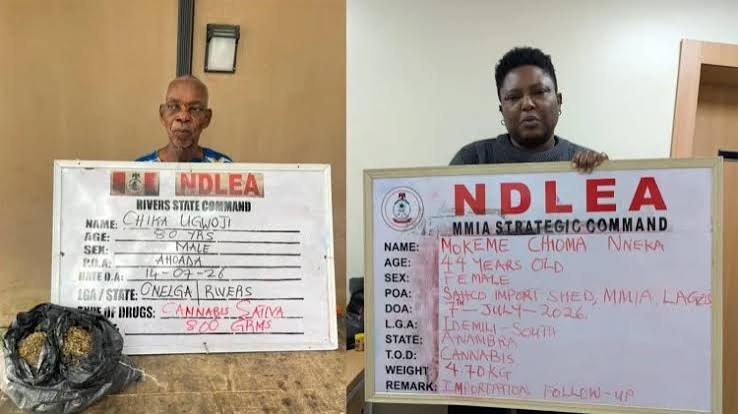
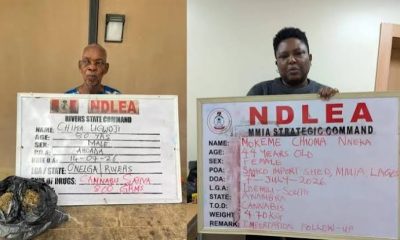
The agency also arrested an 80-year-old suspected drug dealer in Rivers State, a businesswoman linked to cannabis shipments from Canada, a Chadian woman, a couple and other suspects in coordinated operations across Lagos, Edo, Kogi and Rivers states.
The NDLEA’s Director of Media and Advocacy, Femi Babafemi, disclosed this in a statement, yesterday.
According to the statement, the latest intelligence-led operation came barely one week after NDLEA operatives recovered 558,900 pills of tramadol concealed in the false-bottom compartment of a truck that entered Lagos through the Togo-Benin Republic route.
Babafemi said, “Ongoing efforts to dismantle a transnational drug trafficking syndicate smuggling tramadol from Togo, through Benin Republic into Nigeria have yielded another success with the interception of two long trailers used to move One Million Six Hundred and Thirty (1,630,000) pills of tramadol 250mg concealed in fabricated compartments of the trucks across multiple borders into Lagos.”
He added that one of the two trailers was intercepted on July 2 along the Lagos-Ibadan Expressway, where operatives recovered 853,000 pills of tramadol 250mg concealed in a fabricated compartment beneath the cargo floor.
Babafemi said, “One of the two trucks already heading to Kano was tracked and located on 2nd July 2026 along the Lagos-Ibadan Expressway where NDLEA officers recovered 853,000 pills of tramadol 250mg concealed in a fabricated compartment beneath the cargo floor of the trailer and arrested the 22-year-old driver Jabir Kabiru.”
He further disclosed that another trailer was intercepted two days later on the same route.
“Two days later, 4th July, NDLEA operatives acting on processed intelligence successfully tracked and recovered the second trailer from the Lagos-Ibadan Expressway while heading to Kano. A total of 777,000 pills of tramadol 250mg concealed in a fabricated compartment beneath the cargo floor of the truck were evacuated and the 22-year-old driver Muhammed Nuhu arrested,” the statement read.
According to Babafemi, investigations established a link between the three intercepted consignments.
He said, “Investigations revealed that all three trucks and consignments intercepted on 21st June, 2nd July and 4th July belong to the same transnational drug trafficking syndicate operating along the Togo-Benin Republic-Nigeria axis.”
The agency also intercepted 4.70 kilograms of Canadian Loud, a synthetic strain of cannabis, at the import shed of the Murtala Muhammed International Airport, Ikeja, Lagos.
Babafemi said, “Two consignments of Canadian Loud, a synthetic strain of cannabis, with a combined weight of 4.70 kilograms have been intercepted at the import shed of the Murtala Muhammed International Airport (MMIA), Ikeja, Lagos. The cargoes, which arrived the Lagos airport from Canada in cartons with ‘Odugwu’ boldly written on them, came aboard British Airways and Ethiopian Airlines flights on 24th June and 3rd July respectively.”
He said two cargo agents, Ali Rotimi Samson and Orimolade Oluwagbenga, were initially arrested in connection with the shipments, while another suspect, Edeh Onyeamachi Stanislus, was apprehended after arriving at a logistics company to take delivery of the consignments.
The Federal Ministry of Humanitarian Affairs and Poverty Reduction has denied claims that it has commenced registration for a purported ?50,000 National Support Allowance.
The ministry, in a public notice posted on its official X handle, yesterday, described messages, links and websites advertising the alleged programme as fraudulent.
It urged Nigerians to disregard such claims and verify information only through official government channels.
“The Federal Ministry of Humanitarian Affairs and Poverty Reduction has NOT commenced registration for any ?50,000 National Support Allowance,” the ministry said.
It added, “Disregard fraudulent messages, links and websites claiming otherwise. Verify any info only through official govt channels.”
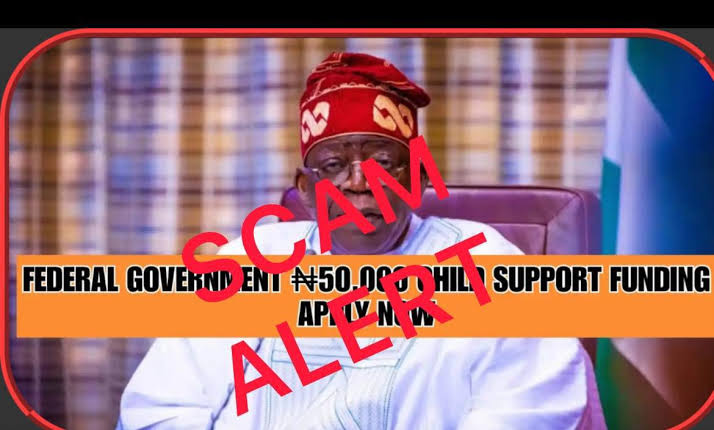
The alert is in response to a circulating scam flyer that falsely claims the program is ongoing under President Bola Tinubu’s directives.
The fake advertisement, which includes text in Hausa and English, directs victims to a suspicious website (kluspz.com) for applications.
The ministry’s warning comes amid heightened concerns over digital fraud targeting vulnerable populations seeking social support.
Similar scams have previously surfaced around programs like N-Power, prompting questions from citizens in replies to the official post.
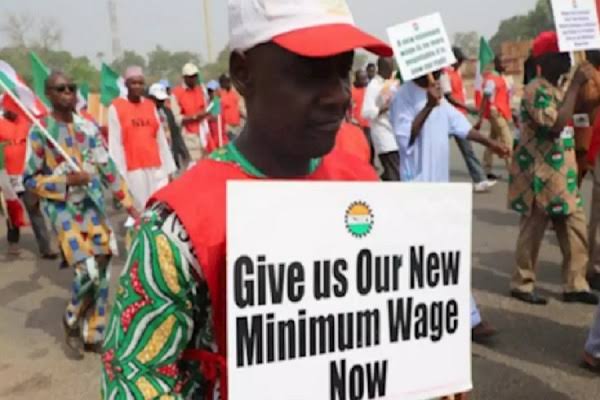
The Nigeria Labour Congress (NLC) has expressed its preparedness for a major national struggle for a comprehensive review of the national minimum wage.
NLC President, Comrade Joe Ajaero, hinted at this while making his remarks at the commissioning of the Comrade Godwin Abumisi Pensioners Legacy House and Multipurpose Hall in Abuja.
Ajaero said it is no longer acceptable to discuss the welfare of workers without also discussing the welfare of those who have completed their active years of service.
He advised workers and pensioners to get prepared for the ideological and economic battles that lie ahead.
According to the NLC president, “The Nigeria Union of Pensioners (NUP) is one of the proud affiliates of the Nigeria Labour Congress. Therefore, your struggle is our struggle, and your welfare remains a priority for the organised labour movement.
“We are currently in the preparatory stages for a major national struggle for a comprehensive review of the national minimum wage.
“However, let me state unequivocally that it is no longer acceptable to discuss the welfare of workers without also discussing the welfare of those who have completed their active years of service.
“Accordingly, the Nigeria Labour Congress will not only push for a new national minimum wage but will also demand the establishment of a national minimum pension. It is a historical injustice that men and women who devoted their youth, strength and productive years to the service of this nation should be condemned to live below the poverty line after retirement.”
Ajaero noted that the cost of living has risen astronomically as food, healthcare and transportation have become increasingly unaffordable.
“We cannot continue to allow our senior citizens to survive on pensions that have become poverty wages. Every retiree deserves to live with dignity after decades of faithful service to the nation,” he said.
He urged pensioners across the country to remain united and prepared as the process begins, adding: “This Legacy House should not merely be seen as a physical structure; it should become a centre for mobilisation, strategic engagement and solidarity as we prepare for the struggles ahead.”
The NLC president pointed out that the working class has always understood that “those who exploit workers are united in advancing their interests. We too must remain united in defending our collective interests and ensuring that government fulfils its obligations to both serving workers and retirees.”
He urged pensioners across the country to remain united and prepared as the process begins, adding: “This Legacy House should not merely be seen as a physical structure; it should become a centre for mobilisation, strategic engagement and solidarity as we prepare for the struggles ahead.”
The NLC president pointed out that the working class has always understood that “those who exploit workers are united in advancing their interests. We too must remain united in defending our collective interests and ensuring that government fulfils its obligations to both serving workers and retirees.”
He said the completion of the project should serve as a clarion call to all workers and lovers of the masses.
“We must not only build physical structures but also build a strong movement capable of compelling government to honour its commitments,” he said.
Ajaero further stated: “We will continue to demand the immediate payment of all outstanding pension arrears and the implementation of a pension regime that guarantees every retiree a life of dignity and security.
“Together, we shall continue to fight until every Nigerian worker and pensioner receives the justice, respect and welfare they deserve.”
-

 News3 days ago
Rivers NUJ Seeks Recruitment Into State Media Houses …Urges Govt To Reposition Public Service
-

 News3 days ago
Family Seeks Police Help As Woman Goes Missing After Fleeing Female Circumcision Threat
-
 News3 days ago
NDLEA Intercepts 1.63m Tramadol Pills, Arrests 80-Year-Old Suspect
-
 Oil & Energy3 days ago
NCDMB Partner Renaissance To Train 300 Youths On oil, gas Skills
-
 News3 days ago
Nigeria Hosts World Public Relations Forum Sept …As Experts Seek Inclusion Of PR In Decision Making
-
 Oil & Energy3 days ago
Local Crude Shortage Crippling Nigerian Refineries – MAN
-
 News3 days ago
Tinubu, Fubara Condole Amaechi Over Mother’s Death
-
 News3 days ago
Uphold Principles Of Dev, Rivers SSG Charges Tertiary Institutions