
Politics
N’Delta: Surviving The Burden Of Political Opposition

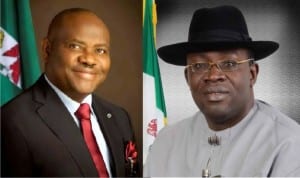
Rivers State Governor, Barr Nyesom Wike and Bayelsa State Governor, Hon. Seriake Dickson
The 2015 general elec
tions in Nigeria made history in many respects. One of the novelties that resulted from that exercise was the fact that a ruling political party became the opposition party for the first time in Nigeria.
Another dramatic outcome of that electoral exercise was that the strong hold of the opposition in Nigeria did not fall to any of the three majority tribes but to the South-South/Niger Delta region which had hitherto always found relevance and prominence on the national stage by affiliating with the ruling party or government at the centre.
Perhaps for fear of domination and/or subjugation by one or a combination of others, the minorities of the South-South region had never felt strong enough to stand alone and had always found it convenient to form alliance with, at least, one of dominant groups, especially the North, for political cover and protection since the inception of democratic governance in Nigeria.
This development has been viewed differently by various political observers. While some remain skeptical about the ultimate outcome of this turn of events in the political landscape of the Nigerian federation, there are others who see the development as a test of the political maturity of the region and its people. Yet there are those who consider it as an opportunity for a more rapid development and progress of the region endowed with natural resources but inhibited by an unfavourable political system in Nigeria.
“I think it’s a new dawn for the Niger Delta and it’s a good thing that has happened”, says Biebele Arimie, a Procurement and Supply Management expert and public affairs analyst.
According to Arimie, the development comes with an opportunity for a healthy competition that will benefit the people if the leaders understand it and will be wise enough not to tear themselves and the people apart along party lines.
He enjoined the political elite in the region to use the opportunity to engage in what he called “Developmental competition; rather than use it to precipitate crisis and violence that will help to further impoverish and underdevelop the people.
“Those who are opportune to be functionaries in the federal government should begin to think of strategies of how to work out ways to compete with their various state government, not by precipitating violence but by attracting projects from the federal government to their various states in the Niger Delta”, he said.
Arimie observed that the long years of romance with the central government had not much benefited the region after all, insisting that belonging to the mainstream had made it difficult for the leadership of the region to be assertive and vehement in agitating for what is their due but had rather just tagged along for fear of losing their place.
“It is also not so beneficial to have the region and the centre in the same party like when Goodluck Jonathan was in power. There was no competition. Everybody was afraid. But right now, if you ask me, we are supposed to have a healthy competitions,” he emphasized, adding that this is possible by functionaries at both levels of government who belong to opposing political parties closely watching each other and taking appropriate development, actions to win the endorsement and support of the people.
Arimie, who was also the Rivers and Bayelsa States Chapter Chairman of the Nigerian Institute of Supply and Procurement Management, urged political leaders in the region to avoid the temptation of using the occasion to engage in unnecessary bickering and unhealthy rivalry that will not yield any beneficial results in the end.
“There will be criticism of how well each one is doing. But we don’t want a situation like what happened in Ogu where Nyesom Wike as Minister of Education came to the Technical School and laid the foundation to say we want to build this school. By then, Chibuike Amaechi as governor of Rivers State also went to the same place and said ‘look I also want to build the same school. At the end of the day, nobody built anything. We don’t want that kind of competition”, he reiterated, adding that, “if both the majority party and opposition will listen to the voice of wisdom and ensure that nobody continues to precipitate violence under any guise, Rivers State and the Niger Delta will grow faster and faster.”
Comrade Christian Lekia, a rights activist and a crusader for non-violence in the Niger Delta shares the sentiments and hopes of Biebele Arimie cautiously. According to Comrade Lekia, the task of the minorities surmounting the challenges of opposition politics in Nigeria is not insurmountable but clearly very difficult. He expressed the fear that with the soul of the opposition outside the three dominant tribes in Nigeria, it would be difficult for the minority tribes to assert themselves on the nation in that role.
He said even though this was not the first time the country would be experiencing politics, it was difficult to see if the minorities of the South-South region have the ingredients to survive and surmount the challenges as Lagos State did under the Olusegun Obasanjo presidency. “Whatever Lagos State did to re-enact itself nationally through alliance and friendship with the North, the minority political opposition party in the South-South must redouble that effort,” he said. Comrade Lekia said Lagos State survived opposition because they remained strong in their focus, principles, belief in their party ideology in addition to believing in themselves and urged the present political leaders in the Niger Delta to borrow a leaf from that experience and make the desired impact for the region and the nation at large.
“When you find a political leadership which major interest is about receiving allocation from the centre and going cap in hand to the centre for every need at the state level, then you justify why we were doing better. Doing better in the sense that they had smooth relationship with the centre but in the actual sense of it I really do not see so much in terms of benefit from the centre because the political leadership was so comfortable with what they were getting”, he stressed.
With the turn of events, Comrade Lekia urged the current political leadership in the region to be “challenged with how to become more productive; how to device better and more effective means of managing our economy, especially when it comes to internally generated revenue and engaging the people.”
“This is an opportunity for the minority opposition in the South-South to show the might of their intellect, the might of their understanding in terms of the game of politics. It’s not about surviving from breast to mouth like a mother-baby relationship,” he said, adding that this is the first time they will have to stand up and devise means of surviving and making a statement that they understand why they are in power as minorities and as opposition in Nigeria.”
He said even through the region remains a component of the federation, the political and socio-economic survival and wellbeing of the states and the region lies squarely on the shoulders of their leadership as no one can dictate to them nor run their affairs directly for them. I couldn’t see it as a disadvantage. I see as a call on the political class within the South-South to re-echo their voices and show their might and that they understand what they’re in power to do. Let them play according to the rules of the game and think of ingenuous ways of generating income from independent sources,” he said, pointing out that if Lagos could stand alone and pull through with only a service based economy, the Niger Delta region with its rich natural endowments cannot but fare better with the right attitude and commitment by its leadership.
“So, if you find a responsible leadership managing the economies of these states and delivering the dividends of democracy to the people, you won’t really find any reason why you will be feeling the impact of the centre negatively,” the rights activist concluded.
Perhaps this is the right time to revive and strengthen such initiates as the BRACED Commission and the South-South Peoples Assembly to foster regional integration through social, cultural, economic and political cooperation aimed at achieving a united front and a structural development for the disadvantaged people of the region.



The Independent National Electoral Commission (INEC) has extended the deadline for political parties to submit the list of candidates for the 2027 governorship and state Houses of Assembly elections from Saturday, August 8, to Tuesday, August 11, 2026.
The commission announced the extension in a statement issued on Saturday and signed by the National Commissioner and Chairman of its Information and Voter Education Committee, Mohammed Haruna.
According to INEC, the decision followed appeals by political parties for additional time to complete the submission process through the dedicated online portal.
“The submission window, which according to the revised Timetable and Schedule of Activities for the General Election was originally scheduled to close on Saturday, 8th August, 2026, has been extended to Tuesday, 11th August, 2026,” the commission said.
In a a related development, INEC announced the suspension of PVC collection in Osun State ahead of the August 15 governorship election.
The commission said voters who applied for replacement of lost, damaged or defaced Permanent Voter Cards would have until midnight on Sunday, August 9, to print downloadable copies of their cards.
The electoral body explained that the deadline was necessary to enable it compile data on downloaded PVCs and produce final statistics on the total number of cards collected ahead of the election.
INEC said PVC collection in Osun commenced at the Registration Area level from July 22 to 28, 2026, but was extended to July 31 following complaints about large crowds and difficulties experienced by voters at collection centres.
The exercise subsequently moved to the local government level and ran from August 1 to 7.
The commission also disclosed that replacement downloadable PVCs had been made available to voters in Odo-Otin and Ife Central Local Government Areas following the theft of cards during attacks on the two collection centres.
It stressed that the stolen cards could not be used to vote.
INEC reassured Osun residents of its preparedness for the August 15 governorship election.
“The commission reiterates that the stolen cards cannot be used to vote.
“INEC reassures the people of Osun State of its readiness to conduct a free, fair, credible and inclusive governorship election on 15th August, 2026,” the statement said.
The commission said the deadline, initially set for Saturday, 8 August, has been extended to Tuesday, 11 August 2026, following appeals from political parties for more time.
INEC also announced that the window for voters who applied to replace lost, damaged or defaced PVCs to download their replacement cards will close at midnight on Sunday, 9 August.
The move is to enable the commission compile final PVC collection figures ahead of the 15 August Osun governorship election.
INEC said replacement downloadable PVCs have also been provided to affected voters in Odo-Otin and Ife Central Local Government Areas after hoodlums carted away cards from two collection centres, stressing that the stolen cards cannot be used to vote.
The commission reaffirmed its readiness to conduct a free, fair, credible and inclusive election in Osun State.
Gov. Kefas made the remarks over the weekend at the Federal Medical Centre (FMC), Jalingo, during the flag-off of the second phase of the Renewed Hope Medical Outreach in Taraba State, organised as part of activities marking Prof. Yilwatda’s 58th birthday.
The governor commended Prof. Yilwatda for choosing to mark his birthday by providing medical care to people in need.
“What Professor Nentawe did is a powerful demonstration of what leadership should be,” Gov. Kefas said.
He assured that his administration would continue to support initiatives that complement government efforts to improve healthcare delivery and the wellbeing of residents.
Speaking at the event, Prof. Yilwatda called on Nigerian leaders to embrace the culture of giving and use their positions to touch the lives of the less privileged.
He said his decision to celebrate his 58th birthday in Taraba State was deliberate and informed by the needs of underserved communities, particularly people who face difficulties accessing healthcare because of distance and financial constraints.
According to him, the intervention followed a needs assessment and was extended across the three senatorial districts of the state.
He said the exercise commenced on August 3 at Takum General Hospital and covered the Federal University Teaching Hospital, Wukari; First Referral Hospital, Sunkani, Ardo-Kola Local Government Area; General Hospital, Bali; General Hospital, Gembu; and FMC Jalingo.
Prof. Yilwatda said the intervention provided medical services to thousands of beneficiaries, including people who required surgical procedures.
He said sustainable national development could only be achieved when strong institutions placed Nigerians at the centre of development.
“Leadership is about service,” he said, urging political and public leaders to make giving back to society an important part of their responsibilities.
He reaffirmed his commitment to serving Nigeria and its people, saying his personal vision was to make every day of his life useful to humanity.
“Every day that I live, the vision is: let it be useful to humanity,” he said.
The Taraba State Commissioner for Health, Dr. Bordiya Buma, commended the initiative, saying it was consistent with the Renewed Hope agenda and efforts to strengthen healthcare delivery in the state.
Dr Buma said the second phase followed the successful completion of the first phase, which was conducted simultaneously in six local government areas, with two LGAs selected from each of the three senatorial districts.
According to him, more than 10,000 patients were attended to during the first phase, including people with medical and surgical conditions.
He disclosed that 327 general surgeries, 71 eye surgeries and 575 dental procedures were carried out during the exercise.
The commissioner expressed appreciation to President Bola Tinubu for the Renewed Hope Medical Outreach and thanked Prof. Yilwatda for supporting the initiative and choosing Taraba State as a beneficiary.
The Minister of Health and Social Welfare, Prof. Muhammad Ali Pate, also commended Prof. Yilwatda for choosing Taraba State to mark his 58th birthday through a medical outreach.
Prof. Pate said making healthcare the centrepiece of the birthday celebration was significant because health affects everyone.
-

 News3 days ago
RSG Targets Nine Million Residents in Mosquito Net Distribution Campaign
-

 Oil & Energy3 days ago
Aiyedatiwa Signs New Electricity Bill
-

 Maritime3 days ago
Marine Minister Commends President Tinubu On NPERA Bill Assent
-

 Oil & Energy3 days ago
NLNG Commissions Research And Innovation Centre In RSU
-

 News3 days ago
KenPoly Holds Eight Convocations, August 29
-

 News3 days ago
RSG Begins Another Phase of Projects Commissioning Today
-

 News3 days ago
RMAFC Completes Revenue Sharing Review, Proposes New Pay
-

 Maritime3 days ago
NAGAFF Petitions IGP Over Alleged Maritime Police Harassment