
Nation
NDDC Building Regional Integration Through Inclusive Conflict Management – Ogbuku

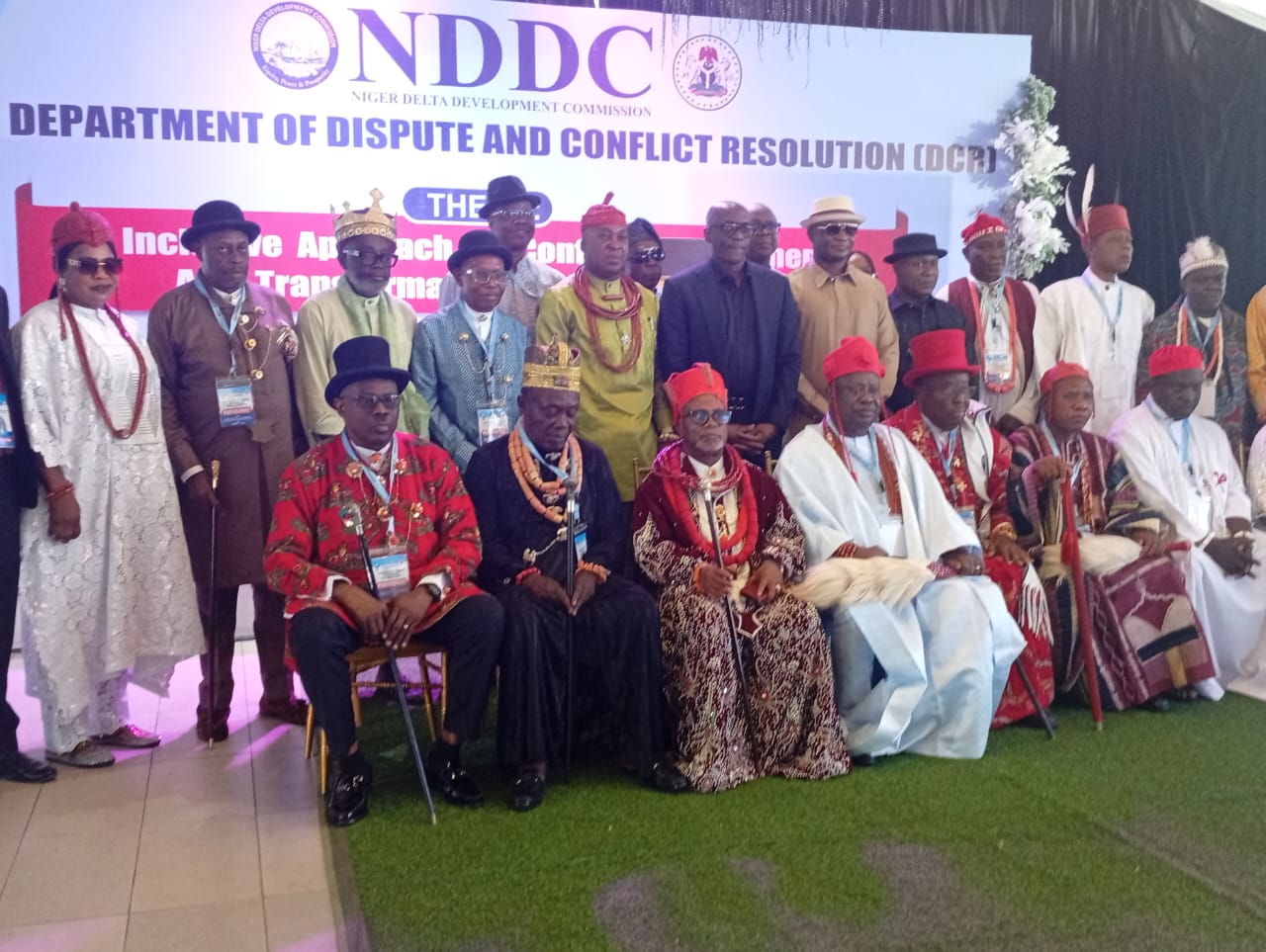
The Managing Director/Chief Executive Officer of Niger Delta Development Commission, (NDDC), Mr Samuel Ogbuku says the commission as an interventionist agency is building a regional integration among the Niger Delta states through inclusive approach to conflict management and Transformative Dispute Resolution.
Ogbuku stated this while speaking at a one _day capacity Building program organised by the Department of Conflict management and Dispute Resolution (DCR) of the Commission on inclusive conflict management and peace building mechanism organism for selected Niger Delta Stakeholders, Traditional Rulers , Religious leaders, Community leaders and women leaders held in port Harcourt, last Tuesday with the theme”Inclusive approach to conflict management and Transformative Dispute Resolution”
He disclosed that the essence of the workshop was to build the capacity of the traditional rulers and other community leaders who are custodians of the people so that they can be able to manage and resolve crisis in their various communities as the needs arises.
According to him,the essence of bringing together all the stakeholders from the Niger Delta states is because they have a common challenges confronting them in the region and the need to have an inclusive approach in resolving such issues even as he stressed the need for leaders in the region to close ranks together and collaborate to promote peace across the region.
He declared that the region is the most peaceful region across the country and attributed it to the various lessons learnt during the crisis period that engulfed the region which emanated from agitations for fair sharing and equitable distribution of natural resources to the region.
“We have learnt our lessons and some good , some also bad but we can not wait untill there is a problem and we must be proactive in handling the situation.we must be armed and equipped our community leaders and it must be all inclusive involving the traditional rulers, Religious leaders,CDCs and women leaders.Every body must synergise to bring peace to the region .
We know we have common challenges like Ecological degradation, Environmental challenges and under development.Although,our challenges may differ but we do have common crisis in the region.we can’t watch one part have crisis and others live in peace,so we must have a universal approach in solving them which is to embrace and preach peace.” he stated.
Ogbuku urged them to be inclusive in taking decisions in their various communities and ensure they people along, adding that the commission is looking at the micro level of engagement for peaceful stability in our region as custodians of the people and not the politicians .
” If our communities are peaceful, local, state and nation will be peaceful.we trust in your capacity to maintain peace in your various communities that informed the reason for choosing you all so as to equip and build your capacities”.he stated.
Also speaking ,the chairman of NDDC Governing Board, Chiedu Ebie harps on importantance of Alternative Dispute Resolution in resolving conflict, stressing that conflict is part of human existence but how to resolve it makes the difference.
He commended the managing Director and his team for giving approval for this workshop to train and build capacity of traditional leaders, religious leaders, community leaders, including women leaders and urged the participants to have a broader mindset during the training.
Earlier in his opening remarks,the Acting Director, DCR, NDDC, Barr Goodwin Ayewumi Ogedegbe averred that the program was designed to enhance their skills and knowledge in conflict management and peace building.
“The inclusive approaches that prioritise dialogue, empathy and collaboration enabling to address the root causes of conflict rather than merely symptoms.
The emphasis on inclusivity is particular important, it ensures that all voices are heard especially those marginalized group who are not part of decision making in the society ”
Amadi Akujobi



The Rivers State Commissioner for Education, Dr. Peters Nwagor, has commended the orderly conduct of the ongoing 2026 West African Senior School Certificate Examination in the state and urged schools to sustain the standard.
Dr. Nwagor gave the commendation on Tuesday during a monitoring tour of selected secondary schools in Port Harcourt and environs where the WAEC exam is ongoing.
The commissioner, who was accompanied by directors and monitors from the Ministry of Education, said he was impressed with the peaceful atmosphere at the centres visited.
“The students conducted themselves properly and wrote their papers under conducive conditions. Invigilators and supervisors also performed their duties professionally,” he stated.

Nwagor noted that the Rivers State Government had invested heavily to ensure the smooth and credible conduct of the examination across the state
He urged candidates to reciprocate government’s effort by shunning all forms of examination malpractice and focusing on their studies.
“Government has done so much to ensure successful examinations in our schools. Students should take advantage of it by remaining focused,” the commissioner said.
While no case of malpractice was recorded in the centres inspected, Dr. Nwagor warned that any principal, teacher, invigilator, or official caught aiding malpractice would face strict sanctions in line with regulations.
He also commended school administrators, teachers, WAEC officials, and security personnel for upholding the integrity of the process.
Centres visited included County Grammar School, Ikwerre/Etche; Government Comprehensive Secondary School, Borokiri; Government Secondary School, Borokiri; and Pabod Model Secondary School.

Rivers State University and the Otonti Nduka Foundation for Values Education jointly hosted a two-day National Conference on 8 and 9 May 2026 to examine the state of values in Nigeria.
The two days conference held at Rivers State University convocation arena brought together academics, policymakers, legal experts and education leaders under the theme _“Trends and Challenges in Upholding Values in Nigeria.”_
The gathering focused on policy gaps, curriculum reform, and the role of ethics in public service and education.
The event opened on Friday with remarks from Vice Chancellor Prof. Chief Isaac Zeb-Obipi, who stressed the need to address declining moral and civic values across Nigeria’s education and public sectors. A book of abstracts for the plenary sessions was also presented to participants.
Key speakers included former Attorney General Chief Dr Kanu Agabi, SAN; NERDC Executive Secretary Prof. Shehu Salisu; Prof. Hauwa Imam, FNAE, of the University of Abuja; former Rivers SUBEB Chairman Ven Dr Fyneface Akah, ; former NIMASA DG Dr Hon. Dakuku Adol-Peterside; and RSU Director of ICT Prof. Sunny Orike.
Discussions centered on integrating values education into schools, tertiary institutions and public institutions, alongside the impact of technology on moral development among young Nigerians. Panel and plenary sessions produced practical recommendations for curriculum and policy reform.
On Saturday, the foundation marked its centenary with the unveiling of the book _Otonti Nduka in History_, launched by Chief Engr. Grant Offor, FNSE. The Nigerian Academy of Education held a ceremonial procession led by its President Prof. Olu Jegede and the Ikwerre Professors Forum.
In a communiqué, participants called for stronger collaboration between government, civil society and academia to mainstream values education nationwide. They recommended reviewing teacher training curricula and expanding digital platforms to promote ethical civic engagement, with the foundation pledging to share the outcomes with education authorities for implementation.
Dignitaries present included Ogbakor Ikwerre Worldwide as Chief Host, Prof. Emeritus Chief T. Uzodimma Nwala, the Ikenga 1 of Mbaise and first philosophy student of Prof. Otonti Nduka, alongside scholars and community leaders.
Amadi Akujobi
-

 Rivers3 days ago
Police arrest 3 suspects over killing of driver in Rivers
-
Politics2 days ago
I DIDN’T PROMISE YOU TICKETS, AKPABIO TELLS APC SENATORS WHO FAILED PRIMARIES
-

 News3 days ago
FUBARA ASSURES NUT OF SECURITY OF SCHOOLS IN RIVERS
-

 News3 days ago
NDLEA Arrests Four Notorious Female Drug Dealers In Four States
-
Politics2 days ago
POST PRIMARIES: IKWERRE MONARCHS ADVOCATE ISSUES-BASED POLITICS IN RIVERS
-
Politics2 days ago
Court Dismisses Rivers PDP Members’ Suit Over LG Election Candidates
-

 Sports2 days ago
Okpekpe Road Race Gets Mobility Solutions, Fan Engagement
-
Politics2 days ago
Don’t Risk Your Legacy, Citizen Begs Jonathan Against 2027 Presidential Race