
News
Fubara Assures Rivers Workers Of Salary Increase

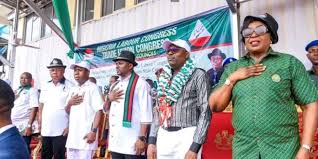
Rivers State Governor, Sir Siminalayi Fubara, has assured workers of implementing the salary increase recently approved by the Federal Government for workers in the State as soon as the parameters are made available.
Governor Fubara gave the assurance at the Yakubu Gowon Stadium, Port Harcourt, where activities to commemorate the 2024 International Workers Day, with the theme: ‘People First’, took place on Wednesday.
The Governor stated how concerned his Administration is about the poor state of the nation’s economy, with the attendant rising inflation, which has impacted adversely on the purchasing power and well-being of the average workers and their families.
Governor Fubara, therefore, said: “Let me assure you that we are going to work with the Federal Government to implement necessary measures, including the continuation of the free bus services and the provision of necessary palliatives to ameliorate the current hardship faced by ordinary citizens.
“We are also committed to implementing the increase in workers’ salaries recently approved by the Federal Government as soon as the parameters are made available.
“We are a listening Government, and we have heard the common concerns and demands of labour on the urgency of stimulating economic growth and improving the living conditions of our people.”
Governor Fubara acknowledged workers as critical human resource that have continued to contribute immensely to the sustained long-term economic growth of the State.
The Governor noted that workers are indispensable, from the production lines of small and big factories to Government offices and institutions.
They also play critical roles, he said, in the vast oil and gas fields, to the movement of goods and services, where they ensure service delivery, wealth creation, and the advancement of human civilization.
Governor Fubara, categorically said: “Rivers State is what it is, economically strong, resilient, and vibrant because of our workers. Our local governments and communities are what they are because workers are doing their jobs.
“Our nation is the largest economy in sub-Saharan Africa only because of the commitment, efforts, and achievements of our workers.
“What this means is that there can be no nation-building or progress in society without the input, effort, and sacrifice of the workforce.”
The Governor gave the assurance that: “As a Government, we recognize the roles, importance, and relevance of our workers to the implementation of our policy agenda for economic growth, provision of infrastructure, social progress and advancing the welfare and well-being of citizens.
“This is the reason we are here, not only to celebrate with you, but also to reiterate, reinforce, and reassure us of the inseparable bonds we have with organised labour as partners in progress.
“We may have reasonable causes to disagree, which is normal in every social relationship. But we cannot afford to be at each other’s throats and neglect our common responsibilities to advance the peace, security, and progress of our State.
“Less we forget that the social contract binds not only the Government; it applies to the workers as much as patriots.”
Governor Fubara recalled his promise made in his inaugural speech, where he proudly reiterated the fact that labour that is his primary constituency will remain so despite the fact that he has become a Governor.
“I stand by this statement even now and for as long as I remain in office as the Governor of Rivers State. I will not disappoint you. I will continue to govern with the fear of God and carry everyone, including labour, along.
“We promised not to neglect the interest and well-being of our workers within the limits of available resources, and we have not faltered on this promise.
“On the 1st of June, 2023, barely three days after the assumption of office, I visited the State Secretariat Complex to see its dilapidated state and take immediate measures to improve the poor working environment of our workers.
“Since then, we have reactivated and restored some facilities and services in the Secretariat Complex, including the water system, elevators, leaking roofs, and improved electricity supply.
“In addition, we have also commissioned a reputable international company to scope the entire complex and advise on the cost of a comprehensive rehabilitation of the Secretariat Complex, which we intend to carry out in phases as available finances will allow.”
Governor Fubara said he implemented promotion of staff stagnated over a decade with financial benefits, and approved the recruitment of 1,000 doctors and other medical personnel to strengthen the State’s healthcare delivery system.
Also, he said, the State’s Contributory Healthcare Insurance Scheme has commenced, urging all workers to take advantage of the benefits of the scheme, adding that the Government was clearing the backlog of gratuities to retired civil servants while ensuring the prompt enrolment and payment of pensions.
“I can assure you that the days of delayed payments of retirement benefits to civil servants are over under our watch.
“We appointed 16 Permanent Secretaries based on merit and equitable spread to local government areas that were hitherto not represented at that level to strengthen the civil service for effective implementation of government policies and optimal delivery of services to our people.
“Few weeks ago, we directed and ensured the implementation of the minimum wage and promotion of our workers in the local government service.
“We have approved and released a grant of N250million only for the completion of the secretariat building of the Nigerian Union of Teachers,” he added.
He assured the workers thst no smount of intimidation, harassment and sabotage will make his Government to change focus, adding that his policy thrusts will continue to be driven by the interest and needs of the people.
The Governor also announced the donation of N100million to assuage the sacrifices of the workers who turned up at the stadium for the celebration of the 2024 May Day.
In his address, the Rivers State Chairman of the Nigerian Labour Congress (NLC), Comrade Alex Agwanwor, said the theme of 2024 International Labour Day, ‘People First’, reflects the leadership direction of Governor Fubara, who has continued to prioritise the welfare of workers in the State.
Comrade Agwanwor stated that the Governor implemented promotion for state and local government workers with consequential financial benefits.
Also implemented, he said, were payment of N30,000.00 minimum wage to LG workers, N100,000.00 Christmas bonus across board to all workers, constitution of governing councils, boards and commissions of government agencies, institutions for effective service delivery, restored functionality of basic utilities at the State Secretariat, and reopened Rivers State Transport Company (RTC).
All of these, he noted, have further motivated workers, and emboldened them to remain unfettered in their support to the success of the Governor Fubara-led Administration while increasing their productivity.
“For us as Rivers State workers, we make bold to state without fear, or favour that, the present Administration of Your Excellency, Sir Siminalayi Fubara, is aptly a reflection of the year 2024 theme of Workers Day celebration.
“We acknowledge consistently, the demonstration of Your Excellency’s confession of purpose and value driven leadership and administration in thoughts, deeds, and actions, and as critical stakeholders in Rivers State project and beneficiaries of Your Excellency’s humane disposition, we offer to journey with you on the quest to positively impact on the lives of Rivers people.”
He commended the Governor for making efforts to revamp the abandoned Songhai Integrated Farms at Bunu Tai, and listed other agricultural initiatives such as Agricultural Development Programme (ADP) and C-4 programmes, Delta Rubber Company, among others, as areas the Government must focus on to enhance food sufficiency and security, while taming hunger and raising job creation opportunities in the State.
Also speaking, the Rivers State Chairman of Trade Union Congress (TUC), Comrade Okechukwu Onyefuru, expressed delight over recent feat of Governor Fubara by increasing the Internally Generated Revenue (IGR) from N11billion to N27billion.
Comrade Onyefuru advised that with items like railways and building of refineries moved to the Concurrent List, the State Government should take advantage of this new legal framework, to further grow the State’s IGR and create more jobs for the youths.
The TUC chairman also appealed to Governor Fubara to use his good offices to compel International Oil Companies (OICs) not to move their headquarters out of the State, while also thanking him for mediating in the industrial dispute in Indorama Petrochemical and Fertiliser Company Limited at Eleme.
Comrade Onyefuru said Nigerian workers condemned and rejected the recent increase of electricity tariffs, describing it as draconian and anti-people.
The TUC chairman also requested that the salary of primary healthcare workers be moved to the Primary Healthcare Management Board, where he said, they feel better protected.
At the event, the State Civil Service offered the Governor gift of a Bible and portrait while the organised labour honoured him with the Labour Champion of Rivers State award for being the most labour-friendly Governor.



Nigeria’s crude oil production has surged to an 11-month high in May, 2026, with the country exceeding its Organisation of the Petroleum Exporting Countries (OPEC) production quota.
The average crude oil production recorded during the month of May represents 102 per cent of Nigeria’s 1.5mbpd of production quota allocated by the OPEC.
The production report released by the Nigerian Upstream Petroleum Regulatory Commission (NUPRC), yesterday, disclosed that Nigeria’s oil production averages 1,530,354 barrels of crude oil and 170,446 barrels of condensates per day (bpd).
According to the report, this brings the total combined production to 1, 700, 800 barrels per day and consolidating Nigeria’s position as Africa’s largest oil producer.
The report said the production performance during the review period remained robust, with combined crude oil and condensate output ranging between a low of 1.51 million bpd and a peak of 1.86 million bpd.
It said the May 2026 production figures represented the highest recorded by Nigeria since July 2025, when output surged to 1,712,282.
“In strict crude oil terms (excluding condensates), the 1.53 million barrels recorded in May 2026 represents the highest Nigeria has witnessed since January 2025 when crude oil production hit 1.538mbpd.
“The latest crude oil production statistics thus represents a 15-month high on a month on month basis, production rose by 2.77 per cent in May 2026 as against 1.48mbpd in April,” it said.
The report said the broader production trend over the last five months had also remained positive.
It said combined crude oil and condensate output increased from 1.48 million bpd in February to 1.54 million bpd in March, 1.66 million bpd in April, and then 1.7 million bpd in May, underscoring sustained growth in Nigeria’s hydrocarbon production levels.
According to the report, among production streams, Bonny Terminal led the pack with a total blend of 293,870 bpd, closely followed by Forcados Terminal at 289,900 bpd, Qua Iboe ranked third with 173,360 bpd, while Escravos Oil Terminal contributed 135,470 bpd.
It said the Odudu (Amenam Blend) completed the top five production streams, accounting for 63,250 bpd during the month under review.
The NUPRC attributes the rise in production to a sustained positive momentum as operations remained stable throughout the reporting period with no significant pipeline or facility outages recorded.
Additionally, all previously scheduled turnaround maintenance activities had been successfully completed, contributing to improved operational reliability and production efficiency.
The House of Representatives, yesterday passed a landmark constitutional amendment bill to establish state police nationwide, marking a significant milestone in Nigeria’s decades-long debate over decentralising policing and strengthening internal security.
The bill, titled “A Bill for an Act to Alter the Constitution of the Federal Republic of Nigeria, 1999 to Provide for the Establishment of State Police and for Related Matters (Sixth Alteration) Bill, 2026,” was approved during consideration at the Committee of the Whole, presided over by Speaker of the House, Rt. Hon. Tajudeen Abbas.
Voting commenced after the Deputy Speaker and Chairman of the House Committee on Constitution Review, Hon. Benjamin Kalu, presented the report on the proposal and canvassed support from lawmakers, stressing the need for a more decentralised policing framework to effectively address the country’s growing security challenges.
The exercise was conducted manually, with members raising their hands to indicate their positions. At the end of the voting, 289 lawmakers voted in support of the bill, one member abstained, while none voted against it, reflecting overwhelming bipartisan backing for the far-reaching reform.
The proposed amendment seeks to fundamentally restructure Nigeria’s policing architecture by creating both Federal and State Police formations.
One of the bill’s key provisions amends Section 214 of the 1999 Constitution to formally establish the Federal Police and the State Police. Under the proposal, the National Assembly would be empowered to prescribe the structure, organisation, administration and powers of the Federal Police, while also providing the legal framework and minimum standards for the establishment and operation of state police services.
The bill stipulates that no state police formation shall commence operations unless it is established by a law enacted by the relevant State House of Assembly and certified as complying with national minimum standards prescribed by an Act of the National Assembly.
It further provides that until a state police force becomes operational, the Federal Police shall continue to exercise policing powers and responsibilities within such states.
In a bid to preserve the autonomy of state police formations and prevent undue federal interference, the bill limits federal intervention in states’ internal security affairs. Under the proposal, the Federal Police may intervene only where there is a complete breakdown of law and order, upon the request of a governor or where a state police force becomes unable to function due to administrative, financial or other operational challenges.
The amendment also proposes significant changes to the police’s appointment and command structure.
Under the amended Section 215 of the Constitution, the Inspector-General of Police would be appointed by the President on the advice of the Nigeria Police Council from among serving members of the Federal Police, subject to confirmation by the National Assembly.
Similarly, a State Commissioner of Police would be appointed by a governor on the advice of the Nigeria Police Council from among serving officers of the State Police, subject to confirmation by the respective State House of Assembly.
The bill empowers governors to issue lawful directives to State Commissioners of Police on matters relating to public safety and the maintenance of law and order. However, where a commissioner considers such directives unlawful or inconsistent with accepted policing standards, the matter may be referred to the Nigeria Police Council, whose decision shall be final.
The proposal also amends Section 84 of the Constitution by replacing references to the “National Police Council and the Federal Police Service Commission” with the “Nigeria Police Council and the Police Service Commission.”
The passage of the bill by the House represents one of the most far-reaching security reforms contemplated since the return to democratic rule in 1999 and is expected to rekindle nationwide debate on issues relating to funding, accountability, operational control and safeguards against abuse.
With the House’s approval, the constitutional amendment bill will now proceed to the Senate for concurrence. Thereafter, it must secure the endorsement of at least two-thirds of the State Houses of Assembly and receive presidential assent before becoming part of the Constitution of the Federal Republic of Nigeria.
If eventually enacted, the legislation would usher in a new era of multi-layered policing in Nigeria and could redefine the country’s approach to tackling banditry, terrorism, kidnapping and other forms of violent crimes through a more localised security architecture.

The Federal Government has declared today, public holiday to commemorate Nigeria’s 27 years of unbroken democratic rule.
This is contained in a statement in Abuja, by the Permanent Secretary, Ministry of Interior, Magdalene Ajani.
Ajani said that the Minister of Interior, Dr Olubunmi Tunji-Ojo, made the declaration on behalf of the federal government.
Tunji-Ojo reaffirmed the federal government’s commitment to the preservation of democratic ideals, rule of law, transparency, accountability and inclusive governance.
He assured that the ministry in collaboration with relevant security agencies woulsd continue to take appropriate measures in maintaining and strengthening Nigeria’s internal security.
The minister noted that a secured and stable environment was essential to democracy and national development.
He urged Nigerians to see the holiday as an opportunity for civic reflection.
“As we mark this historic day, every Nigerian is encouraged to remain law-abiding, uphold the institutions that sustain our democracy, and remember that the strength of any democracy lies ultimately in the character of its citizens,” he said.
He also said that June 12 every year remained a significant day in Nigeria’s history in honour of the courage, resilience and sacrifices of Nigerians whose efforts made democratic governance possible.
“Their legacies continue to inform the values and responsibilities of the Nigerian state,”Tunji-Ojo added.
-
Nation5 days ago
Asarama Kingdom Condemns Gruesome Murder of A Commercial Vehicle Driver
-
Rivers5 days ago
Monarch Raises Alarm Over Defamatory Politics … Urges For Unity In Ogoni
-
News5 days ago
Nigeria, Ethiopia Seal Agreement To Transfer 100 Nigerian Prisoners
-
News5 days ago
Nigeria No Longer Safe For Drug Cartels – Marwa
-
News5 days ago
Xenophobia: 268 Nigerian Returnees Arrive In Lagos From S’Africa
-

 News5 days ago
FG Declares Today Public Holiday To Mark Democracy Day
-
Women5 days ago
Nigerian Women And Dividends Of Democracy
-
Business5 days ago
FG Approves $1 Bn AFCFTA Credit Facility For Nigerian Exporters