
Opinion
Soludo’s Mandate, Austerity Or Prudence?

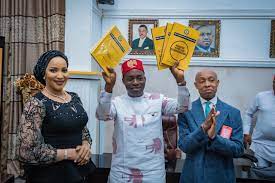
The Governor of Anambra State, Prof. Chukwuma Soludo, recently celebrated the anniversary of his two years in office. Prof. Soludo won the Anambra State 2021 guber elections with a remarkable landslide, in one of Nigeria’s most popular and freest elections. A professor of economics and former governor of the Central Bank of Nigeria, who spearheaded banking sector reforms and reconsolidation that became points of reference, Prof Soludo was heralded as the Messiah of Anambra State, especially as he promised to make the State the “Dubai and Japan of Africa.”
But mid-way into his administration, the euphoria about the Soludo magic has long dissipated. The disappointed well-wishers who gathered at the venue of his anniversary at Awka, may have come to get first-hand account of the happenings, and to reassess their stand. Usually such events are opportunities for office holders to recount their accomplishments. Governor Soludo, while narrating a litany of achievements said he runs an austere government in the State to the point of claiming not taking any salaries since assumption of office, and that even the first lady does not have any car allocation from the State.
What stands out however, is that the governor said he had insisted not to borrow, even though records show that the governor has sought and got approval from the State assembly to borrow N100 billion. So far, Soludo’s decision not to draw the loan is commendable, because records show that as at January 2023, the State’s debt deductions stood at N872,425,828.86 per month, which was 27.8 per cent of net statutory allocation, and 12.4 per cent of total allocation. Today, that burden is more than double due to naira devaluation.
Additional kudos goes to Soludo from Anambra’s 2024 budget summary documents, which show that the approved 2023 budget estimate of N260,394,690,434 yielded a revenue of only N155,647,114,526.22, of which the State spent only N76,905,169,399.35 to realise a whopping surplus of N78,741,945,126.87.
However, how austere is Soludo’s administration? And is austerity a measure of development? As sympathetic as the first family’s acclaimed self-denial may sound, the office of the first lady is not a constitutional creation, and therefore has no entitlements. The governor’s basic salary is N185,306.75, while his hardship and constituency allowances are N92,654.37 and N370,617.50, respectively, all of which sum to N648,578.62, a negligible amount compared to the governor’s monthly security vote of N850 million, amounting to over N10 billion per year, plus other perks of office.
Former Governor Obiano is currently facing charges of diverting N4 billion from security votes. Soludo should have told the public if he has cut down such humongous allowances.
Anambra State’s approved 2024 budget of N410,132,225,272.11 also shows that the governor’s office receives N11,199,200,089.19 comprising personnel bills of N4,668,243,574.08 and capital expenditure sum of N6,530,956,515.11, for the State’s Boundary Commission, Anambra State Public Procurement Agency, Anambra State Investment Promotion & Protection Agency, Anambra State Action Commission on AIDS (ANSACA), Christian Pilgrims Board, Muslim Pilgrims Board, Anambra State Small Business Agency (ASBA), Greater Onitsha Development Agency and the Greater Nnewi Development Agency, whereas these agencies should belong to requisite ministries, while the office of the governor is saddled with developmental concerns.
On the social sector, Soludo’s administration allocates a paltry annual purse of N175,000 for the upkeep of each secondary school in the state, which translates to less than N60,000 per term, and may be the reason some principals got tempted to request fees from students.
The plight of 656 health centre in the state are more pitiable as most receive N140,000 per year, which is about N11,667 per month, may be to fuel generators and other expenditures. The Orumba General Hospital is allocated N105,000.
The Anambra State should be more realistic in funds allocation to ensure that meager funds do not stifle essential institutions.
Anambra’s 21 local councils that draw a total monthly federal allocation of over N8 billion, continue to be ruled by illegal Transition Committee Chairmen appointed by the governor, thus denying the State of political tutelage at the council levels that groom vibrant politicians to the national level, while Anambra State Independent Electoral Commisson lies idle with allocation of N197,301,110.40.
As for roads construction, the governor may have done well, with the Ekwulobia on-going project standing most prominent, but what is on ground across the State lags far behind expectations. It took him two years to deliver his flagship campaign promise at Okpoko in Onitsha, combined with a re-election fever, to deliver the Okpunoeze road at Nnewi, probably out of wariness of the Senator Ifeanyi Ubah factor. Governor Soludo almost turned the road commissioning at Nnewi into a campaign ground.
In a country where politicians envision themselves as construction project management officers, road works, however inappropriate, have become the be-all-of- the-average. But for a professor of economics, who had sat at the vintage position of a Central Bank governor, where the impacts of policies and big industries are clearly understood, there are far bigger development expectations for which Soludo’s coming sounded messianic.
While his tax administration reforms are commendable, the brigandage of the Ocha Brigade and ANJET, who enforce tax drives, are eliciting sorrowful tales from the masses, especially road transport drivers. Insecurity remains a terror in the State. Meanwhile, in less than nine months, Alex Otti of Abia State has initiated rapid ‘positive disruptions’ as Soludo likes to coin it, and capped it with Geometric Power’s 24-hour of electricity in Aba, a project worth $800 million. In Imo State, Seplat Energy and Nigeria Gas Infrastructure Company (NGIC) are rounding-up a $700 million ANOH Gas Processing Plant, while Shell/NNPC is completing a $3.5 billion Obiafu-Obrikom-Oben OB3 gas pipeline network, despite insecurity, to link the Escravos-Lagos pipeline system. The revenue that would accrue to Imo State when it comes onstream far outweighs what Anambra gets harassing struggling transporters. Moreso, Shell has just empowered youths from the host communities of Assa, Ochia, Awarra, Obile, Avu, Obissima, Obuomadike, Ununwaku, Ohoba, Obitti and Umuapu, who graduated from its one-year training. Road construction and contracts in Imo would be usual community development accompaniments.
While the rat-race for revenue drives continues in Anambra, the State sits on 50 billion barrels of crude oil reserve, and 10 trillion cubic feet of gas awaiting development, out of its seven gas acreages, only two are being minimally tapped. Vested interests bind State-owned Orient Petroleum Plc with inept partners, First Modular Gas Systems Ltd, in ways that may have repelled big Oil and Gas players like Seplat Energy whose major shareholder, Dr. ABC Orjiako, is from Anambra State, and Mr. Emeka Offor’s Chrome Group, whose Interstate Electric Company Ltd are stakeholders in Enugu Electricity Distribution Company (EEDC) and the Alaoji Power Plant. It is obvious, the State has the human resources to develop its potentials, but needs prudent leadership.
Anambra, home to the Innoson Car Assembly plant, industries and businesses that are suffocating under poor electricity, needs visionary managers that draw down greater benefits, even if they do not forego salaries.
By: Joseph Nwankwo


-

 Featured1 day ago
WASSCE: RSG Distributes Science Materials To Secondary Schools
-
News2 days ago
Xenophobic Attacks: Nigerian Lives More Important Than Foreign Investment – Oshiomhole
-
Rivers2 days ago
MBA Forex Trial Adjourn To June 3, Amid Bereavement … As Court Declines Cost Application
-
News2 days ago
ActionAid Demands Probe Of Govs Using Public Funds For Campaign
-
Aviation2 days ago
Passengers Stranded As Delta Airline From Atlanta Route Back Eight Hours After
-
Business2 days ago
Customs Impound N2.35bn Cocaine, 15 Trailers of Rice
-
Politics2 days ago
2027: Bayelsa Senator Gets Critical Endorsement For Second Term
-
 Politics2 days ago
INEC Sets Rivers South-East Senatorial By-Election For June 20