
News
VCDF Promotes Innovation Among Students For Sustainable Future

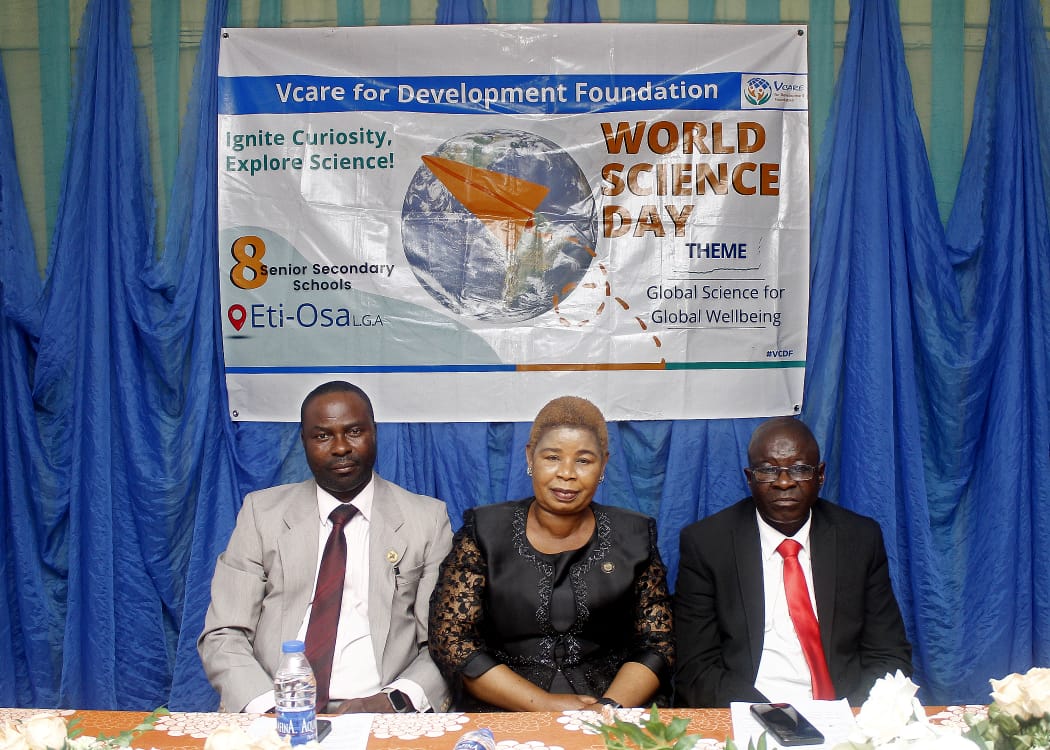
In an ever-evolving world, it is important to use science to protect our future. Many problems like environmental damage, healthcare gaps, and tech issues happen because people do not know enough about the usage of science in daily life. Getting young people interested in science is key to making the world a better place. Science helps solve problems, understand our world, create new things, and make smart choices based on facts.
To commemorate World Science Day on November 27, 2023, Vcare for Development Foundation (VCDF), a not-for-profit organisation based in Lagos, partnered with Lagos State Ministry of Education, to organise a science exhibition themed ‘Global Science for Global Wellbeing’ at Government Senior College, Ikoyi, Eti-Osa LGA, Lagos. This exhibition aimed to engage young minds in scientific activities, with the main objective of promoting innovation among students for a sustainable future, making science usual, not rare.
To bridge the gap between classroom learning and real-world applications, VCDF with the help of selected schools initiated the idea of organising the event. Following an orientation programme by VCDF and a rigorous screening process by the designated schools, thirteen projects from eight schools were selected to present their projects at the finale.
During the process, VCDF reached out to 762 students and 22 teachers in Lagos Island. The students developed scientific models, with themes centred around the following Sustainable Development Goals: Affordable and Clean Energy, and Climate Action. Winners were declared based on the projects’ feasibility, creativity, and potential impact on sustainability and were facilitated with scientific models and tools. Brilliant science projects showcased during the exhibition not only enlightened the students but also captivated the dignitaries and guests attending the event.
Dignitaries in attendance included Dr. (Mrs.) Olufunke Oyetola – Tutor General/Permanent Secretary (TGPS), Lagos State Ministry of Education, District III, Mr. Pot Sessi-Balogun – Head, Public-Private Partnership, Lagos State Ministry of Education, and Mr. Hassan Ogunfuyi – Representative of Director, Science & Technology, Lagos State Ministry oEducation.
During the event, Dr. (Mrs.) Olufunke Oyetola, TGPS, Dist.III said, ‘This endeavour is not merely about showcasing scientific experiments; it’s about nurturing their skill sets to excel in life. Science plays a pivotal role in enhancing the quality of life, and such initiatives provide the future generation with the much-needed direction to turn their ideas into reality.’
The primary focus of VCDF revolves around equipping the younger generation with mindful usage of resources and quality education. It is dedicated to offering support to underprivileged students, aiming to establish a secured future for everyone.
Mr. Pot Sessi-Balogun, said, ‘Scientific literacy is important for assisting the future generation with tools and knowledge to navigate the complexities of the changing world. Science teaches students to solve problems, which consequently gives them an edge over others to thrive.’
VCDF’s vision goes beyond this event to empowering young people with 21st-century skill sets. Thus far, VCDF has reached out to more than 5500 students and 260 teachers in Lagos with various educational enhancement interventions and teacher capacity-building workshops for the inclusive development of the young generation.



Operatives of the National Drug Law Enforcement Agency (NDLEA) have intercepted consignments of cocaine and various opioids concealed in walls of cartons used to package cloths and other items going to the United Kingdom and Australia.
Spokesman of the agency, Femi Babafemi, in a statement shared on X yesterday confirmed the interdiction.
According to him, “The two seizures were recorded at a courier company in Lagos on Friday 15th May 2026 during examination of shipments going to the UK and Australia.
“A total of 170grams of cocaine sealed in cellophane parcels and buried in the walls of a carton of cloths heading to Australia were recovered.
“A wide range of opioids including: 200 ampoules of pentazocine injection; 1,100 capsules of tramadol and 100 ampoules of promethazine injection were recovered from another carton which has United Kingdom as its final destination”.
“In FCT Abuja, NDLEA operatives on Monday 11th May arrested a 29-year-old businessman Ogadi Peter who specializes in producing drug laced cakes and cookies for parties and social gatherings in the capital city.
“Following credible intelligence, he was traced to his home in Life Camp area of the FCT where he was nabbed while 800grams of skunk and 2.70kg drug laced cookies recovered from him”.
“In Delta state, NDLEA operatives on Sunday 10th May, raided Ejeonu village in Ukwuani local government area where they destroyed 27,500 kilograms of skunk on 11 hectares of farmland and recovered 22.9kg of same substance while a 52-year-old suspect Ifeanyichukwu Peter was arrested in a follow up operation at Obiaruku.
“A similar raid in Orogun village, Ughelli North LGA on Tuesday 12th May led to the destruction of 37,500 kilograms and recovery of 55.4kg of same psychoactive substance on 15 hectares of farm as well as the arrest of 30-year-old Godwin Vincent Osadera.
“This brings the total weight of skunk destroyed by NDLEA operatives supported by soldiers in the two operations to 65,000 kilograms”.
“In Kaduna State, 361kg of skunk was recovered during a raid operation at Dan Magaji area of Zaria town on Wednesday 13th May. and a suspect Husaini Suleiman, 42 ,was arrested.
“A large cache of military-grade ammunition was intercepted by NDLEA officers on patrol along Abuja-Kaduna highway, Kaduna on Tuesday 12th May.
“A suspect, 35-year-old Abdullahi Hassan was caught conveying the 1, 989 rounds of RLA 7.62mm concealed in fresh white cassava granules locally known as garri.
“Both the suspect and exhibit have since been transferred to another security agency for further investigation’.
Also, a total of 181kg skunk was recovered from a suspect Aliyu Sani when NDLEA operatives raided the Ogere area of Ogun state on Wednesday 13th May, while another suspect Sufiyanu Mohammed Misa, 27, was arrested with 105,850 pills of opioids including tramadol, diazepam and exol-5 along Zaki- Biam road Wukari LGA, Taraba state on Thursday 14th May.
In Oyo State, two suspects: Adeleke Olamide Aliyah, 20, and Aloba Abdulazeez, 25, were arrested on Thursday, 14th May at Challenge II, Saki town, in connection with the seizure of 99 litres of skuchies.
NDLEA also said a total of 1,388.4175 kilograms of skunk were destroyed on two farms on Friday, 15th May when NDLEA officers raided Ago forest, Orhionmwon LGA, Edo state.
A 25-litre jerry can of palm oil used to conceal 1.2kg pills of tramaking 225mg was recovered from Kofar Ruwa motor park in Kano on Monday, 11th May following credible intelligence while a suspect Aminu Isa, 35, was arrested at Sabuwar Sharada area of the state same day with 30.5kg skunk.
The War Against Drug Abuse (WADA) social advocacy activities by NDLEA Commands equally continued across the country in the past week including: WADA sensitization lecture delivered to students and staff of The Apostolic Church Model College, Ijokodo, Ibadan Oyo State; School of Health Technology, Lambata, Niger state; Yewa Junior High School, Agege, Lagos; Government Secondary School, Yardaje, Katsina; Igogo Commercial High School, Igogo Ekiti and Government Girls Secondary School, Magwan, Kano state; among others.
While commending the officers and men of DOGI, Delta, Kaduna, Oyo, Taraba, Kano, FCT and Edo Commands of the Agency for the arrests and seizures of the past week, Chairman/Chief Executive Officer of NDLEA, Brig. Gen. Mohamed Buba Marwa (Rtd) also praised their counterparts in all the commands across the country for pursuing a fair balance between their drug supply reduction and drug demand reduction efforts.

No fewer than five persons have been confirmed dead after a three-storey building under construction collapsed in the Durumi 3 area near Gudu Market in the Abuja Municipal Area Council of the Federal Capital Territory on Saturday morning.
Ten other persons were rescued alive from the rubble, according to the media aide to the Minister of the Federal Capital Territory, Lere Olayinka, who provided an update on the incident via his X handle on Saturday.
Olayinka further stated that the Mandate Secretary of the Health Services and Environment Secretariat of the Federal Capital Territory Administration, Dr Adedolapo Fasawe, who visited the site, disclosed that the Minister of the Federal Capital Territory, Nyesom Wike, had directed that “all casualties be given free medical treatment.”
According to him, emergency responders continued efforts to evacuate more victims believed to be trapped beneath the rubble.
Officials of the Federal Fire Service, health workers, security agencies and local volunteers were at the scene working to rescue victims.
Recall that in April, six persons were injured following a similar collapse of a two-storey building under construction in Jikwoyi within the AMAC area.

Rivers State Deputy Governor, Prof. Ngozi Odu, has charged newlywed couples to build their marriages on the virtues of love as taught in the Word of God.
Prof. Odu gave the charge at the wedding ceremony of Amblessed Favour Sunny-Cookey and Samson Jesuganji at Lifegate Power Ministries, Dominion Cathedral, in Port Harcourt at the weekend.
This was contained in a statement by the Head of Press, Deputy Governor’s Office, Owupele Benebo last Saturday.
The statement identified the bride as the daughter of Pastor Sunny Cookey, the Founder and Presiding Pastor of Lifegate Ministries.
The deputy governor congratulated the couple on a new phase of life, and prayed for God’s blessings upon their union, noting that the couple were raised by godly parents and encouraging them to uphold the Christian values instilled in them.
Referring to the sermon delivered during the ceremony, Odu emphasized that the principles of love and submission remain fundamental to a successful marriage.
According to her, genuine love reflects the nature of God, stressing that love should remain the foundation of the couple’s relationship as they journey through life together.
She prayed for enduring peace, happiness, and progress in their home, expressing confidence that the marriage would continue to flourish under God’s guidance.
The deputy governor commended the families of the couple for their support and upbringing, while urging the newlyweds to always remember the significance of the day and the commitment they had made before God and witnesses.
In his sermon at the wedding, the Founder and Presiding Pastor of Salvation Ministries, Pastor David Ibiyeomie, stated that marriage did not originate from Western culture, traditions, or human ideas, but from God, whom he described as the “manufacturer” of marriage.
According to the cleric, couples seeking lasting and peaceful homes must rely on biblical principles rather than societal trends or assumptions.
He explained that many marital crises and rising divorce rates stem from ignorance and failure to apply scriptural teachings in family life.
Drawing from the biblical parable of building a house on a rock, Ibiyeomie said the Word of God remains the only solid foundation capable of sustaining marriages through challenges and difficult times.
He noted that marriage naturally comes with unexpected realities and pressures, stressing that religious ceremonies or cultural practices alone are not enough to sustain a home without proper understanding of God’s instructions.
The pastor further warned that ignorance of scripture remains one of the greatest weapons against believers, urging Christians to study and practice the Word of God rather than merely attending church services.
The ceremony had many ministers in attendance including Apostle Zilly Aggrey, Pastor George Izunwa, and Bishop Winston Iwo.
-

 Featured5 days ago
WASSCE: RSG Distributes Science Materials To Secondary Schools
-

 Politics5 days ago
INEC Sets Rivers South-East Senatorial By-Election For June 20
-
Sports5 days ago
Football Pundit Lauds Chelle’s Effort In Monitoring Nigeria League Players
-
 Editorial5 days ago
NCC, Save Nigerians From Exploitation
-
News5 days ago
RSG Reaffirms Commitment To Quality Education
-

 Niger Delta5 days ago
Fubara Charges Graduands On Discipline, Professionalism … As IAUE Holds 44th Convoc
-
 News5 days ago
INEC To Deploy 1.4m Corps Members For 2027 Elections
-
News5 days ago
RSUBE Holds Training For 1,000 New Teachers