
Politics
Delta PDP Protesters Storm Party Headquarters, Demand Ayu’s Resignation

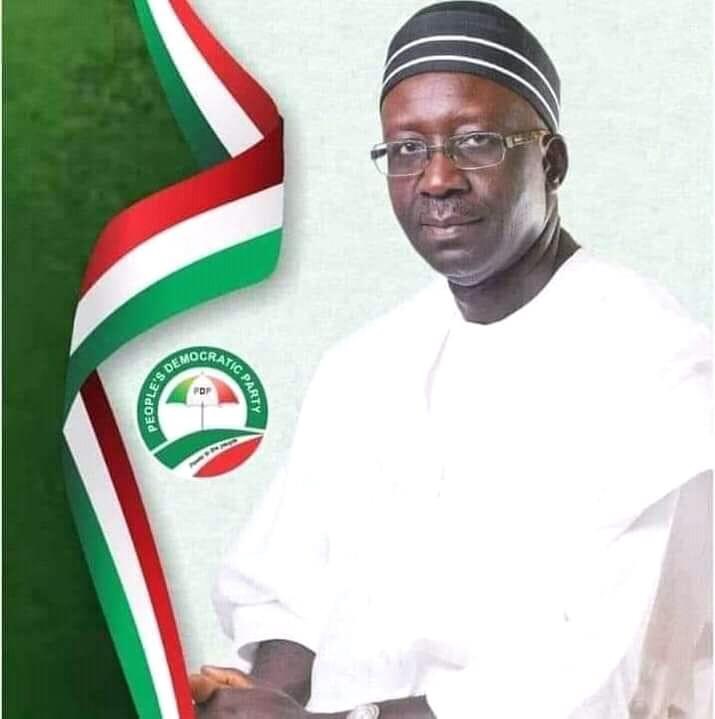
Some members of the Peoples Democratic Party (PDP), on Wednesday, protested at the party’s headquarters, demanding the resignation of Iyorchia Ayu.
The demonstrators, under the platform of Concerned Deltans for Good Governance, besieged the PDP national secretariat, saying Ayu, national chairman of the party, has “deliberately” refused to obey a court order disqualifying Sheriff Oborevwori as PDP governorship candidate in Delta.
It had been reported that Oborevwori was disqualified by a federal high court in Abuja over alleged certificate forgery. In May, Oborevwori, Speaker of the Delta State House of Assembly, polled 590 votes to beat his closest rival, David Edevbie, Commissioner for Finance during the James Ibori administration, who polled 113 votes.
While Oborevwori is the preferred candidate of the Delta State Governor, Ifeanyi Okowa, Ibori, the former governor of the state, is said to be backing Edevbie. Aggrieved by the outcome of the primary, Edevbie filed a law suit against Oborevwori and the party, citing discrepancies in Oborevwori’s certificates.
In July, Taiwo Taiwo, judge of a federal high court in Abuja, disqualified Oborevwori for submitting false information to the Independent National Electoral Commission (INEC) to back his nomination as PDP’s governorship candidate.
Not satisfied with the verdict, Oborevwori filed an appeal through his lawyer, Joe Agi. The PDP candidate had also filed an application in a high court, praying for a stay in the execution of the judgment pending the determination of the appeal.
Addressing journalists in front of the PDP secretariat on Wednesday, Chris Anthony, who spoke on behalf of the protesters, said the national leadership of the PDP led by Ayu had shown “incompetence” by not complying with the court order.
“The implication of the PDP action on the Delta issue is that they are trying to throw up the fortunes of the PDP in Delta,” he said.
“Everybody knows that the PDP in Delta state is the majority party and there is no other political party in Delta state apart from the PDP.
“But with the action of the national chairman of the party, we are beginning to be convinced of what people have been saying that Ayu is a mole in the PDP to throw up Delta state PDP to the opposition.
“We see Ayu as a mole in the PDP. He is playing the script of the APC just to actualise the emergence of an APC governor in Delta.
“He lacks the capacity to lead the PDP and so he should honourably resign. He has demonstrated gross incompetence in handling the affairs of the party. He should resign. Ayu should resign. He does not have the capacity to manage the affairs of the PDP.”



Minister of Works, Senator David Umahi, has directed his legal team to resume all court proceedings against Mrs. Tracy Ohiri over her repeated allegations of indebtedness and other claims against him.
Mrs Ohiri had publicly accused Senator Umahi of owing her N280 million for campaign materials from his tenure as party chairman in Ebonyi State.
The allegations went viral on social media, where she also accused the Minister of sexual harassment.
Security agencies arrested Mrs Ohiri, and she was subsequently prosecuted. Her lawyer, Barrister Marshall Abubakar, intervened, leading to the deletion of all posts and a public apology, which also gained widespread attention online.
However, days after the apology, Mrs Ohiri resumed her claims against Senator Umahi.
In a statement issued on Saturday by his Senior Special Assistant on Media, Francis Nwaze, Senator Umahi said he had informed Barrister Abubakar during the intervention that if Mrs Ohiri could provide verifiable evidence, logs, and communications from the period in question, some of his associates were willing to contribute a sum of One Billion Naira (N1billion) to her, evidence which, he said, she had yet to provide.
“The Honourable Minister of Works, Senator Engr. David Umahi, has been monitoring the ongoing public discourse surrounding the claims and counterclaims by Mrs. Tracy Ohiri.
“Ordinarily, this would have been ignored, but in the interest of truth and public clarity, it is necessary to address the issues directly”, the statement read.
The statement clarified that Barrister Abubakar acted in good faith and without any financial interest, motivated solely by a desire to assist Mrs Ohiri.
At no point did the lawyer discuss or negotiate any payment with the minister, although some well-meaning associates independently offered support”, the statement added.
Senator Umahi reiterated the conditions for resolving the matter: either the claims must be tested in court, or Mrs Ohiri must provide credible evidence, including all relevant communications, to substantiate her allegations.
The minister emphasised that Barr Abubakar conducted himself with integrity throughout the process.
“Following the failure to meet these conditions, particularly the inability to provide verifiable evidence, the Minister has directed his legal team to proceed with all court processes to ensure the truth is fully established,” the statement said.
Senator Umahi said despite years of public provocations and attacks, he chose to remain silent, focusing on national and state services.
He thanked Nigerians who had taken time to assess the facts and noted that “not everyone who presents themselves as a victim truly is one, and in some cases, narratives are deliberately inverted.”
The Minister affirmed that he will not be distracted by Mrs Ohiri’s allegations and remained committed to his mandate at the Ministry of Works.
“The focus remains on results, service, and ensuring that Nigerians continue to benefit from projects that improve connectivity, economic growth, and national development. This administration will continue to pursue its transformation agenda with dedication, transparency, and an unwavering sense of responsibility,” he concluded.

A Rivers State High Court sitting in Port Harcourt has adjourned proceedings in a suit filed by three aggrieved members of the Peoples Democratic Party (PDP) to April 14, 2026, for the hearing of all pending motions.
Justice Stephen Jumbo made the pronouncement during a recent sitting in Port Harcourt.
The suit, which borders on the legitimacy of the party’s leadership structure in the state, was instituted against the factional State Chairman of the PDP, Chief Aaron Chukwuemeka, alongside the Rivers State Independent Electoral Commission (RSIEC) and other respondents.
Also joined in the matter are the PDP as a corporate entity, the Rivers State Government, as well as Obio/Akpor, Port Harcourt City and Ogba/Egbema/Ndoni Local Government Areas, including their respective Vice Chairmen and Councillors.
The claimants, Enyi Uchechukwu, Wisdom Kalio and Uche Amadi, approached the court via an originating summons seeking judicial interpretation on the validity of actions taken by the Chief Chukwuemeka-led state executive committee of the party.
Central to the dispute is whether the said executive committee, whose emergence the claimants contend has been nullified by a subsisting court judgment, retains the legal authority to act on behalf of the party in critical electoral matters.
The plaintiffs specifically urged the court to determine whether the factional leadership could validly submit a list of candidates to RSIEC for the purpose of participating in local government elections.
They further questioned the legitimacy of the PDP’s participation in the August 30, 2025 local government elections, contending that any list purportedly submitted by the factional leadership was invalid and of no legal consequence.
In addition to the declaratory reliefs sought, the claimants also prayed the court to grant consequential orders addressing the outcome and conduct of the said elections across the affected local government areas.
At the resumed hearing, counsel representing the PDP and the affected local government councils informed the court that they had only recently been served with the originating processes and accompanying documents.
The defence team, comprising several Senior Advocates of Nigeria (SANs), disclosed that service of the court processes was effected on March 13, 2026, leaving them with limited time to adequately prepare their responses.
Consequently, the defence counsel applied for an adjournment to enable them study the processes and address the legal issues raised, particularly as they relate to jurisdictional questions and points of law.
Counsel to the claimants, Glory Chizim-Chinda, did not oppose the application, following which the presiding judge granted the request and adjourned the matter to April 14, 2026, for the hearing of all pending motions, with a possible ruling expected ahead of the substantive suit.
By: King Onunwor

A former state lawmaker in the old the Rivers State, Professor Alex Eseimokumo, has described Nigerian opposition political parties as mere preposition political parties.
He also advised the country’s electorate against selling their votes during next year’s general elections.
The former legislator, who is also the president of the Institute for Peace, Conflict Resolution and Entrepreneurial Research, said this in an exclusive interview with The Tide on the sidelines of an event organized by the institute in Port Harcourt.
He said opposition political parties in Nigeria have been reduced to preposition political parties as most of them are not only dinning with the government but advising government on what to do to win election.
“The problem in Nigeria is we are not practicing politics the way it is supposed to be.The opposition are more in preposition.
“You see, opposition is supposed to find out things that are wrong in government but in our present day politics, you see opposition even dinning with the other group. So, there is basically nothing like opposition in Nigeria “, he said.
He lamented a situation where some individuals within the opposition are allegedly working hard to prevent their parties from fielding presidential candidates in the forthcoming election, adding that such individuals were only there to protect their personal interest.
Prof. Eseimokumo said as a member of the All Progressives Congress (APC), he could not wish his party to fail in the election, even though nothing is impossible in Nigeria.
He noted that though the government in power has been trying it’s best, there was more to be done.
In his words, “I’m an APC member, so I don’t have the right to criticize my party but a word of advice: we still need to do more, more people oriented leadership where everybody will feel carried along.
“For now, I’m campaigning for APC to be re elected and if I stand here to say APC is not doing well, I’m not being fair to myself. But I think, with God all things are possible, there can be changes”.
On his assessment of the performances of governors of the Niger Delta states, Prof Eseimokumo said the governors were doing well within the limit of their resources.
” I don’t know what is given to them as allocation, but if what we are seeing in terms of window dressing is not window shopping, then they are doing well”, he said.
Meanwhile, Prof. Eseimokumo has advised Nigerian electorates against selling their votes during the forthcoming elections.
He said credible election could only be achieved when the electorates refuse financial inducement during the elections.
According to him, though Nigerian voters had been difficult to persuade, the time had come for them to stop selling their votes.
Prof. Eseimokumo said the forthcoming elections will serve as a litmus test for the Nigerian electorate to demonstrate their desire for changes in the country, stressing that free and fair elections will continue to be a mirage in the country until the was a change in the attitude of the electorate.
“If you want your vote to count, don’t take money from anybody; if you want your votes to count, don’t collect money for your vote. The moment you collect money for your vote, you have sold your conscience”, he warned.
He said his institute will continue to work for peace, not just in the Niger Delta region but across Nigeria.
By: John Bibor
-

 News7 hours ago
RSG Reiterates Commitment To Youth Dev
-

 Business4 hours ago
NSCDC Discloses Illegal Dump Site In Ikwerre Community
-

 Business4 hours ago
Yenagoa’s Radisson Hotel Ready December — NCDMB, Other
-

 Maritime4 hours ago
MWUN Raises Alarm Over Port Security Lapses In Lagos
-

 News7 hours ago
Kwankwaso Dumps NNPP, May Join ADC Today
-

 Maritime4 hours ago
Maritime Workers Demand Reinstatement Of Tally Clerks, Gangway Security Over Port Revenue Loss
-

 Maritime4 hours ago
NNS Hands Over Two Suspected Stowaways to Immigration Service
-

 Rivers4 hours ago
Education Commissioner Lauds STAN Executive, Appreciates Support