
Featured
Your PhD Is Empty, Wike Blasts Peterside …Says He Lacks Understanding Of How Economy, Budget Work …As Tambuwal Unveils 10km Odiokwu Internal Roads

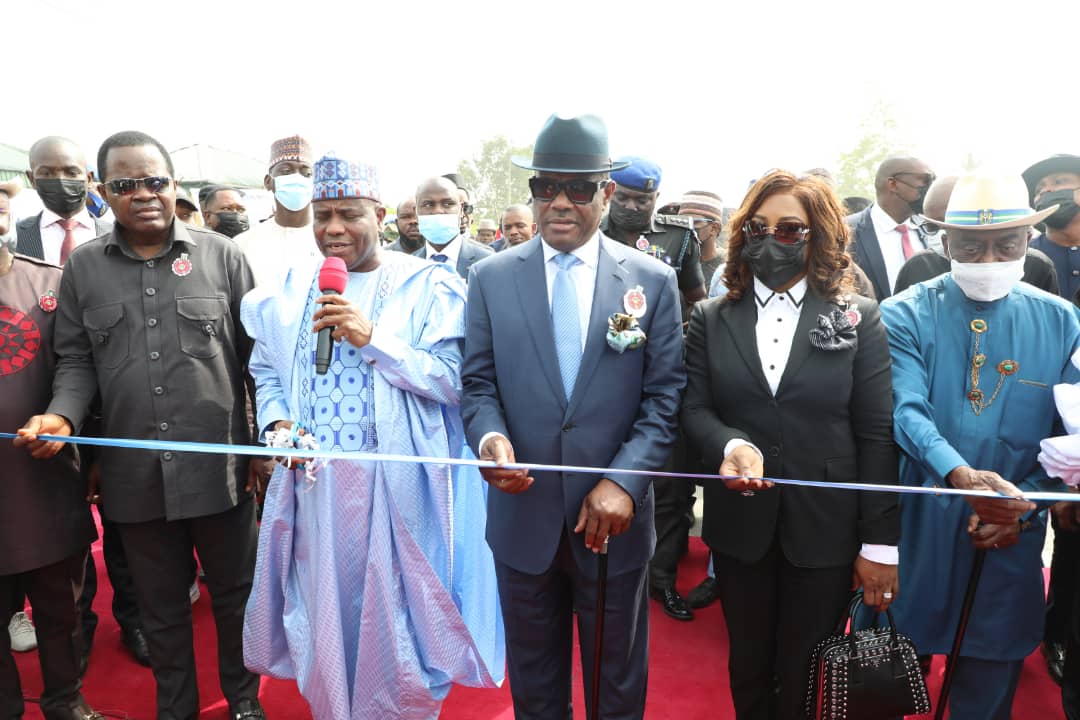
Rivers State Governor, Chief Nyesom Wike has berated the former Director General of Nigerian Maritime Administration and Safety Agency (NIMASA), Dr Dakuku Peterside for speaking about Rivers economy from the point of ignorance.
The governor wondered why Peterside, with his educational attainment, would say that merely because the budget figures of Lagos and Akwa Ibom states are higher, compared to Rivers’ budget, it means that Rivers economy was performing poorly.
He said if a man, who is that ignorant, refused to be silent but comes to public discourse to display such loose grasp of the subject matter, people would question his academic status.
Wike, therefore, stated that Perterside puts a question mark on his doctoral degree, otherwise, how could he say that the performance of the economy was dependent on budgetary estimates.
“When they asked him about the budget of Rivers State, he said the mere fact that Lagos State budget is very high, the mere fact that Akwa Ibom budget is very high, and Rivers State budget is low, that means the economy is not doing well.
“A PhD holder saying that the performance of an economy is based on the size of a budget. Does that mean that Cross River that had a budget of N1.3trillion has performed more than every other state economy?”
Wike also decried the low level of understanding showed by Peterside when he claimed that there was no governance in Rivers State.
The governor queried Perterside’s understanding of governance, saying that he served in the last administration when all the courts in Rivers State were shut for two years, and they also failed to deliver the Opobo Road to enable Opobo people drive on road to their country home.
“They asked him about governance, he said there is no governance in Rivers State. I agree with him. There was governance when the courts were shut down. You are aware that the courts were shut down for almost two years. There was governance at that time.
“There was governance when there was no road to Opobo. There was governance when they put bill one to rob Rivers State. You award a job of N7billion, in bill one is N4.5billion. Now, there is no governance because bill one has been removed? Now, there is no governance because you can drive to Opobo? Now, there is no governance because you can go to the court to seek for your right?”
Wike also took a swipe on a factional chairman of the All Progressives Congress (APC), who is traditionally cursed, and hardly could write his name, to dare challenge him for criticising the Federal Government’s economic stimulation programmes.
The Rivers State governor asserted that with the level of infrastructure and other inclusive policies of government towards Ahoada communities, nobody would say his administration has failed the Ekpeye people.
Wike enumerated some of the projects delivered, particularly in Ahoada-West to include, the Ibiama-Okarki Road, 10km internal roads in Odiokwu community, water scheme, health centre, and recognition of five first class traditional stools.
The governor said 100percent of the contract sum for the reconstruction of Government Secondary School, Okarki, was released to some of their sons, but they diverted the money.
He, however, promised not to be deterred by their act but to revisit the project and ensure that it was competed.
Wike said it was important that they resolve their problems over the selection and choice of a new Eze Ekpeye Logbo.
He urged them to complete that process within the next two months, and endorse a person who would not sell out Ekpeye’s interest or go to companies to take what was meant for the entire Ekpeye people, and present same to the state government.
Wike also directed the demolition of structures for which compensation has been paid, to enable the contractor commence work on the dualisation of the first phase of the Ahaoda-Omoku Road project.
Inaugurating the 10km internal roads, Sokoto State Governor, Hon. Aminu Tambuwal noted that he was witnessing a success story of infrastructural development in a rural Odiokwu community whose socio-economic life has been revived.
He said that despite the lack of capacity of the Federal Government to deliver good governance, they, the governors, were doing their utmost best, playing their role to keep Nigeria together.
Tambuwal said they were proud of Wike for strengthening the existing relationship between Rivers and Sokoto states.
Walking in the footsteps of Melford Okilo and Shehu Shagari, Tambuwal stated that he was working with Wike to foster national unity, cohesion, survival of their people.
Providing a description of the project, Special Adviser to Governor Wike on Special Projects, Dax Kelly Alabo said the 10km network of internal roads have 20km of drains on both sides.
He assured that the roads, built to last 40 years, would impact positively on the socio-economic dynamics of the community.
This is because the crisscross nature of the roads has made access in and out of the farms easy, he said.



Governor of Rivers State, Sir Siminalayi Fubara, has reaffirmed the unwavering commitment of his administration to peace, unity, security, and inclusive development as Rivers State marked its 59th anniversary, last Wednesday.
In a goodwill message issued on Wednesday to commemorate the anniversary, Governor Fubara stated that despite the challenges faced over the years, the people of Rivers State have continued to demonstrate resilience, strength, and an enduring spirit of unity that has sustained the state since its creation.
The Governor noted that the strong bond of brotherhood among the various ethnic nationalities of the state, including the Ijaw, Ikwerre, Ogoni, Etche, Ekpeye, Andoni, Kalabari, and others, remains one of Rivers State’s greatest strengths and a critical foundation for peace, stability, and progress.
He further observed that Rivers State has remained a major driver of Nigeria’s economy for decades, not only because of its abundant oil and gas resources, but also because of the exceptional contributions of its people across diverse sectors including academia, jurisprudence, business, entertainment, public service, and sports.
Governor Fubara assured the people that his administration will continue to prioritize policies and programmes that promote peace, protect lives and property, and expand development across all parts of the state. He emphasized that governance must be people centered and impactful, with equal attention given to every Local Government Area of the state.
The Governor also paid tribute to the elders and founding leaders of the state for preserving the spirit of unity and coexistence over the years, while urging the youths to remain hopeful, responsible, and actively committed to building a greater Rivers State through innovation, hard work, and patriotism.
He equally acknowledged the invaluable role of women in strengthening families, communities, and society, describing them as indispensable partners in the continued growth and stability of the state.
Governor Fubara called on all Rivers people to use the occasion of the anniversary as a moment of reflection and renewed commitment to peaceful coexistence, mutual respect, dialogue, and collective progress, stressing that the unity and future of Rivers State must always rise above personal interests and political differences.
Rivers State was created on May 27, 1967, by General Yakubu Gowon.


The Rivers State Government has distributed science equipment and materials to all senior secondary schools across the state to support students during the ongoing West African Examinations Council exams and to strengthen practical learning.
Flagging off the distribution at the Rivers State Senior Secondary Schools Board premises in Port Harcourt, on Monday, the State Commissioner for Education, Dr. Peters Nwagor, said the move demonstrates Governor Siminalayi Fubara’s commitment to improving education standards in the State.
Nwagor said the materials were approved and provided by the state government specifically to boost the teaching and learning of science subjects, describing science education as the foundation for technological advancement, innovation, and national development.
“No society can compete globally without deliberate investment in science and technology,” the Commissioner stated.
He commended the governor for consistently prioritising the education sector by providing tools needed for effective teaching and hands-on learning.
The Commissioner directed principals to ensure that the equipment are used strictly for practical lessons in their schools, warning that any principal or administrator found diverting, hoarding, or selling the materials wil face disciplinary action under public service regulations.
Nwagor also warned against examination malpractice, saying any principal found aiding or encouraging malpractices will be decisively sanctioned.
“We must collectively restore the dignity and credibility of our educational system,” he said.
Also speaking, Chairman, Rivers State Senior Secondary Schools Board, Tony Egwurugwu, urged school heads to make judicious use of the materials for students’ benefit.
He thanked the State Government for providing the resources, and assured that monitoring mechanisms would be put in place to ensure the materials serve their intended purpose.
In his own remarks, a Board Member for Technical Education, Nwisabari Bani Samuel, expressed appreciation to the governor for prioritising education and acknowledged the Commissioner’s role in advancing education development in the State.
He said the distribution covers all senior secondary schools in the State and is intended to improve students’ performance in both internal and external science examinations.
Akujobi Amadi
-
News2 days ago
Obuah’s Victory Excites Former Lawmaker as APC Primaries Conclude in Rivers West
-

 Politics4 days ago
APC PRIMARIES: FUBARA’S WITHDRAWAL, HISTORIC SACRIFICE FOR NATIONAL STABILITY ……. GROUP
-

 News4 days ago
Court Sentences Seven To Death Over Murder Of Cleric In Rivers
-
News2 days ago
105 Nigerians Killed In S/Africa In Seven Years
-

 Sports4 days ago
PH Arsenal Community Set For Streets Procession, Saturday
-

 Niger Delta2 days ago
Royal Father Endorses PH Arsenal Community, Pledges To Support
-

 Politics4 days ago
IPAC Flays INEC Over Election Guidelines Judgement
-

 Politics4 days ago
NDC To Adopt Electronic Voting For Future Primaries