
Featured
NDDC Mismanaged N6trn, Maintains 362 Bank Accounts -Forensic Report …As Commission Abandons 13,777 Projects

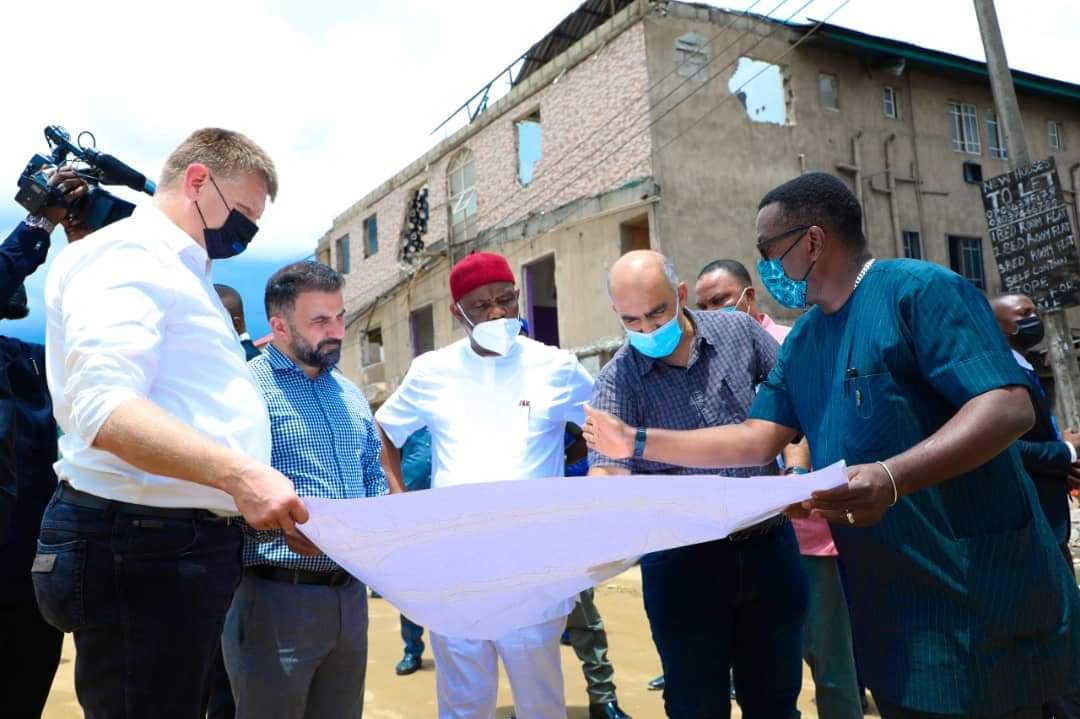
The Federal Government, yesterday, said it was concerned that over 13,777 projects being handled by the Niger Delta Development Commission (NDDC) have their execution “substantially compromised”.
The report indicated that over 13,777 projects awarded by those at the helms of affairs were abandoned.
It also said that the commission has about 362 bank accounts that lack proper reconciliation.
The Attorney General of the Federation and Minister of Justice, Abubakar Malami, said this while receiving the forensic audit report of the NDDC from the Minister of Niger Delta Affairs, Godswill Akpabio, in Abuja, yesterday.
Malami said the government was concerned about what he described as the colossal loss occasioned by uncompleted and unverified development projects in the Niger Delta region, in spite of releasing about N6trillion to the commission in eight years.
According to him, the essence of the forensic audit was to ensure accountability in the use of public funds.
The minister said, “It is on record that between 2001 and 2019, the Federal Government has approved N3, 375, 735,776,794.93 as budgetary allocation and N2,420,948,894,191.00 as Income from Statutory and Non-Statutory Sources, which brings the total figure to the sum of approximately N6trillion given to the Niger Delta Development Commission.
“The Federal Government is particularly concerned with the colossal loss occasioned by uncompleted and unverified development projects in the Niger Delta region, in spite of the huge resources made available to uplift the living standard of the citizens.
“We have on record over 13,777 projects, the execution of which is substantially compromised. The Federal Government is also concerned with the multitudes of Niger Delta Development Commission’s bank accounts amounting to 362 and lack of proper reconciliation of accounts.”
Malami said it was clear that considerable resources have been channelled by the Federal Government to the development of the Niger Delta from 2001 to 2019.
He said it was, therefore, important for the Federal Government and the public to be properly informed of what has been spent and how that has been spent.
“The essence of the forensic audit is to ensure probity and accountability in the use of public funds. It is against this background that the Federal Government will without hesitation strategically implement all aspects of the audit exercise that will promote probity and greater prosperity for the Niger Delta region and Nigeria as whole,” he asserted.
Malami added that the Petroleum Industry Act recently signed into law was to “to bring about the prudence and accountability in the petroleum sector and to give a sense of participation and ownership to the Host communities.”
While submitting the Forensic Audit Report on the Niger Delta Development Commission (NDDC), the Minister of Niger Delta Affairs, Sen. Godswill Akpabio said that 13,777 projects were abandoned in the region.
“The report of the audit committee showed that there are over 13,000 abandoned projects in the Niger Delta and even before the submission of the report some contractors have returned to site on their own and completed about 77 road projects.
“Although the exercise had a chequered history, I thank Mr President and all those who supported and ensured its success”.
He stressed that the exercise was not done to witch-hunt anyone but to ensure that the huge sums of funds committed to the area yearly are justified.
He lamented that the region had remained backwards since 1958 in spite of successive governments efforts through the creation of various interventionist programmes and projects.
The Lead Forensic Auditor, Kabir Ahmed, in a brief overview of the report, said that the team recommended managerial as well as structural changes, chief of which is the downsizing of the NDDC’s board.
He said to reduce cost the team recommended that members of the team should henceforth be appointed on part time basis.
The appointment of members of the board of the NDDC had been suspended until release of the audit report.
Ahmed also disclosed that oil companies in the country are still in default of their contributions to the commission.
“We recommended that the government should withdraw the license of any oil company which defaults for a period of three years.
“Also, deduction of 15% ecological fund at source and be paid to the commission because both the federal and state governments have failed to make payments to the commission.
“The team recommended as a measure of effective revenue collections, the Federal Inland Revenue Services should collect funds on behalf of NDDC from oil companies in the country”.



Rivers State Governor, Sir Siminialayi Fubara, has dissolved the State Executive Council.
The governor announced the cabinet dissolution yesterday in a statement titled ‘Government Special Announcement’, signed by his new Chief Press Secretary, Onwuka Nzeshi.
Governor Fubara directed all Commissioners and Special Advisers to hand over to the Permanent Secretaries or the most Senior officers in their Ministries with immediate effect.
He thanked the outgoing members of the State Executive Council for their service and wished them the best in their future endeavours.
The three-paragraph special announcement read, “His Excellency, Sir Siminalayi Fubara, GSSRS, Governor of Rivers State, has dissolved the State Executive Council.
“His Excellency, the Governor, has therefore directed all Commissioners and Special Advisers to hand over to the Permanent Secretaries or the most Senior officers in their Ministries with immediate effect.
“His Excellency further expresses his deepest appreciation to the outgoing members of the Executive Council wishing them the best in their future endeavours.”
The Independent National Electoral Commission (INEC) yesterday told the National Assembly that it requires N873.78bn to conduct the 2027 general elections, even as it seeks N171bn to fund its operations in the 2026 fiscal year.
INEC Chairman, Prof Joash Amupitan, made the disclosure while presenting the commission’s 2026 budget proposal and the projected cost for the 2027 general elections before the National Assembly Joint Committee on Electoral Matters in Abuja.
According to Amupitan, the N873.78bn election budget covers the full conduct of national polls in 2027.
An additional N171bn is needed to support INEC’s routine activities in 2026, including bye-elections and off-season elections, the commission stated.
The INEC boss said the proposed election budget does not include a fresh request from the National Youth Service Corps seeking increased allowances for corps members engaged as ad-hoc staff during elections.
He explained that, although the details of specific line items were not exhaustively presented, the almost N1tn election budget is structured across five major components.
“N379.75bn is for operational costs, N92.32bn for administrative costs, N209.21bn for technological costs, N154.91bn for election capital costs and N42.61bn for miscellaneous expenses,” Amupitan said.
The INEC chief noted that the budget was prepared “in line with Section 3(3) of the Electoral Act 2022, which mandates the Commission to prepare its election budget at least one year before the general election.”
On the 2026 fiscal year, Amupitan disclosed that the Ministry of Finance provided an envelope of N140bn, stressing, however, that “INEC is proposing a total expenditure of N171bn.”
The breakdown includes N109bn for personnel costs, N18.7bn for overheads, N42.63bn for election-related activities and N1.4bn for capital expenditure.
He argued that the envelope budgeting system is not suitable for the Commission’s operations, noting that INEC’s activities often require urgent and flexible funding.
Amupitan also identified the lack of a dedicated communications network as a major operational challenge, adding that if the commission develops its own network infrastructure, Nigerians would be in a better position to hold it accountable for any technical glitches.
Speaking at the session, Senator Adams Oshiomhole (APC, Edo North) said external agencies should not dictate the budgeting framework for INEC, given the unique and sensitive nature of its mandate.
He advocated that the envelope budgeting model should be set aside.
He urged the National Assembly to work with INEC’s financial proposal to avoid future instances of possible underfunding.
In the same vein, a member of the House of Representatives from Edo State, Billy Osawaru, called for INEC’s budget to be placed on first-line charge as provided in the Constitution, with funds released in full and on time to enable the Commission to plan early enough for the 2027 general election.
The Joint Committee approved a motion recommending the one-time release of the Commission’s annual budget.
The committee also said it would consider the NYSC’s request for about N32bn to increase allowances for corps members to N125,000 each when engaged for election duties.
The Chairman of the Senate Committee on INEC, Senator Simon Along, assured that the National Assembly would work closely with the Commission to ensure it receives the necessary support for the successful conduct of the 2027 general elections.
Similarly, the Chairman of the House Committee on Electoral Matters, Bayo Balogun, also pledged legislative support, warning INEC to be careful about promises it might be unable to keep.
He recalled that during the 2023 general election, INEC made strong assurances about uploading results to the INEC Result Viewing portal, creating the impression that results could be monitored in real time.
“iREV was not even in the Electoral Act; it was only in INEC regulations. So, be careful how you make promises,” Balogun warned.
The N873.78bn proposed by INEC for next year’s general election is a significant increase from the N313.4bn released to the Commission by the Federal Government for the conduct of the 2023 general election.

President Bola Tinubu yesterday expressed grief over the death of a former President of the Academic Staff Union of Universities and one of Africa’s foremost literary scholars, Professor Emeritus Biodun Jeyifo.
Jeyifo passed away on Wednesday, drawing tributes from across Nigeria and the global academic community.
In a condolence message to the family, friends, and associates of the late scholar, Tinubu in a statement by his spokesperson, Bayo Onanuga, described Jeyifo as a towering intellectual whose contributions to African literature, postcolonial studies, and cultural theory left an enduring legacy.
He noted that the late professor would be sorely missed for his incisive criticism and masterful interpretations of the works of Nobel laureate, Professor Wole Soyinka.
The President also recalled Jeyifo’s leadership of ASUU, praising the temperance, foresight, and wisdom he brought to the union over the years.
Tinubu said Jeyifo played a key role in shaping negotiation frameworks with the government aimed at improving working conditions for university staff and enhancing the learning environment in Nigerian universities.
According to the President, Professor Jeyifo’s longstanding advocacy for academic freedom and social justice will continue to inspire generations.
He added that the late scholar’s influence extended beyond academia into political and cultural journalism, where he served as a mentor to numerous scholars, writers, and activists.
Tinubu condoled with ASUU, the Nigerian Academy of Letters, the Wole Soyinka Centre for Investigative Journalism, the University of Ibadan, Obafemi Awolowo University, Oberlin University, Cornell University, and Harvard University—institutions where Jeyifo studied, taught, or made significant scholarly contributions.
“Nigeria and the global academic community have lost a towering figure and outstanding global citizen,” the President said.
“Professor Biodun Jeyifo was an intellectual giant who dedicated his entire life to knowledge production and the promotion of human dignity. I share a strong personal relationship with him. His contributions to literary and cultural advancement and to society at large will be missed.”
Jeyifo was widely regarded as one of Africa’s most influential literary critics and public intellectuals. Among several honours, he received the prestigious W.E.B. Du Bois Medal in 2019.
-
Maritime3 days ago
Nigeria To Pilot Regional Fishing Vessels Register In Gulf Of Guinea —Oyetola
-
Maritime3 days ago
Customs Declares War Against Narcotics Baron At Idiroko Border
-

 Sports3 days ago
Gombe-Gara Rejects Chelle $130,000 monthly salary
-
Maritime3 days ago
NIMASA,NAF Boost Unmanned Aerial Surveillance For Maritime Security
-

 Sports3 days ago
TEAM RIVERS SET TO WIN 4×400 ” MORROW” …Wins Triple jump Silver
-
Maritime3 days ago
NIWA Collaborates ICPC TO Strengthen Integrity, Revenue
-

 Sports3 days ago
NPFL Drops To 91st In Global League Rankings
-

 Sports3 days ago
NPFL Impose Fines On Kwara United Over Fans Misconduct