
Politics
2023 And Conduct Of All Elections Same Day

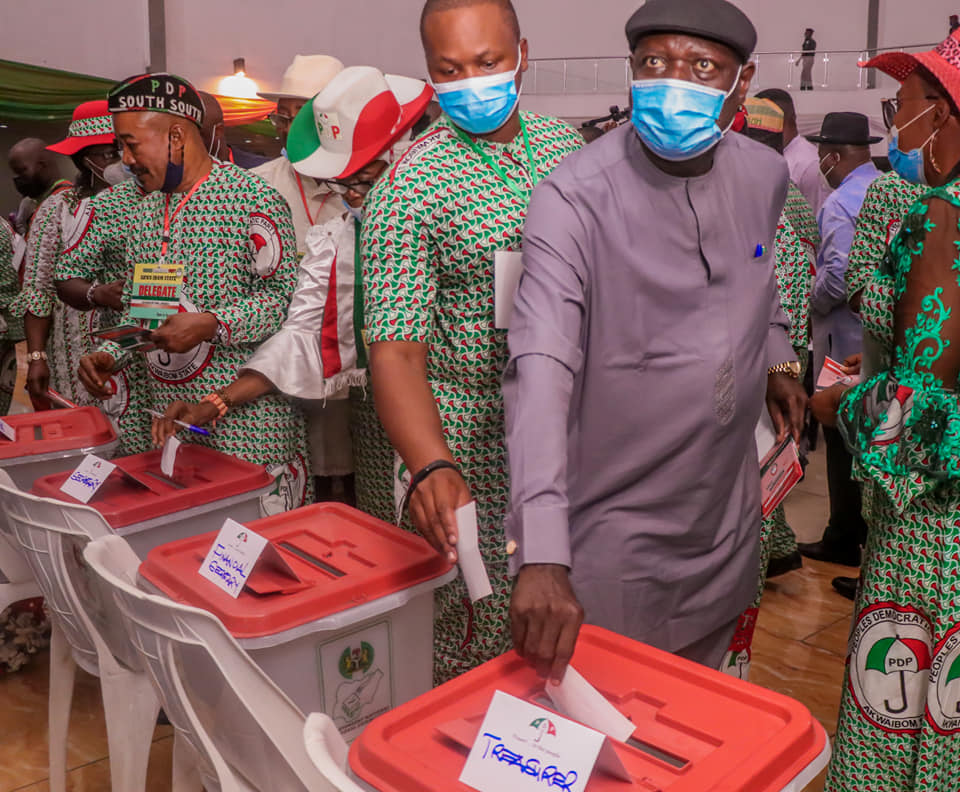
Credible election, experts say, is the bedrock of constitutional democracy. Free and fair election guarantees peace and stability.
The consequences of a disputed election are obvious: protracted litigation, image problems for the candidates that emerge, among others.
Unarguably, Nigeria has a fair share of disputed elections. In most cases, after long litigation, the court has to decide the eventual winner.
They say that to deepen our democracy, we need to get the elections right.
To restore normalcy in the country’s electoral system, some stakeholders have suggested that all elections should hold on the same day.
There were, however, divergent views on the suggestion to hold all elections on the same day.
Even before the clamour to hold all elections in one day, the Minister of Science and Technology, Dr Ogbonanya Onu, had said that it was possible.
He said his ministry had developed a machine to handle elections of that magnitude.
Onu, who spoke with State House correspondents in Abuja, after the Federal Executive Council (FEC) meeting, said that Council had been briefed on the machine in the performance assessment report he submitted.
He added that the electronic voting machine would be solar-powered.
The minster explained: “This voting solution will help us to have clean elections in Nigeria and will make it possible for us as a nation to conduct all our elections in one day at the same time. “All the elections, the national, state and local governments; seven of them can be conducted the same day.”
Onu added that the other qualities of the machine included the that fact it is paperless and also designed not to store data.
“So, if somebody comes to snatch it, it’s a waste of time. As soon as data comes into it, it transmits it.
“So basically, you’ll have a system that will be addressing many of the problems that we have today in the conduct of our elections.”
The minister said that the ministry was in consultation with the Independent National Electoral Commission (INEC) on the machine, which had also been presented to the National Economic Council (NEC).
“We have gone to INEC on this, to set up a committee; we also took this before the National Economic Council and we are still working to further improve on the system,” he added.
The Chief Whip of the Senate, Sen. Orji Kalu, recently re-echoed the need to conduct all elections on the same day.
The former governor of Abia, called on INEC to consider holding the 2023 general elections same day, in order to reduce cost and rigging.
Kalu said that presidential election as well as the national assembly, governorship and state house of assembly elections could be concurrently taken care of on the same day, rather than having staggered dates for them.
He stressed that holding 2023 elections on the same day would minimise cost, give the electorate opportunity to vote their genuine choice and protect their votes.
Kalu also cited the U.S., Ghana and Sierra Leone as countries indulging in same day election, adding that Nigeria will not be out of place to do same.
The former governor said inter alia: “The INEC should conduct the 2023 elections same day as staggered elections are unnecessarily expensive.
“The conduct of the elections in different days gives room for rigging, thuggery and several vices. It also puts the lives of the voters and INEC officials on intense danger.
“When elections are conducted on the same day, popular candidates will emerge, because everyone will be busy in their polling units and zones, unlike different days. The cost of running two days’ elections will also be saved.
“To deepen our democracy, we need to get the elections right. When leaders with genuine interests of the people are voted to power, they provide exceptional leadership and infrastructure to their people.”
In the same vein, a former Commissioner for Information and Orientation in Ebonyi, Chief Abia Onyike, said, conducting all elections in one day will further entrench democracy in the country.
According to Onyike, a former Deputy National President of Nigeria Union of Journalists (NUJ), the idea will save cost and minimise political manipulations during elections.
“Presidential, national assembly, governorship and house of assembly elections should be conducted in one day, as this is the general practice all over the world.
“Organising elections in one day will save the country the huge cost usually incurred during staggered elections.
“Also, it will not create room for electoral manipulations which had been threatening our democratic process,’’ Onyike added.
He also stressed that conducting elections in one day would provide the electorate the opportunity to demonstrate their will without being unduly influenced.
“So, INEC should go back to the drawing board and review its capacity to conduct all the elections in one day.
“There will be no bandwagon effect and people will vote based on what they know,’’ he said.
However, two dons who spoke on the issue said it would be impossible to successfully conduct all elections in one day during the 2023 general elections.
The dons of the Department of Political Science, University of Nigeria, Nsukka, spoke in separate interviews with the News Agency of Nigeria (NAN).
Prof. Aloysius Okolie, said that conducting all the elections in one day would be impossible because the country lacked the manpower to do so without the process losing its credibility.
“If all the elections are conducted in a day, the Independent National Electoral Commission (INEC) and security agencies will be overwhelmed as they will not have enough manpower to perform their duties.
“Yes, if it is possible to be conducted in a day it will save cost, but it is impossible because of dearth of manpower.’’
Okolie, who is Dean, Faculty of Social Sciences, said staggering of elections was not responsible for electoral malpractice as canvassed by opponents.
He said malpractice was caused by overzealous and wrong perception of some politicians, who saw election as a do or die affair.
“Even in the U.S. and other developed countries, elections are not conducted in one day, but election malpractice recorded is negligible.
“No country can conduct perfect election or election that is 100 per cent free and fair, but the malpractice should be minimal and negligible,” he said.
Head of Department of Political Science, Prof. Jonah Onuoha, also said the country lacked the manpower and logistics to conduct all 2023 elections in one day.
Onuoha said that even if it would be possible, it would not be now that the country is battling with serious security challenges, coupled with the penchant of politicians to rig elections
“Saving cost and staggering of elections are not main problems of conducting elections in the country, but how to get it right and conduct credible, free and fair elections even when staggered 10 times,’’ he said.
According to him, there will even be more fraud if all elections are conducted in a day because electoral stakeholders will be overwhelmed by the magnitude of work needed.
“INEC, security agencies, election observers and the media will not have enough manpower that will give adequate attention to all elections conducted that day.
“Nigeria should focus on conducting credible, free and fair elections, which results will be accepted by all contestants.
“This will improve the country’s image as well as save billions of naira spent by aggrieved candidates to challenge election results in election petition tribunals,” Onuoha said.
Undoubtedly, Nigeria is facing a challenge of conducting free, fair and credible election. Probably, experimenting with conducting all election same day, may save the situation.
By: Obike Ukoh
Ukoh writes for the News Agency of Nigeria (NAN).



The commission announced the extension in a statement issued on Saturday and signed by the National Commissioner and Chairman of its Information and Voter Education Committee, Mohammed Haruna.
According to INEC, the decision followed appeals by political parties for additional time to complete the submission process through the dedicated online portal.
“The submission window, which according to the revised Timetable and Schedule of Activities for the General Election was originally scheduled to close on Saturday, 8th August, 2026, has been extended to Tuesday, 11th August, 2026,” the commission said.
In a a related development, INEC announced the suspension of PVC collection in Osun State ahead of the August 15 governorship election.
The commission said voters who applied for replacement of lost, damaged or defaced Permanent Voter Cards would have until midnight on Sunday, August 9, to print downloadable copies of their cards.
The electoral body explained that the deadline was necessary to enable it compile data on downloaded PVCs and produce final statistics on the total number of cards collected ahead of the election.
INEC said PVC collection in Osun commenced at the Registration Area level from July 22 to 28, 2026, but was extended to July 31 following complaints about large crowds and difficulties experienced by voters at collection centres.
The exercise subsequently moved to the local government level and ran from August 1 to 7.
The commission also disclosed that replacement downloadable PVCs had been made available to voters in Odo-Otin and Ife Central Local Government Areas following the theft of cards during attacks on the two collection centres.
It stressed that the stolen cards could not be used to vote.
INEC reassured Osun residents of its preparedness for the August 15 governorship election.
“The commission reiterates that the stolen cards cannot be used to vote.
“INEC reassures the people of Osun State of its readiness to conduct a free, fair, credible and inclusive governorship election on 15th August, 2026,” the statement said.
The commission said the deadline, initially set for Saturday, 8 August, has been extended to Tuesday, 11 August 2026, following appeals from political parties for more time.
INEC also announced that the window for voters who applied to replace lost, damaged or defaced PVCs to download their replacement cards will close at midnight on Sunday, 9 August.
The move is to enable the commission compile final PVC collection figures ahead of the 15 August Osun governorship election.
INEC said replacement downloadable PVCs have also been provided to affected voters in Odo-Otin and Ife Central Local Government Areas after hoodlums carted away cards from two collection centres, stressing that the stolen cards cannot be used to vote.
The commission reaffirmed its readiness to conduct a free, fair, credible and inclusive election in Osun State.
Gov. Kefas made the remarks over the weekend at the Federal Medical Centre (FMC), Jalingo, during the flag-off of the second phase of the Renewed Hope Medical Outreach in Taraba State, organised as part of activities marking Prof. Yilwatda’s 58th birthday.
The governor commended Prof. Yilwatda for choosing to mark his birthday by providing medical care to people in need.
“What Professor Nentawe did is a powerful demonstration of what leadership should be,” Gov. Kefas said.
He assured that his administration would continue to support initiatives that complement government efforts to improve healthcare delivery and the wellbeing of residents.
Speaking at the event, Prof. Yilwatda called on Nigerian leaders to embrace the culture of giving and use their positions to touch the lives of the less privileged.
He said his decision to celebrate his 58th birthday in Taraba State was deliberate and informed by the needs of underserved communities, particularly people who face difficulties accessing healthcare because of distance and financial constraints.
According to him, the intervention followed a needs assessment and was extended across the three senatorial districts of the state.
He said the exercise commenced on August 3 at Takum General Hospital and covered the Federal University Teaching Hospital, Wukari; First Referral Hospital, Sunkani, Ardo-Kola Local Government Area; General Hospital, Bali; General Hospital, Gembu; and FMC Jalingo.
Prof. Yilwatda said the intervention provided medical services to thousands of beneficiaries, including people who required surgical procedures.
He said sustainable national development could only be achieved when strong institutions placed Nigerians at the centre of development.
“Leadership is about service,” he said, urging political and public leaders to make giving back to society an important part of their responsibilities.
He reaffirmed his commitment to serving Nigeria and its people, saying his personal vision was to make every day of his life useful to humanity.
“Every day that I live, the vision is: let it be useful to humanity,” he said.
The Taraba State Commissioner for Health, Dr. Bordiya Buma, commended the initiative, saying it was consistent with the Renewed Hope agenda and efforts to strengthen healthcare delivery in the state.
Dr Buma said the second phase followed the successful completion of the first phase, which was conducted simultaneously in six local government areas, with two LGAs selected from each of the three senatorial districts.
According to him, more than 10,000 patients were attended to during the first phase, including people with medical and surgical conditions.
He disclosed that 327 general surgeries, 71 eye surgeries and 575 dental procedures were carried out during the exercise.
The commissioner expressed appreciation to President Bola Tinubu for the Renewed Hope Medical Outreach and thanked Prof. Yilwatda for supporting the initiative and choosing Taraba State as a beneficiary.
The Minister of Health and Social Welfare, Prof. Muhammad Ali Pate, also commended Prof. Yilwatda for choosing Taraba State to mark his 58th birthday through a medical outreach.
Prof. Pate said making healthcare the centrepiece of the birthday celebration was significant because health affects everyone.
-

 News2 days ago
RSG Targets Nine Million Residents in Mosquito Net Distribution Campaign
-

 Oil & Energy2 days ago
Aiyedatiwa Signs New Electricity Bill
-

 Oil & Energy2 days ago
NLNG Commissions Research And Innovation Centre In RSU
-

 Maritime2 days ago
Marine Minister Commends President Tinubu On NPERA Bill Assent
-

 News2 days ago
KenPoly Holds Eight Convocations, August 29
-

 News2 days ago
RSG Begins Another Phase of Projects Commissioning Today
-

 News2 days ago
RMAFC Completes Revenue Sharing Review, Proposes New Pay
-

 Maritime2 days ago
NAGAFF Petitions IGP Over Alleged Maritime Police Harassment