
Business
FG’s $2 bn Refining Pact With Niger Sparks Outrage

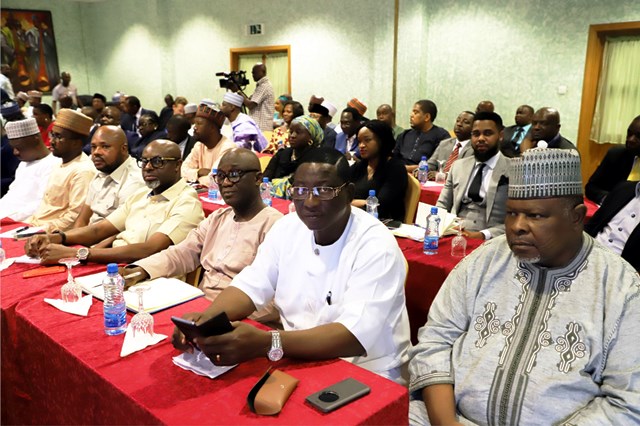
The recent Memorandum of Understanding (MoU) between the Federal Government and the Niger Republic on refining of petroleum products has sparked a public outrage, mostly from the Niger Delta region.
The Tide’s findings show that the $2 billion pact in which Nigeria will transport crude by pipeline to Niger, and in turn buy the refined product from Niger did not go down well with many Nigerians.
Public analysts who spoke to our correspondent on the development said the pact raised so much questions on the sincerity of the present administration in fixing the existing refineries in the country.
According to a public commentator, Nathan Barine, “it is a big shame that the Federal Government entered into such agreement with the Niger Republic, which is a very smaller country that is not up to Lagos State.
He said the Federal Government was yet to tell the world the real reason behind the agreement it signed with Niger that has a refining capacity of 20,000 barrel per day, compared to Nigeria’s refineries that have the capacity to refine more than that.
Another public analyst, Barr. Chimelem Wodi, described the agreement as another form of colonialism, alleging that it was a deliberate plan by the Federal Government to transport the crude from the Niger Delta to boost refining activities in Niger.
“I see an ethnic collaboration in the whole thing, and the move is to make the economy of Niger and the Northern states closer to them to boom, while the refineries here are undermined which has caused many loss of jobs.
“They know what they are doing. Why can’t our refineries here be fixed, and how much will it cost to fix the refineries here? All of a sudden, you are (Federal Government) signing MoU of $2 billion to boost Niger’s economy and the economy of some northern states closer to them”, he said.
Wodi called on the Niger Delta leaders to wake up and speak on the continuous neglect of refineries in the region.
However, the chairman of the Independent Petroleum Marketers Association of Nigeria (IPMAN), Rivers State chapter, supported the agreement.
He said that the MoU with Niger would be less stringent and stressful than other importations of petroleum products with vessels from far countries, because of nearness of Nigeria to Niger Republic.
According to him, the transportation of crude through the pipeline is cheaper in the supply chain, than through the sea and vessels.
He, however, described as embarrassing the Federal Government’s move to abandon the nation’s four refineries with a refining capacity of 450,000 barrel per day, only to sign an MoU of $2 billion with Niger that has a refining capacity of just 20,000 barrel per day.
By: Corlins Walter



The Nigeria Inter-Bank Settlement System (NIBSS) has said that Bank Verification Number (BVN) enrolments rose by 6.8 per cent year-on-year to 67.8 million as at December 2025, up from 63.5 million recorded in the corresponding period of 2024.
In a statement published on its website, NIBSS attributed the growth to stronger policy enforcement by the Central Bank of Nigeria (CBN) and the expansion of diaspora enrolment initiatives.
NIBSS noted that the expansion reinforces the BVN system’s central role in Nigeria’s financial inclusion drive and digital identity framework.
Another major driver, the statement said, was the rollout of the Non-Resident Bank Verification Number (NRBVN) initiative, which allows Nigerians in the diaspora to obtain a BVN remotely without physical presence in the country.
A five-year analysis by NIBSS showed consistent growth in BVN enrolments, rising from 51.9 million in 2021 to 56.0 million in 2022, 60.1 million in 2023, 63.5 million in 2024 and 67.8 million by December 2025. The steady increase reflects stronger compliance with biometric identity requirements and improved coverage of the national banking identity system.
However, NIBSS noted that BVN enrolments still lag the total number of active bank accounts, which exceeded 320 million as of March 2025.
The gap, it explained, is largely due to multiple bank accounts linked to single BVNs, as well as customers yet to complete enrolment, despite the progress recorded.
-

 News3 days ago
2026 Budget: FG Allocates N12.78bn For Census, NPC Vehicles
-

 Sports3 days ago
AFCON: Osimhen, Lookman Threaten Algeria’s Record
-

 Politics3 days ago
Wike’s LGAs Tour Violates Electoral Laws — Sara-Igbe
-

 Politics3 days ago
Rivers Political Crisis: PANDEF Urges Restraint, Mutual Forbearance
-

 Sports3 days ago
NPFL To Settle Feud between Remo Stars, Ikorodu City
-

 Sports3 days ago
Palace ready To Sell Guehi For Right Price
-

 Sports3 days ago
Arsenal must win trophies to leave legacy – Arteta
-

 Sports3 days ago
Tottenham Captain Criticises Club’s Hierarchy