
Politics
Osoba’s Loyalists Want Commissioner Sanctioned For Attacking Ex-Gov

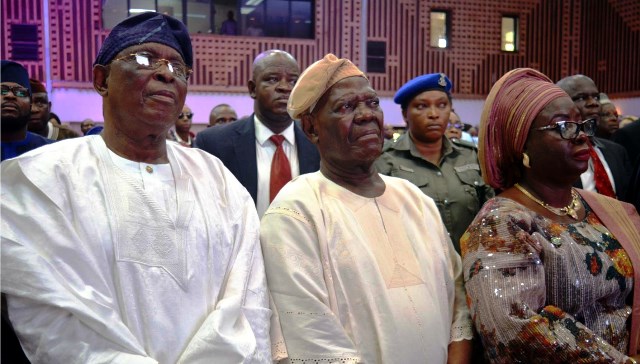
Loyalists of a former governor of Ogun State, Chief Olusegun Osoba, have urged the All Progressives Congress to heavily sanction the Commissioner for Youth and Sports, Dr Kehinde Oluwadare, for abusing the former governor.
The loyalists, led by the Financial Secretary of the APC and a member of the Governor’s Advisory Council, Sunday Sowunmi, said the call was made to serve as a deterrent to others.
The embattled commissioner had been quoted to have described Osoba as a failed leader that could not match a former Governor of Lagos State, Bola Tinubu in terms of grooming leaders.
Apparently dissociating himself and government from the comment by his commissioner, Governor Dapo Abiodun suspended Oluwadare indefinitely.
Though Osoba’s loyalists in Abeokuta South applauded the governor for the action, they insisted that the party must do something to sanction embattled commissioner to avoid further abuse of the party leader in the state.
Sowunmi said Abiodun would not have become the governor without Osoba’s efforts before and during the election.
He said: “Despite the fact that the ‘baba’ is a veteran journalist, he will not talk. But if we fold our hands and allow the commissioner to get away with such statements, that will be highly ridiculous.
“The fact is that he (Osoba) is a national leader and the architect of this government. So, I don’t know why somebody in the government of Governor Abiodun will deem it fit to say such a thing about Chief Osoba. It is like biting the finger that fed it.”
According to Sowunmi, what the commissioner said might be the reflection of what some people in the government might have been saying in their private discussions.
He noted that that made him bold enough to say it out to the public.
He added, “I give kudos to Governor Dapo Abiodun for his immediate reaction.
“He has done well. But we cannot just keep quiet. ‘Oro ti ologbon ba so, enu ashiwere ni ati ngbo’ (what a wiseman says is echoed by a foolish man).
”I will further appeal to the APC in Ogun State to add more to the punishment given to the man by the governor because if we don’t, it won’t be good for the party.
“I don’t think anyone can dispute my statement, including the governor himself. Therefore, I will advise my people, including political colleagues, that it will be very unfortunate for us to stand up one day and begin to say such to our leaders, especially, Chief Osoba, who is an elder statesman.
”After the commissioner made such statements, we started receiving calls from every part of the country which is very embarrassing.”

Politics
Alleged Coup: Protests Rock N’Assembly As Detained Officers’ Children, Wives Demand Justice


Scores of children and wives of military officers detained over an alleged coup plot yesterday staged a peaceful protest at the National Assembly, demanding a speedy trial and the release of the accused officials.
The protesters who gathered at the entrance of the National Assembly complex, moved in a slow procession while clutching placards with inscriptions such as “Don’t Kill Our Daddies,” “Detention Without Trial is Injustice,” and “Six Months of Torture: Enough Is Enough.”
Amid tears and trembling voices, the children appealed for justice and access to their detained fathers, many of whom they said they had not seen for months.
The appeal was made during a press briefing in Abuja attended by no fewer than 20 wives and several children of the detained officers, including a two-month-old baby.
The families were accompanied by human rights lawyer, Deji Adeyanju and activist Omoyele Sowore.
At the briefing, the families lamented that the officers had been held for over 160 days without trial or contact with their relatives, describing the situation as a violation of their fundamental rights.
Speaking on behalf of the families, Memuna Bashiru said the prolonged detention had thrown their households into uncertainty and emotional distress, noting that while allegations had been widely publicised, families remained in the dark about the fate of their loved ones.
The arrest of the indicted officers was first announced on October 4, 2025, by the then Director of Defense Information, Brigadier General Tukur Gusau, who disclosed that 16 officers were taken into custody for alleged breaches of military regulations and acts of indiscipline.
However, an interim investigation later suggested the existence of a clandestine network of officers, allegedly coordinated by a senior Army officer, which had begun preliminary planning for a coup.
According to the report, the alleged plot involved surveillance of key national assets, including the Presidential Villa, Armed Forces Complex, Niger Barracks in Abuja, and major international airports, with October 25, 2025, cited as the planned date for the operation.
Those reportedly in custody include Brig Gen M. A. Sadiq, Col M. A. Maaji, Lt Col S. Bappah, Lt Col A. A. Hayatu, Lt Col P. Dangnap, Lt Col M. Almakura, Maj A. J. Ibrahim, Maj M. M. Jiddah, Maj M. A. Usman, Maj D. Yusuf, Capt I. Bello, Capt A. A. Yusuf, Lt S. S. Felix, Lt Cdr D. B. Abdullahi, Sqn Ldr S. B. Adamu and Maj I. Dauda.
The alleged plot, according to findings, targeted senior government officials, including President Tinubu and Vice President Kashim Shettima.

In a statement issued yesterday, the party’s National Publicity Secretary, Mr Felix Morka, said the exercise would take place in all wards and designated centres nationwide.
He called on existing members to update their records, while encouraging new entrants to join the party through the digital platform.
“As the electronic membership registration exercise resumes in all wards and designated locations nationwide, we urge existing members to validate their membership while new members are encouraged to register and join the progressive family,” Mr Morka said.
According to him, eligibility for registration is limited to individuals aged 18 and above who possess a valid National Identification Number (NIN).
The party said the initiative is part of efforts to modernise its operations by transitioning to a digital database that would enhance record accuracy and accessibility.
Mr Morka noted that the e-registration would “digitise the party’s membership register, ensure the integrity of records, and enhance efficient access to membership data for planning and management decisions.”
He added that the move is also aimed at promoting internal democracy within the party and strengthening its commitment to democratic innovation.
The APC had previously introduced electronic registration as part of broader reforms to streamline its membership system and improve organisational efficiency.
-
Opinion5 days ago
Ozoro Festival: Tradition or Tyranny?
-
News2 days ago
Decentralizing Pipeline Surveillance Poses Greater Dangers To Niger Delta …. Group Warns
-
 Politics3 days ago
APC Resumes Electronic Membership Registration Nationwide
-

 Rivers2 days ago
Court Rules Out Interim Administration In Jumbo House, Bonny
-
Politics5 days ago
RIVERS WOMEN RALLY SUPPORT, CONTINUOUS PRAYERS FOR TINUBU
-
Politics5 days ago
AKPABIO, DIRI, OBOREVWORI, OTHERS VOW TO REELECT TINUBU …AS GIADOM RETAINS APC ZONAL CHAIR
-
 Business2 days ago
33 Banks Raise N4.65tn As Recapitalisation Ends
-
Politics5 days ago
Viral 2027 Nomination Forms Price List Fake, Misleading – APC