Environment
Dead Fishes:Environment Groups Demand Palliatives For Bonny Residents
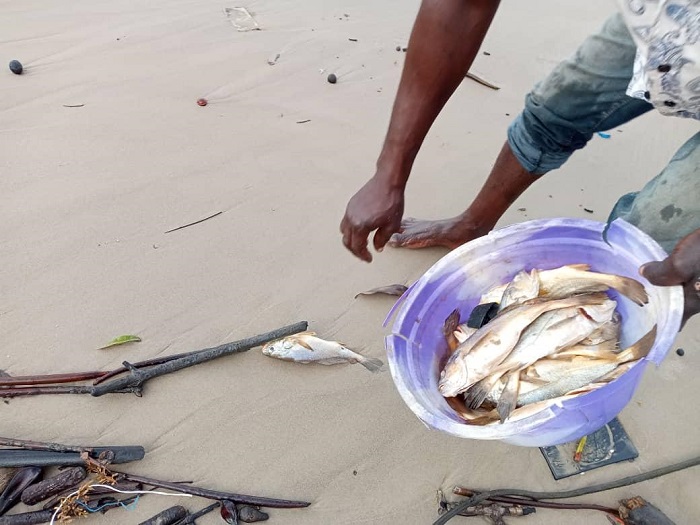
Two environment groups in Nigeria, the Bonny Environment Consultant Committee (BECC) and the Association of Environmental Lawyers of Nigeria, have decried the devastating impact of the massive dead fishes floating along the Bonny coastline in Rivers State which they say have destroyed economic lives of the inhabitants of the area, with a call for the provision of palliatives to them.
The groups which made their position known in separate interviews with The Tide in Port Harcourt said it was not enough to unravel the causes of the dead fishes on the coastline but that there was the need to provide palliatives to the people whose livelihoods have been adversely affected by the ugly incident.
The Chairman of Bonny Environment Consultant Committee, Prof. Sodeinye Abere, who described the incident as disturbing, said on confirming the veracity of the massive dead fishes on the Bonny coastline, his committee directed the people to stop harvesting, buying and eating fishes for now, thereby temporarily putting on hold their means of livelihoods.
According to him, “the stench of the dead fishes alone is very, very disturbing. Ordinarily, the coastline dwellers enjoy the cosy breeze that comes in and refreshes their bodies. It is no more the case. More than that, with the Coronavirus issue restricting people’s movement, again, the ordinary Bonny man can go behind of his house at the creek and fetch fish to subsist with, but he cannot do that any more. The economic load now would be so much on the ordinary natives.”
To cushion the effects of this seeming disruption of the people’s socio-economic wellbeing, Prof. Abere said there was the need to provide palliatives to them. “Palliative measures are also solicited because our people waiting to die of Coronavirus should be alive first”, he said.
He pointed out that there was also the need not to only investigate the circumstances surrounding the dead fishes but also the physiochemical properties of the water where the fishes live, stressing that if not properly handled, the situation can become a pandemic in Nigeria.
On his part, the President of the Association of Environmental Lawyers of Nigeria, Dr Samuel Chisa Dike said the body was disturbed by the development and urged the Federal Government to treat the issue the same way it is treating the COVID-19 pandemic.
Dike, an Associate Professor of Energy and Environment Law at the Rivers State University, stressed the need for critical stakeholders to work together to address the issue.
“ You never can tell who has consumed this specie of fishes since one month now. And we want to be sure that government is sensitised about it, because there is the tendency to tell the people about the danger of consuming the fishes but another thing is what happens to their economic lives?”, he queried.
By: Donatus Ebi

Environment
NSE Inauguates 18 Units Residential Terrace In Lagos
President, Nigerian Society of Engineers (NSE), Mrs Margaret Oguntala, has inaugurated the construction of 18 units residential terrace in highbrow Alausa area of Lagos toward bridging the nation’s shelter gap.
Environment
FG Launched 1 GOV Digital Content System In Nigeria
Ministry of Water Resources and Sanitation has launched the 1GOV Enterprise Content Management System (ECMS) to enhance digital governance and improve service delivery.
The launch, held on Thursday in Abuja, marks the ministry’s transition from paper-based operations to a smart, integrated and technology-driven work environment.
The Minister of Water Resources and Sanitation, Prof. Joseph Utsev, said the deployment aligns with the Renewed Hope Agenda of President Bola Tinubu.
Utsev said the system would improve data management, streamline workflows and strengthen transparency and accountability across the ministry.
According to him, the ECMS will enhance productivity, preserve institutional memory and reduce operational costs in the ministry.
Launching the platform, the Head of the Civil Service of the Federation, Mrs Didi Walson-Jack, said the initiative is a major step in public sector reform.
She said the ministry’s mandate affects Nigerians through water supply, sanitation, irrigation, river basin development and climate resilience programmes.
Walson-Jack said the 1GOV ECMS enables secure digital records management, automated workflows, electronic approvals and real-time collaboration across MDAs.
She added that the deployment aligns with the Federal Civil Service Strategy and Implementation Plan 2021–2025 and the directive for full digitalisation by December 2025.
“Effective governance cannot afford delays caused by manual bottlenecks or avoidable inefficiencies,” she said.
She directed that all official correspondence in the ministry must henceforth be processed through approved digital registry channels.
In her remarks, the Permanent Secretary, Dr Emanso Umobong, said the system would eliminate workflow inefficiencies and improve service delivery.
She urged staff to fully adopt the platform and engage in continuous capacity building.
Environment
Usamali Builds Oil Communities’ Resilience against Environmental Degradation
Research shows that local communities and citizens living at the grassroots, particularly women, are directly impacted by the environmental degradation, flooding and others that result from these manifestations.
In the light of this, non-governmental organisation, Ese Usamali Foundation For Rural Development (EUFORDe), has held a forum for women and other members of oil impacted communities, tagged: ‘Voices from the Grassroots,’ and aimed at building their resilience and mitigation efforts against climate change and environmental degradation
The forum, with the theme: ‘Building Resilience for Oil Spill Impacted Ahoada Communities,’ organised with support from Global Green Grants, was held in Ahoada Community, Ahoada East Local Government Area of Rivers State, on December 5, 2025.
Executive Director of Ese Usamali Foundation For Rural Development, Mercy Elemchukwu-James, said women are at the forefront of efforts to mitigate the impact of climate change and environmental degradation.
The event, therefore, was “designed for community women impacted by oil spills, flooding and other environmental degradation,” she said.
Community women were enlightened by resource persons on new opportunities for sustainable agricultural practices and water management techniques that cushion the impact of oil spills.
Lectures were also delivered on Self-care and Trauma-care, with focus on physical and mental health of the population, and increasing access to health-related resources and services; as well as on Food security and women’s critical role in decision making in oil spill and flood situations in communities
Elemchukwu-James pointed out that the event created a forum for stakeholders, civil society actors and others to dialogue on measures at advancing inclusive and sustainable livelihoods of community women.
She stressed the need for collaborative efforts towards achieving mitigation efforts, while underscoring EUFORDe’s commitment to “fostering partnerships as a critical driver for achieving a healthy community and sustainable development.”
Elemchukwu-James described participants’ design of ‘Community Resilience Plan,’ to manage and combat environmental degradation and crises, as part of achievements recorded at the event.
The forum also witnessed the launching of EUFORDs’ Center For Resilience and Rights.
“This center is established to build resilience as Trauma-Care for victims of environmental degradation, support for survivors of Gender Based Violence (GBV) and a platform where victims of environmental injustice and other GBV cases can seek redress,” Elemchukwu-James said.
Participants celebrated the milestones achieved and charted a path toward greater impact in the coming years. They also described the event as “an inspiring and transformative experience.”
Elemchukwu-James said the awareness creation workshop “reaffirms EUFORDe’s mission to create an equitable society in which the rights and capacities of women, youth, children and underprivileged are integrated in the socio-economic planning and development of communities, for the attainment of equity and peace.