
Featured
PDP Links Suicide, Vices To Buhari …Says Aisha’s N500bn Fraud Claim On SIP Vindicates Party

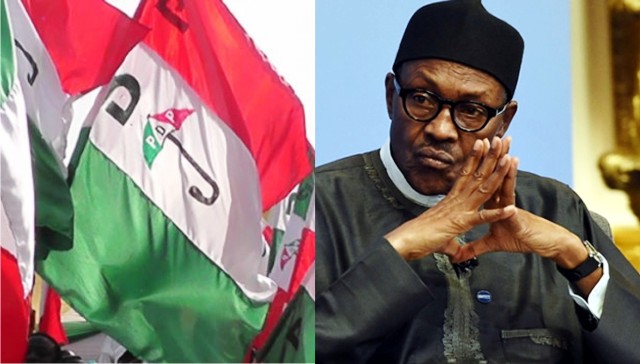
The Peoples Democratic Party, PDP, yesterday lamented what it identified as the escalated despondency, depression and misery in the country since the rigging of the 2019 presidential election.
The party stated this in reaction to the increase in the rate of suicide, youths’ desperation to travel abroad and other social vices since the conclusion of the 2019 presidential election.
In a statement by its spokesperson, Kola Ologbondiyan, the former ruling party charged Nigerians to “uphold and support one another in love, at this trying time to check the rising social degeneration in our nation, particularly acts of suicide.”
PDP described as a “national tragedy, the rising spate of suicides, slavery mission abroad, divorces, child abandonment and other social degeneration occasioned by the worsening economic hardship, poverty, hunger and rising insecurity under the incompetent, corrupt, divisive and manipulative All Progressives Congress (APC) administration.
“Such social ills, which is a direct response to bad governance, occurs when citizens are overwhelmed by gloom, with no hope in sight, particularly after their majority vote for a new, purposeful and result-oriented President in the PDP candidate AtikuAbubakar, as expressed in the February 23 Presidential election, was subverted with brazen impunity.
“In the last few months, the news media has been awash with horrible reports of teenage suicide in our country.
“Banditry, insurgency, marauding, bloodletting and kidnapping with unmentionable ransoms, have almost become daily occurrences. Our citizenry is now battling with the worst kind of siege mentality.
“Constitutional violations, human rights abuses, arbitrary arrests, extra-judicial killings, assault on perceived dissenting voices and attempt at annexation of our institutions of democracy, particularly the judiciary, signposts a nation in dire strait.
“Misery has set in. This is evident in the shrinking of our nation’s Gross Domestic Produce (GDP) to 2.1percent in the first quarter of 2019.
“It is saddening that at the time Nigerians ought to be celebrating, they are rather forlorn, committing suicide and exiting the country in droves.
“Most Nigerians have become downhearted in the face of an administration that wrecked our once robust economy and divided our people; in the face of worsening joblessness, piling bills, hunger and diseases; in the face of incompetence, lies, and unfulfilled promises of free homes, monthly allowance to unemployed youth and the poor, bringing the naira to the same value as the US Dollar, creating of 5 million new jobs, ending of insurgency in three months and myriad of other false promises.
“Instead, what our nation has witnessed is an official entrenchment and elevation of incompetence, deceit, propaganda, failure and cabal mentality on the corridors of power; a situation where the only achievement is the foisting of economic recession and mortgaging of the future of our nation with the accumulation of N24.39 trillion debt, with no tangible project to show.
“It is instructive to state that the President Muhammadu Buhari-led APC administration has obstinately refused to allow any scrutiny of its books, knowing that they are catalogues of corruption, treasury looting, violations, impunity and acts that have brought our nation to its knees.”
The PDP however called on Nigerians not to despair but “stand firm in their collective determination to retrieve the stolen Presidential mandate at the tribunal, so they can have an administration that truly cares for them and which has the competence to return our nation on her deserved path of peace, national cohesion and economic prosperity.”
Meanwhile, President Muhammadu Buhari’s wife, Aisha, has rubbished the N500billion Social Investment Programme of her husband’s administration, saying that it failed “woefully” in the North in particular.
Aisha, who hails from Adamawa State, said the situation in her home state, as far as the implementation was concerned, was pathetic.
She also cited Kano, a highly-populated northern state, as another example where she believed the programme failed, despite the huge funds the Federal Government budgeted for it.
The SIP is domiciled in the Office of Vice-President Yemi Osinbajo, but its direct implementation is done by the Senior Special Assistant to the President on Social Investment, Mrs Maryam Uwais.
Mrs Buhari bared her feelings, last Saturday in Abuja during an interactive programme she organised for women at the Presidential Villa.
For instance, she disclosed that though Uwais informed her that 30,000 women would be beneficiaries in Adamawa State, four years had passed and there was no evidence that the SA kept her word.
The President’s wife spoke in detail, expressing her disappointment.
She went on, “Concerning the N500bn voted for SIP, that was part of 2015 campaigns where they promised to give out N10,000, feed pupils in primary schools and give N5,000 to the poorest of the poor.
“The SSA to the President on Social Investment is a lady from Kano and I am sure that my husband decided to put somebody from Kano because of the population and political impact it made. I have never asked how the money is being used or is being given out.
“I met Barrister (one of the President’s aides on SIP) once, and he promised me that for my state (Adamawa), we should get 30,000 women to be given N10,000. Up till now, I haven’t heard from him.
“I don’t want to raise the alarm that my state does not benefit from it, where the SGF (Secretary to the Government of the Federation) came from; I kept quiet because I don’t want people to say that I talk too much. Recently, I saw a 74-year-old man selling petty things in Kano, I asked him how much is his capital, he told me between N3,000 and N4,000. Don’t forget that we have campaigned to give the poorest of the poor N5,000 every month.
“So, I don’t know where is the social investment… Maybe, it worked out in some states. In my own state, only a local government benefited out of the 22. I didn’t ask what happened and I don’t want to know, but it failed woefully in Kano, it’s not a good sign and it’s not a good thing.
“We have a lot of women that do business locally due to the cultural thing in the North; they are at home doing their business. Some are millionaires, some have thousands of naira, they need the assistance but they do not get it. Most northern women do not belong to any market association.
“I was expecting the N500billion to be utilised in different methods in the North for the aim to be achieved. I don’t know the method they used, but most of the northern states do not get it. My state does not get it.
“How many of you (women in the hall) get it in your state? My state did not benefit from it.”
The women responded by saying that they got nothing in the past four years.
She argued that the method employed in implementing the programme in the North was faulty, a reason she believed it failed there.
“It worked out well in a situation whereby they have market associations but I was thinking different methods should be used in the North”, the President’s wife stated.
Amid applause from women in the hall, Mrs Buhari also criticised the $16million counterpart fund said to have been used so far on procurement of mosquito nets.
She noted, “I have heard about mosquito nets, Nigeria paid its counterpart fund, $16million. I asked them to give my own share of the net to send it to my village people. I didn’t get it.
“They have spent $16million in buying mosquito nets, I did not get it, maybe some people have got it. But I feel that, that’s my personal opinion, $16million is enough to fumigate mosquitoes in Nigeria. That’s my opinion.”
However, she commended the SGF, Mr Boss Mustapha, for the initiative to include women in the inauguration programme of her husband for his second term on May 29.
She stated further, “I will also like to use the opportunity to thank the SGF for including women in the inaugural activities of Mr President; this is what is called next level. They didn’t allow us to participate in politics but now they have started giving us hope that we can be involved in certain things.”
On the anti-drug committee chaired by a former Military Administrator of Lagos State, Buba Marwa, President’s wife recalled how she practically made herself a member to ensure that things went well.
She added, “I also managed to put myself as member of the committee and the wife of the Vice-President. The wife of the Vice-President (Dolapo Osinbajo) has worked very well; it took her one year to go round schools in Abuja because of the level of abuse. Many girls don’t go to school because they are afraid of being raped while returning from school or when their parents are away.
“You know most of their parents are farmers. The revelation is beyond comment. I asked her to publicise her discovery but she didn’t; if she had done so, it would have served as a lesson.
“Over N12billion has been released by the President to take care of trauma cases across the country. Can you please monitor the money? The ministers are going very soon and the money is being released.”
On the 2019 polls, she called on the All Progressives Congress to refund the money female contestants spent to purchase nomination forms since the women ended up being marginalised.



Governor of Rivers State, Sir Siminalayi Fubara, has reaffirmed the unwavering commitment of his administration to peace, unity, security, and inclusive development as Rivers State marked its 59th anniversary, last Wednesday.
In a goodwill message issued on Wednesday to commemorate the anniversary, Governor Fubara stated that despite the challenges faced over the years, the people of Rivers State have continued to demonstrate resilience, strength, and an enduring spirit of unity that has sustained the state since its creation.
The Governor noted that the strong bond of brotherhood among the various ethnic nationalities of the state, including the Ijaw, Ikwerre, Ogoni, Etche, Ekpeye, Andoni, Kalabari, and others, remains one of Rivers State’s greatest strengths and a critical foundation for peace, stability, and progress.
He further observed that Rivers State has remained a major driver of Nigeria’s economy for decades, not only because of its abundant oil and gas resources, but also because of the exceptional contributions of its people across diverse sectors including academia, jurisprudence, business, entertainment, public service, and sports.
Governor Fubara assured the people that his administration will continue to prioritize policies and programmes that promote peace, protect lives and property, and expand development across all parts of the state. He emphasized that governance must be people centered and impactful, with equal attention given to every Local Government Area of the state.
The Governor also paid tribute to the elders and founding leaders of the state for preserving the spirit of unity and coexistence over the years, while urging the youths to remain hopeful, responsible, and actively committed to building a greater Rivers State through innovation, hard work, and patriotism.
He equally acknowledged the invaluable role of women in strengthening families, communities, and society, describing them as indispensable partners in the continued growth and stability of the state.
Governor Fubara called on all Rivers people to use the occasion of the anniversary as a moment of reflection and renewed commitment to peaceful coexistence, mutual respect, dialogue, and collective progress, stressing that the unity and future of Rivers State must always rise above personal interests and political differences.
Rivers State was created on May 27, 1967, by General Yakubu Gowon.


The Rivers State Government has distributed science equipment and materials to all senior secondary schools across the state to support students during the ongoing West African Examinations Council exams and to strengthen practical learning.
Flagging off the distribution at the Rivers State Senior Secondary Schools Board premises in Port Harcourt, on Monday, the State Commissioner for Education, Dr. Peters Nwagor, said the move demonstrates Governor Siminalayi Fubara’s commitment to improving education standards in the State.
Nwagor said the materials were approved and provided by the state government specifically to boost the teaching and learning of science subjects, describing science education as the foundation for technological advancement, innovation, and national development.
“No society can compete globally without deliberate investment in science and technology,” the Commissioner stated.
He commended the governor for consistently prioritising the education sector by providing tools needed for effective teaching and hands-on learning.
The Commissioner directed principals to ensure that the equipment are used strictly for practical lessons in their schools, warning that any principal or administrator found diverting, hoarding, or selling the materials wil face disciplinary action under public service regulations.
Nwagor also warned against examination malpractice, saying any principal found aiding or encouraging malpractices will be decisively sanctioned.
“We must collectively restore the dignity and credibility of our educational system,” he said.
Also speaking, Chairman, Rivers State Senior Secondary Schools Board, Tony Egwurugwu, urged school heads to make judicious use of the materials for students’ benefit.
He thanked the State Government for providing the resources, and assured that monitoring mechanisms would be put in place to ensure the materials serve their intended purpose.
In his own remarks, a Board Member for Technical Education, Nwisabari Bani Samuel, expressed appreciation to the governor for prioritising education and acknowledged the Commissioner’s role in advancing education development in the State.
He said the distribution covers all senior secondary schools in the State and is intended to improve students’ performance in both internal and external science examinations.
Akujobi Amadi
-
News2 days ago
Obuah’s Victory Excites Former Lawmaker as APC Primaries Conclude in Rivers West
-

 Politics4 days ago
APC PRIMARIES: FUBARA’S WITHDRAWAL, HISTORIC SACRIFICE FOR NATIONAL STABILITY ……. GROUP
-

 News4 days ago
Court Sentences Seven To Death Over Murder Of Cleric In Rivers
-
News2 days ago
105 Nigerians Killed In S/Africa In Seven Years
-

 Sports4 days ago
PH Arsenal Community Set For Streets Procession, Saturday
-

 Niger Delta2 days ago
Royal Father Endorses PH Arsenal Community, Pledges To Support
-

 Politics4 days ago
IPAC Flays INEC Over Election Guidelines Judgement
-

 Politics4 days ago
NDC To Adopt Electronic Voting For Future Primaries