Connect with us

Environment

UNDP Traces Poverty In N’Delta To Environmental Degradation

Published

on

The United Nations Development Programme (UNDP) has blamed the root causes of poverty and conflicts in the Niger Delta on environmental pollution and degradation.
National Coordinator of the Niger Delta Biodiversity Conservation Programme, Dr Matthew Dore said this at the project steering committee meeting recently in Port Harcourt.
Dore said the long years of oil exploration and exploitation in the Niger Delta has led to the massive displacement of the people from their sources of livelihood.
According to him, though oil exploration has brought in billions of dollars into the coffers of the government, the millions of animal and plant species which have become extinct in the region have not been addressed.
The coordinator explained that the interest of the United Nations Development Programme (UNDP) and Global Environmental Facility (GEF) in the region is not on the oil, but to preserve certain plants and animals species in the Niger Delta that cannot be found elsewhere in the world.
“If some of these animals and plants become extinct, future generations will not see them again” adding that the United Nation’s interest, is the development of a process that will ensure that the region’s biodiversity is preserved for the future.
Dr Dore also said that the organization also intends to ensure that communities in the region play a major roles in the conservation programme, stressing that the UNDP will provide both the fund and the technical expertise for the programme .“All groups in the Niger Delta must be represented. This year, Memoranda of Understanding (MoU) will be signed with both communities and state governments in the region he said.
Meanwhile, the Elele Community in Ikwerre Local Government Area of Rivers State has called for the assistance of the UNDP in the preservation of the Mgbuigwe-Igbo Iyarara Wetland.
Mr. Emmanuel Amadi who spoke on behalf of the community at the meeting decried the continuous encroachment on the Wetland.
He said that, if the situations not checked , the Mgbuigwe Igbo Iyarara Wetland will be completely destroyed.
Also speaking, Mr. Egeonu Innocent from Umuakurulobite, Etche Local Government urged for effort to reafforestate the Kpakpu/Ohia Ojo forest as some plant and animals species in the forest have become extinct.

Continue Reading

Environment

AEPB Decried Low Performance Of Waste Evacuator In Abuja

Published

on

The Abuja Environmental Protection Board (AEPB) has decried the low performance of the waste evacuation and cleaning contractors, engaged by the Federal Capital Territory Administration to keep Abuja clean.
The Director, Mrs Kate Ogbonna gave the assessment during an interactive session with the contractors in Abuja on Friday.
Ogbonna said she was overwhelmed with unsavoury reports from the supervisors who monitor the daily performance of the cleaning and waste contractors.
“The reports at my disposal from our supervisors, who monitor the performance of the contractors are not too good.”
She called on the contractors to brace up and ensure proper and efficient waste evacuation across the Federal Capital City.
She said that the FCT Minister, Mr Nyesom Wike, has been keeping his promise of paying the contractors on time, stressing that they, therefore, have no excuse not to deliver on the terms of agreement.
She acknowledged that there could be challenges, which were normal with every job, and advised the contractors to procure more equipment and engage more hands where necessary, to make their job easy and seamless.
The director reminded the contractors that they signed the contracts on grounds that they were capable, and assured them that the Board would assist where necessary.
Ogbonna explained that the meeting was to educate and guide the contractors on the full weight of their duties as waste managers and evacuators.
“We want them to know that there are standards and what we expect from them. We have set rules and agreements guiding their schedules.
“All we want is for the Federal Capital City to be clean,” she said.
She appealed to residents and institutions doing businesses in the capital city to pay their waste and cleaning bills and procure the right size of waste bins commensurate with their residences and business offices.
She noted that waste removal and management was capital intensive, adding that residents need to do their part while the Board do its part.
“You cannot be owing and expect clinical waste removed.
“You cannot also have a bin meant for one household for a block of 10 flats and expect it to hold the waste you generate until the contractor’s trucks come around. It will definitely overflow and mess up the environment.
“To ensure Abuja capital city remains clean, devoid of pollution and epidemic free, all must do their part,” she said.
In his remarks, Mr Benjamin Enwerem, Director, Solid Waste Management, AEPB, said that some of the contractors have complained that most of the waste on the streets was being generated by night traders and funfare operators.
“These traders and funfare operators generate waste and litter the whole area, thereby, forming illegal waste dumps around residential and business areas.
“We have taken notice of this complaint and we will send our task force after them,” Enwerem said.
On the performances of the contractors, Enwerem said that although there were still lapses, the contractors were doing better by the day, noting that additional capable hands have been injected into the cleaning force.
On his part, Chairman, Association of Solid Waste Contractors, Mallam Ibrahim Babayo, acknowledged the unsatisfactory performance of the contractors and promised that they would improve.
Babayo also promised that the contractors would procure modern equipment and employ more hands to improve on routine evacuation of waste.
Continue Reading

Environment

Buildings Destroyed, 40 Injured In Lagos and C’Rivers 

Published

on

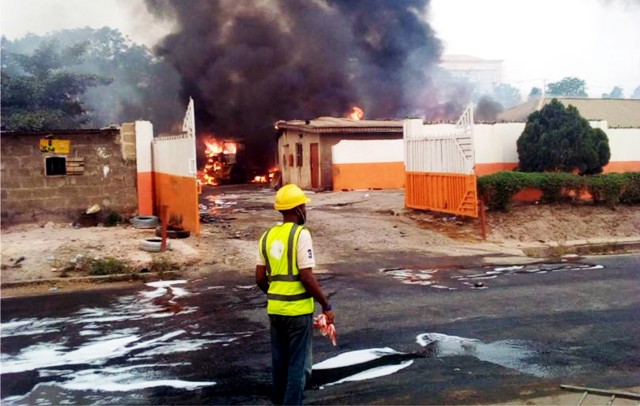
No fewer than 40 people sustained injuries, while one person was confirmed dead, in separate tanker-related explosions in Lagos and Cross River states.
In Lagos, the incident occurred in the early hours of Saturday along the Lekki–Epe Expressway, around Ologuro Bus Stop, opposite a filling station in the Sangotedo area.
According to the Lagos State Emergency Management Agency, a tipper truck rammed into a gas tanker from behind, sparking a massive fire outbreak.
The Permanent Secretary of LASEMA, Olufemi Oke-Osanyintolu, in a statement, said one person died in the incident, while two others sustained injuries.
“Upon arrival at the scene, it was discovered that a tipper truck rammed into a gas tanker, resulting in a fire outbreak. The driver of the tipper truck died as a result of the impact, while two adult females sustained minor injuries,” he said.
Oke-Osanyintolu attributed the crash to overspeeding and reckless driving, adding that the fire engulfed several roadside shops, causing extensive damage.
Tide source gathered that emergency responders, including the Lagos State Fire and Rescue Service and ambulance officials, were able to contain the fire and prevent it from spreading to nearby buildings.
Similarly, the Federal Road Safety Corps, in a statement by the Sector Public Education Officer, Elizabeth Jayeola, confirmed the incident, saying the crash involved a Sinotruck tipper and a Mack trailer.
“A total of four male adults were involved. One person died, one was injured, while two were unhurt. The crash was caused by speed violation, which led to loss of control and collision,” she said.
Jayeola added that the impact triggered a fire that left the tipper driver burnt beyond recognition, while his assistant sustained injuries.
According to her, three warehouses and about 10 roadside shops, including a gym and a generator house, were affected before firefighters brought the situation under control.
Several vehicles, including buses and cars parked within the affected area, were also damaged.
In a separate incident in Calabar, Cross River State, no fewer than 38 persons sustained varying degrees of burns following a gas explosion at a filling station.
The explosion reportedly occurred during the transfer of gas from a storage tank to a service tank when a hose detached, causing gas to leak into the surrounding area.
An eyewitness in a video, Ekanem Essien, described the moment as chaotic, likening the explosion to a bomb blast.
“The only thing we heard was a loud explosion. Everywhere was in confusion. I had to rush my baby out and grab my documents. We could not even reach the fire service in time,” he said.
The Police Public Relations Officer in the state, Sunday Eitokpah, in a statement, said the leakage quickly escalated into a fire, leaving residents with little time to escape.
“Several residents sustained injuries, primarily burns, and those with serious cases have been taken to the Teaching Hospital for treatment,” he said.
Despite the scale of destruction in Calabar, the PPRO confirmed that no death was recorded, while victims were receiving treatment at the University of Calabar Teaching Hospital.
Continue Reading

Environment

Why Buildings Keep Collapsing In Nigeria…. NIOB

Published

on

The Nigerian Institute of Building (NIOB) has attributed the recurring building collapse cases across the country to weak construction laws and failure to hold offenders accountable.
President of the institute, Daniel Kolade, made this known in Abuja at the 2026 Builders Day celebration, themed, “Advocacy and Policy Influence: Towards Sustainable Reforms for a Resilient Built Environment”
He expressed worry that, in spite of concerns over building safety, a key regulatory framework meant to strengthen enforcement within the built environment has remained pending before the National Assembly since 2006.
According to him, the delay has created a situation where those responsible for structural failures often escape punishment.
“Because the enforcement arm of the law is still lying with the National Assembly and has not been passed into law since 2006, the room remains for people to go scot-free when these incidents happen,” Kolade said.
According to Kolade, the lack of consequences encourages negligence on construction sites, as many operators believe little or nothing will happen, even if they violate building regulations.
Kolade cited previous building collapse incidents where, years after the tragedies, no individual had been prosecuted or sanctioned.
“As long as people continue to go free when these things happen, you should expect that it may not stop,” he said.
The NIOB president also said that the growing number of unqualified individuals working on construction sites worsened the problem.
He said it has become common for people without the required training or professional certification to assume technical roles in building projects.
“On most construction sites today, everybody claims to be an engineer, even labourers.
“Without the requisite knowledge and understanding, people just assume roles they are not qualified for,” he said.
Kolade noted that professional builders are regulated by the Council of Registered Builders of Nigeria (CORBON), which has the authority to register practitioners and discipline erring members.
He explained that builders found guilty of professional misconduct should face sanctions, including the withdrawal of their practicing licences.
However, he said the absence of a strong enforcement mechanism outside professional bodies makes it difficult to prosecute developers or project promoters who violate construction standards.
“In Nigeria, only one major case in Lagos saw the building promoter go down with the incident.
“In many other cases across the country, those responsible have walked free,” he said.
Kolade stressed that the built environment consists of several specialised professionals, each with defined responsibilities, including builders, architects and engineers.
He said the NIOB remained committed to promoting professionalism, ethical standards and quality assurance within the building industry.
March 13 is observed annually as Builders’ Day to create public awareness about the roles of professional builders and the importance of engaging qualified professionals in construction projects.
Continue Reading

Trending